With ¥200 million in paid-in capital and a full set of licenses, Pop Mart pushes designer toys toward art collecting and physical amusement parks, gambling on the IP life cycle and a valuation ebb.
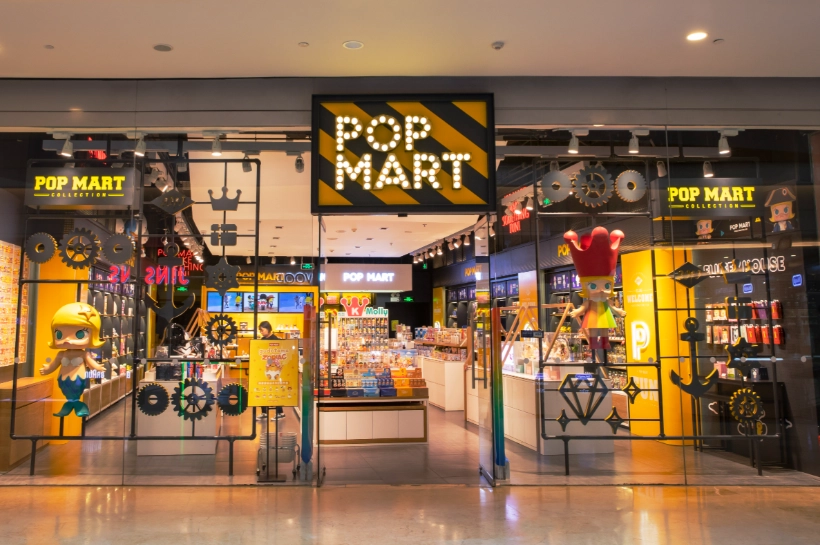
When examining the industrial and commercial foundation of Pop Mart's core domestic operating entity, Beijing Pop Mart Cultural Creativity Co., Ltd., the most striking contrast lies in the extreme mix of its business qualifications: for a trend toy leader that started with tens-of-yuan blind box plastic toys, its parent entity's business scope not only covers traditional toy sales and catering services, but also packages and lists amusement park services, publication retail, copyright agency, jewelry, and even the high-threshold auction business all together.
200 million yuan in registered capital has been fully paid in, 1,871 core employees have social insurance paid, and the enterprise type is firmly locked into a Taiwan, Hong Kong, and Macao legal person sole proprietorship structure. If this scene were merely regarded as the routine business expansion of a pan-entertainment enterprise, then Wang Ning's intensity of capital-level maneuvering would be completely underestimated — this is by no means a simple business assortment, but rather Pop Mart's institutional defense after the global surge of super hit products such as LABUBU, in the face of retreating secondary-market valuations and anxiety over single-product life cycles, as it attempts to forcibly elevate trend toys from fast-moving plastic figures into art assets with secondary-market circulation premiums, and to advance into Disney-like experience-heavy business formats.
The underlying weakness of the trend toy business has always been the fragile life cycle of IP assets. Unlike traditional cultural giants that possess century-old story texts, feature films, and worldview support, trend toy IPs that start from content-free images are highly dependent on consumers' immediate emotional resonance and social currency effects. Once the trend风向 changes, or the secondary-market scalping frenzy recedes, the blind box sales network piled up in the early stage is extremely prone to sudden stalling.
In the first half of 2026, although Pop Mart's domestic base still maintained volume growth, its core overseas markets have shown signs of cooling after experiencing high growth, and the capital market's judgment of its high valuation has become increasingly harsh.To completely escape the fast-moving consumer fate of plastic toys priced individually, the company must complete a jump at both ends of the industrial chain: upward, using art auctions and limited-edition copyrights to push dolls onto the altar of collectibles; downward, relying on physical amusement parks and jewelry accessories to solidify illusory IP emotions into high-stickiness immersive physical consumption.
Following the traces left in the industrial and commercial foundation to penetrate the governance base of this trend toy empire, its domestic asset foundation is clearly presented in Tianyancha records. Tianyancha industrial and commercial data shows that Beijing Pop Mart Cultural Creativity Co., Ltd. was established on October 20, 2010, with Wang Ning as the legal representative, registered capital of 200 million yuan, fully paid in, and registration status of surviving. In the enterprise type penetrated by Tianyancha, it is registered as a limited liability company (Taiwan, Hong Kong, and Macao legal person sole proprietorship), wholly owned by an offshore entity controlled by the Hong Kong-listed company POP MART.
The 1,871 insured employees under the 2025 annual report basis, together with the fully paid-in 200 million yuan of paid-in capital, constitute the most core parent entity through which Wang Ning dispatches hundreds of directly operated offline retail stores nationwide, thousands of robot stores, and the Beijing Chaoyang Park City Park (POP LAND).
Among the business scope disclosed by Tianyancha, the most intriguing hardcore lever is undoubtedly the rare co-occurrence of publication retail, amusement park services, and auction business.
The implantation of auction qualifications precisely hits the vital point of trend toy premiumization. For a long time, speculation in the private secondhand market on MEGA collectible series and artist collaboration one-off pieces, due to the lack of official compliant circulation channels, has not only easily bred counterfeit chaos, but also caused the brand side to白白 miss out on the astonishing resale premiums of the secondary market. Writing the auction business directly into the lawful business scope of the core domestic entity means that Pop Mart legally possesses the central function of building its own secondary-market art bidding, official collectible buybacks, and pricing of high-end art derivatives.
Through an officially controlled auction mechanism, the company can artificially create top-tier scarcity, not only continuously injecting the illusion of appreciation into the underlying blind boxes, but also directly benchmarking trend toys against contemporary art, building an extremely high value moat for core IPs.
The bundling of amusement park services with catering and publications points to its breakthrough experiment in asset-heavy physical entertainment.
Pop Mart City Park, located in Beijing Chaoyang Park, operates precisely on the qualification foundation of this domestic operating entity. In the trend toy industry, transforming 2D or 3D drawings into a physical-space real-scene park is a high-difficulty adventure with a very low success rate. Initial equipment investment running into tens of millions or even hundreds of millions of yuan, plus long-term property depreciation, requires extremely high-frequency customer repurchases and high-ticket derivative consumption to amortize.
The reason Pop Mart insists on embedding an amusement park license into its operating hub is essentially to emulate Disney's business flywheel: using offline castles, interactive games, and immersive NPC performances to inject personalized flesh and blood into IPs such as MOLLY, LABUBU, and DIMOO that have no story background, thereby extending the half-life of the IPs.
However, pulling back the glossy outer garment of this all-around license and full-industrial-chain extension, hidden asset-heavy backlash and business reality lie right before our eyes.
The first is the dilution of sales per square foot and gross margin from cross-border asset-heavy operations. Selling blind boxes is a light-asset, high-profit business with a gross margin close to 70%, but amusement parks, catering, and large offline experience spaces are all heavy-load business formats with heavy rent, heavy manpower, and heavy maintenance. As a trial work, Chaoyang Park Park, although providing fans with a check-in destination, still leaves a huge question mark as to whether, at a time when cultural tourism consumption across the industry is returning to rationality, check-in photos and light amusement facilities alone can support a long-term healthy independent return on investment.
Once the depreciation and operating expenses of the physical amusement park spiral out of control, this asset-heavy portion can easily erode the comprehensive profitability quality of the listed company in reverse.
A more severe challenge lies in the fragility of the auction and collectible narrative in the face of consumption cycles.
The underlying support for auctions and high-priced MEGA figures is the blind faith of high-net-worth young customer groups in the financial attributes of trend toys. However, as macroeconomic consumption sentiment turns pragmatic, cases of blind boxes and MEGA figures breaking issue price or trading below cost on secondhand trading platforms are commonplace.When the public is no longer willing to pay premiums, relying solely on an official auction license to support the floor can easily fall into the awkwardness of self-dealing or liquidity exhaustion.
If, outside the core circle, it cannot continuously break out of the circle and form a long-lasting spiritual totem, then the so-called art auction is nothing more than a dangerous game of passing the parcel within a small circle.
This 200 million yuan paid-in industrial and commercial review occurring in late autumn releases the most profound business dialectic to the entire Chinese new consumption and cultural going-global sector: selling blind boxes can make a fortune overnight by riding an emotional风口, but building an IP empire must lay the foundation brick by brick in heavy industrial entities.The domestic hub armed with a full set of licenses demonstrates Pop Mart's ambition to break out of the toy factory positioning and evolve into a full-industrial-chain cultural group.
However, when the风口 recedes and overseas expansion encounters setbacks, how to avoid the amusement park becoming a heavy fixed-asset burden, and how to maintain the long-term vitality of IPs without the hard flaw of film and literary heritage — these are the core issues that this trend toy giant must answer with a real business closed loop as it moves toward maturity.