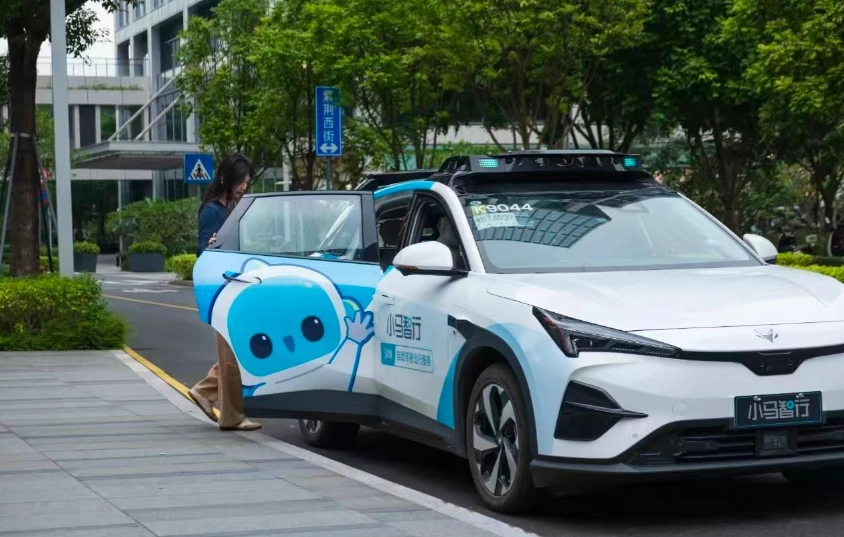
Pony.ai raises registered capital to 200 million yuan, shifting from asset-light algorithms to heavy-asset operations, building its own fleet to tackle commercialization challenges.
In early summer 2026, if anyone still believes that autonomous driving is a lightweight, clever business where geeks type at keyboards and train algorithms in the cloud to rake in easy money, they clearly haven't grasped the real struggle of this capital-devouring beast as it approaches the deep waters of commercialization.
The honeymoon of writing code is over. This is now a brutal, physical grind of steel, rubber, and heavy-asset depreciation.
Beijing Pony.ai Technology Co., Ltd. recently completed an extremely aggressive capital expansion. Just trace the company's change history through the underlying business registry grid on Tianyancha, and you'll see a steep funding pool expansion—the company's registered capital was forcibly increased by roughly 54 percent, jumping directly from 130 million yuan to 200 million yuan.
In a cycle where the primary market is fiercely tightening its purse strings around the autonomous driving sector, 70 million yuan of real, hard cash is not meant to hand out bonuses to programmers or lease two more floors of CBD office space. This is an "entry fee to the physical world," carried with intense urgency.
Many observers accustomed to AI narratives tend to interpret this capital increase as routine technical reserves for Pony.ai to push the next generation of autonomous driving large models. Such a take, lacking industry insight, completely sidesteps the most lethal commercial paradox facing Robotaxi players like Pony.ai right now: they originally wanted to be software suppliers providing souls to automakers, but have been forced into becoming asset-heavy taxi companies that must buy vehicles and build fleets with their own money.
Over the past few years, Pony.ai and its peers applied Silicon Valley algorithm logic, trying to package high-level intelligent driving systems for sale to automakers. But the harsh reality is that any automaker with a shred of ambition is fiercely defending its chassis data and the sovereign soul of autonomous driving, refusing to hand over core control to third parties. With no retreat available, Pony.ai had no choice but to go all in itself, deploying its own driverless taxi fleets across various regions to complete the business loop and data feedback.
But once this logic hits the ground, the internet company financial model shatters completely.
To build a Robotaxi fleet capable of truly running commercial toll collection on real streets in first-tier cities like Beijing, you need to procure large numbers of physical vehicles from upstream automakers, equip them with LiDAR systems and high-computing platforms that cost tens of thousands each, and establish vast vehicle dispatch, charging, and maintenance centers on the urban periphery. This legal shell, fully owned by Beijing Xiaoma Yixing Technology Co., Ltd., with its stated technical R&D and computer system services, now actually conceals massive fixed-asset procurement contracts and accounts payable underneath. The newly added 70 million yuan in registered capital is essentially meant to fill the financial black hole created by the high-frequency depreciation of these heavy physical assets in their early stages.
A deeper push comes from the ironclad red lines of compliance and risk.
When driverless vehicles truly remove the safety officer and begin charging ordinary citizens real fares by the kilometer, the accident liability determination, personal injury claims, and compliance scrutiny from local transportation authorities will amplify exponentially in complexity. A capital base of 130 million yuan looks far too thin when facing the long-tail litigation risks that could arise from large-scale driverless fleets operating simultaneously on public roads. Pushing the capital base directly up to 200 million is Pony.ai's way of showing local regulators and insurance giants that it has a sufficiently robust financial breakwater to hedge against low-probability but highly destructive physical collision liability.
The endgame of autonomous driving has never been poetry and distant horizons. When the pure algorithmic narrative is ruthlessly punctured by the anxiety of commercial monetization, Pony.ai's heavy investment in Beijing coldly and starkly reveals the survival truth of this track: in the second half, defined by real cash-generation efficiency and fleet asset scale, no one can stay suspended in the cloud forever. Either grit your teeth and become a mud-covered, asset-heavy operator, using capital to fill every physical-hole, or be completely liquidated by this heavy steel machinery before cash runs out.