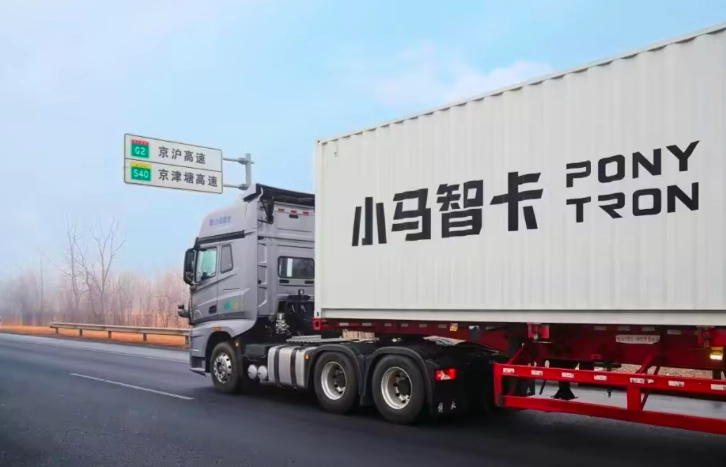
Pony.ai's Trucking Unit Gets $28.6M Capital Injection: L4 Focus Quietly Shifts from Passenger to Freight
Pony.ai's trucking unit raises registered capital to 200 million yuan, pivoting L4 autonomous driving from passenger services to long-haul freight, with a stronger emphasis on asset-heavy operations and regional expansion.
During the current commercial shakeout driven by the dual pressures of large models and autonomous driving, the narrative focus of L4 autonomous driving is undergoing an extremely subtle shift. As capital markets gradually lose patience with the prolonged profitability timeline of Robotaxi's C-end business, the long-haul logistics segment—a trucking track with greater certainty and stronger B-end willingness to pay—is becoming the real training ground for autonomous driving giants to generate revenue and sustain operations.
A recent capital restructuring by a key operating entity under Pony.ai reveals the deeper trajectory of this brutal battle in commercial vehicle intelligence.
The latest business registration changes from Tianyancha App show that the registered capital of Guangzhou Pony Truck Technology Co., Ltd. has surged from 160 million RMB to 200 million RMB, an increase of 25%. This core entity, wholly controlled by Beijing Pony Huixing Technology Co., Ltd., has a business scope covering hardcore sectors such as software outsourcing services, software development, and artificial intelligence hardware sales.
In the context of autonomous driving financing stories often involving billions of US dollars, a capital increase of 40 million RMB may seem like pocket change to industry giants. However, when placed within the deep-water zone of current long-haul logistics autonomous driving fulfillment, one can discern Pony.ai's genuine strategy of heavy-asset defense and operational centralization at the regional logistics hub of South China.
Autonomous heavy-duty trucks are by no means a simple port of algorithm software; they constitute a heavy business deeply tied to regional road rights, fleet management, specialized hardware integration, and freight fulfillment. In the closed loop of long-haul logistics, autonomous driving companies that merely provide technology solutions are highly susceptible to marginalization by upstream OEMs and downstream logistics giants. To truly break into the trillion-yuan high-speed freight market, autonomous driving companies must, as independent legal entities, personally participate in the compliant operation of fleet assets and the deployment of hardware.
Guangzhou, as the core freight distribution hub of the Guangdong-Hong Kong-Macao Greater Bay Area, possesses one of the most representative interprovincial long-haul logistics networks and road freight capacity pools in mainland China. Pony Truck's decision to inject capital into its Guangzhou entity at this time is, in essence, welding shut an external "regional operational fortress" equipped with independent freight carrier qualifications and hardware delivery capabilities. The capital increase trajectory shown in Tianyancha plainly reveals its determination to transition from pure technology R&D to a "technology plus compliant fleet asset operation" model.
Raising the registered capital to 200 million RMB reflects a deeper consideration: hedging against the high compliance and risk-control costs incurred during commercial deployment. In highway scenarios, the error tolerance for autonomous heavy-duty truck accidents is extremely low. As testing scales transition to commercial operation scales, local governments, enterprises, and logistics major clients have established extremely high rigid thresholds regarding asset scale, risk resistance, and fulfillment guarantees when selecting autonomous driving carriers. This capital injection is precisely aimed at forcibly raising the entry barrier for competitors in local freight capacity bidding and specialized qualification approvals.
The second half of the internal battle in heavy-duty truck autonomous driving has long moved past the romanticism of buying capital confidence through road-test mileage and demo presentations. With industry dividends fully exhausted, what tests whether an autonomous driving company can survive the commercial liquidation period is no longer the parameter scale of its algorithm models, but whether its core entity can, within the extremely muddy freight chain, use the lowest operating costs and the most robust balance sheet to firmly control real freight capacity flow.
The 200-million-RMB capital increase that Pony Truck has recorded on Tianyancha is a clear industry gear-shifting signal: In the hard-fought battle of long-haul logistics, whoever can first embed algorithms into the real wheel hubs of heavy-duty trucks and squeeze out profits from the extremely unforgiving per-ton-kilometer freight rates will be the one who truly stands firm in the coming major reshuffle.