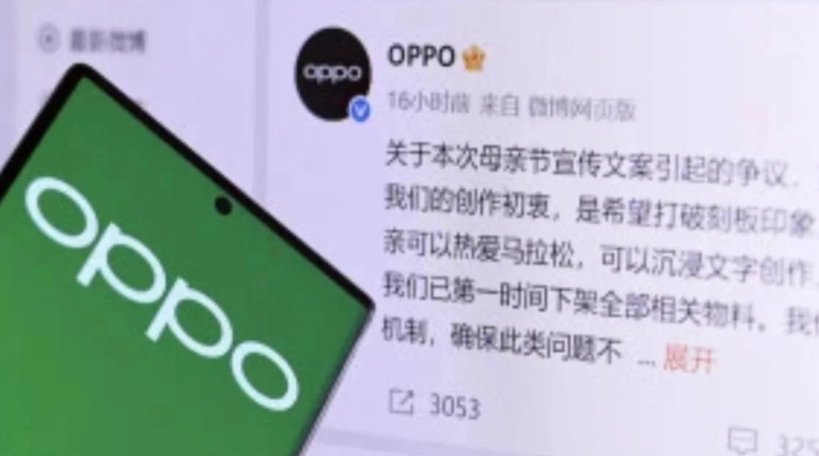
Mother's Day Marketing Blunder Exposes Deep Instability Within OPPO's Organizational Structure
OPPO's Mother's Day marketing failure exposes internal structural turbulence, with management reshuffles and growth anxiety leading to operational missteps, frequent legal disputes, and deep-seated transformation pains.
A public relations crisis sparked by a botched Mother's Day marketing campaign is merely a surface-level ulcer exposing the hidden pains within OPPO's vast corporate body. While the PR team hurried to quell public sentiment with a bland, unremarkable apology statement, a colder business undercurrent has long been churning inside this veteran device maker. What appears on the surface to be a copywriting mishap is, in reality, a deformation of actions squeezed by organizational restructuring and growth anxiety.
The executive change this past February is the key to understanding all this internal friction. Duan Yaohui stepped down, and Li Jie took over as legal representative and general manager. In 2026, when the smartphone market has long entered a zero-sum game, such a handover at the core management level is never a simple business card exchange, but a violent upheaval accompanied by a restructuring of vested interests. A change at the helm often means discarding established strategies and reshuffling resource allocations. What Li Jie inherited is an extremely brutal zero-sum landscape. To defend the home turf in a hyper-competitive domestic market or even break through in the high-end segment, the pressure from management's performance targets inevitably cascades down through the ranks. When this KPI anxiety spreads to the frontline execution level, it mutates into a pathological craving for traffic and eyeballs. The overstepping of the Mother's Day promotional material is the inevitable byproduct of coarser management granularity and failed review mechanisms under this pressure.
The misstep in marketing is only a superficial lapse; the more destructive reef lies hidden in the blood-and-flesh battles between legal affairs and channel strategy. A quick browse through the judicial analysis of OPPO Guangdong Mobile Communications Co., Ltd. on Tianyancha reveals a long list of litigation records involving tort liability disputes and unfair competition disputes. These cold case names completely tear apart the facade of harmony and mutual benefit in the smartphone industry.
When the supply chain for core components is highly transparent and disruptive technological inflection points have yet to arrive, piling up hardware specs has made it difficult for major players to create meaningful differences in user experience. As a result, the focus of competition has been forced to retreat from competing on product definition to erecting patent barriers and fighting for channel mindshare. OPPO's involvement in multiple infringement and unfair competition lawsuits reflects the aggressive defensive—or even offensive—measures it has had to take to sustain its massive offline channel profit system while fending off patent attacks from rivals. These lawsuits often are not simply about seeking compensation; they serve as commercial leverage to delay competitors' product launches and seize pricing power in regional markets.
Although Euro-Asia Holdings, as the wholly-owned majority shareholder, provides OPPO with a registered capital base of nearly 500 million yuan, that money cannot buy a sense of security to weather business cycles. Over the past decade, OPPO relied on powerful channel push and precise, saturation marketing to capitalize on the dividends of lower-tier markets and younger consumers. But now, the old traffic pools have been drained dry, and the high-end transformation faces an extremely steep brand perception barrier. The margin for error across the entire system is shrinking rapidly.
Facing relentless pressure from competitors in imaging, in-house chips, and ecosystem connectivity, OPPO is in an extremely sensitive pressure period. The management transition and frequent legal disputes together paint a picture of a giant in the deep waters of transformation experiencing systemic growing pains. For Li Jie, newly at the helm, pulling down a controversial poster to soothe public opinion is not difficult. The real test lies in how to untangle the internal discord bred by the interest realignment in this hostile, zero-sum market, and how to rediscover the composure needed to define hit products amid the quagmire of legal entanglements and marketing infighting. That is far crueler than writing a PR apology letter that leaves nothing to fault.