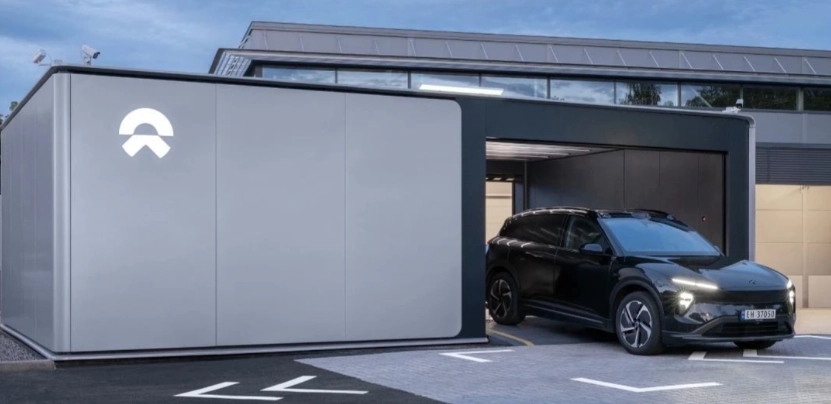
Behind the 5.7 Billion Capital Surge: NIO's Ambition to Spin Off Its Battery Swap Assets and Restructure Energy
NIO injected 5.7 billion yuan into Wuhan NIO Energy, raising its registered capital to 7.484 billion yuan, aiming to spin off the battery swap business into an independent energy infrastructure operator to address cross-brand alliances and grid peak-shaving demands.
When Wuhan NIO Energy increased its registered capital from less than 1.8 billion yuan to 7.484 billion yuan in one move — a staggering expansion of over 320% — outsiders who still view this as routine cash-burning by an EV startup in the quagmire of charging infrastructure investment have completely underestimated the strategic shift behind this capital maneuver. At a time when pure electric vehicles are mired in price wars and automaker profit margins are being squeezed to the extreme, injecting several billion yuan of real money into a regional energy entity in a single stroke is far from simply building a few more battery swap stations.
This is NIO's breakthrough battle to strip the battery swap business of its subordinate label tied to vehicle sales and completely restructure it into an independent, newly formed energy infrastructure operator with the capacity to handle heavy assets.
For a long time, the battery swap model has been criticized by the capital markets as a heavy-asset burden dragging down financial statements. But as new energy penetration rates cross the critical tipping point, with grid load pressure and charging efficiency bottlenecks erupting simultaneously, the center of gravity in industry competition is undergoing a fundamental shift. Battery swap stations are no longer just premium experience tools serving car owners; their commercial value as distributed energy storage units in grid peak shaving, off-peak electricity arbitrage, and virtual power plant operations is now coming into sharp focus.
To cross over from a car-making manufacturer into an energy player participating in national-level power dispatch, one must have an independent capital platform large enough to absorb extremely high leverage and project financing.
Tracing the Equity Structure: Full-Chain Centralization and Plans for Independent Spin-Off
Following the industrial and commercial change trail captured by Tianyancha to trace this core entity, the path of capital maneuvering is clearly visible. Wuhan NIO Energy is wholly owned by NIO Energy Investment (Hubei) Co., Ltd. According to information disclosed by Tianyancha, its business scope covers the full chain, from energy recovery system R&D and new energy vehicle battery swap facility sales to motor control systems. This approach of consolidating underlying equipment manufacturing, sales, and energy operations under a single entity exposes NIO's clear intent to solidify and enlarge its energy segment assets, paving the way for introducing strategic investment from local state capital and even an independent spin-off.
The Direct Driver Behind the Registered Capital Surge: Performance Requirements of the Cross-Brand Alliance
Padding the registered capital to such a substantial level has a more direct commercial driver: meeting the performance requirements for rolling out the cross-brand battery swap alliance.
As multiple mainstream automakers, including Changan, Geely, and GAC, have successively joined the battery swap ecosystem, the focus of interest-based negotiation among all parties has quickly shifted to standard setting, network co-construction, and asset allocation. An operating entity with a base of just over one billion yuan simply cannot establish commensurate credit guarantees or asset-level bargaining power when dealing with traditional automaker groups backed by massive state capital and the power grid system. By sharply increasing registered capital to the 7-billion-yuan level, Wuhan NIO Energy can not only significantly raise its ceiling for bank credit lines and green bond issuance, but also leverage a highly substantial corporate form to directly secure premium land quotas and electricity usage indicators from local governments, accelerating the dense rollout of the national battery swap network.
A Key Step in the Assetization of Battery Swapping
Competition among EV startups has moved beyond the early stage of simply competing on hardware sales volume. Converting heavy charging infrastructure into a large-scale asset package with independent profit-generating capacity and external financing appeal is the real trump card for surviving the brutal shakeout in the second half of the industry. The 5.7-billion-yuan surge in registered capital is a pivotal commitment card NIO has played on the road to assetizing its battery swap business.
In this deep-water zone of reshaping the charging landscape, whoever can solidify their service system into industry-standard energy infrastructure earliest will be the one to hold the most foundational pricing power in the next round of industrial restructuring.