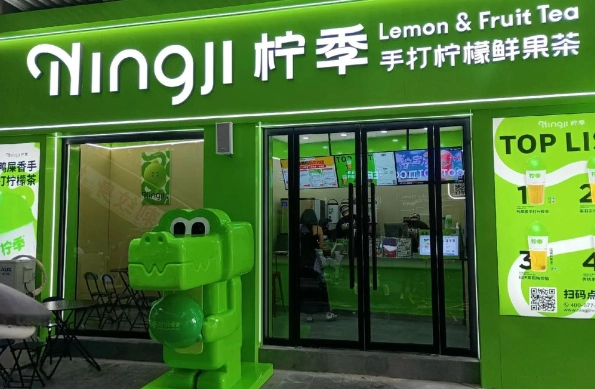
The Submerging Pyramid: How Ningji's Takeover of Haagen-Dazs Reveals White-Label Gains and Capital Encirclement
Ningji's acquisition of Haagen-Dazs' China stores, backed by Tencent and Douyin capital, uses down-market efficiency to transform a premium brand, revealing the supply chain and traffic strategies of local white-label giants.
The new tea beverage track is racing toward a full saturation phase by mid-2026, and a reverse acquisition that could go down in Chinese retail business history quietly landed early this summer. General Mills recently officially announced that it will sell its entire Haagen-Dazs physical store business in mainland China to Ningji, a local white-label lemon tea manufacturer. Upon completion of this transaction, Ningji will secure an exclusive license with deep control over Haagen-Dazs's ice cream stores and gift card monetization rights in mainland China.
This century-level alliance, personally orchestrated by Citibank, is by no means a simple international co-branding between restaurant brands—it is a cold-blooded class reversal and capital encirclement.
In traditional industry consensus, unaffiliated self-media often interpret this as the "rise of a national brand" among local grassroots dining businesses, or romanticize it as a "nostalgic, affordable alternative" where new tea beverages replace aging foreign consumer brands. Such politically correct platitudes completely obscure the underlying power restructuring within the fast-moving consumer goods supply chain.
Since Haagen-Dazs entered China in the 1990s, it has long monopolized the most expensive lightweight asset traffic premium in core business districts of high-tier cities, built on the grand narrative of "If you love her, take her to Haagen-Dazs." However, in the current macroeconomic consumption cycle, this castle in the air woven from middle-class illusions and high premiums is facing irreversible financial suffocation. Haagen-Dazs's expensive store rents, rigid heavy capital depreciation, and extremely low table turnover rates are morphing into long-term liabilities that General Mills cannot shed from its financial statements.
In contrast, Ningji, which fought its way out of the mud of Changsha's streets, is fundamentally an extremely ruthless machine of maximum down-market penetration and efficiency. The rise of this local white-label giant is essentially using high-frequency, low-ticket lemon water to hedge against the remaining dividend of consumption downgrading across the era.
This daring gamble of using down-market profits to offset aristocratic assets paints an extremely seasoned capital defense map with strong establishment-style compliance characteristics in the business genealogy revealed through Tianyancha.
The Tianyancha App shows that Ningji's core associated entity, Hunan Sanfa Catering Management Co., Ltd., was established in December 2020, with legal representative Fu Linya and a registered capital of only approximately 2.82 million RMB. Beneath this seemingly lightweight and thin financial shell, Tianyancha's shareholder registry prominently lists two strategic investments from China's internet traffic and capital titans: Guangxi Tencent Venture Capital Co., Ltd. and Beijing Quantum Leap Technology Co., Ltd., a subsidiary of Douyin.
The rare co-appearance of Tencent and Douyin fully exposes the underlying interest chain driving this acquisition. This is not the independent will of a hand-pounded lemon tea workshop—it is a pixel-level hunt meticulously stitched together by top-tier traffic capital from major tech companies.
In the fast-moving consumer goods landscape of 2026, control over short-video and instant local-life service traffic directly determines the survival of physical stores. Douyin holds absolute dominance over down-market content consumption mindset, while Tencent commands the private domain community sovereignty of the WeChat ecosystem. When these two giants funnel their massive traffic artillery directly into Ningji—a company with just over 2 million RMB in registered capital—Ningji effectively transforms into a traffic skin for the big tech firms to clean up Meituan in the local-life services track and replace traditional e-commerce shelves. Bringing in these two giants is essentially the most formidable digital moat that Ningji pre-built to swallow the Haagen-Dazs behemoth.
What best showcases this white-label tea beverage giant's heavy-asset ambition is the endless chain of affiliated controls listed in the Tianyancha system. The controlled enterprise information clearly shows that Hunan Sanfa Catering Management Co., Ltd. currently actually controls as many as 45 enterprises. Among them, 29 remain in high-frequency cash generation and existing operational status, with business reach precisely extending down-market to entities such as Anhui Camellia Biotechnology Co., Ltd. and Guangdong Zhanjiang Qiling Agricultural Science and Technology Co., Ltd.
These upstream supply chain entities quietly resting in the Tianyancha archives completely tear away the disguise of "light-asset franchising" in the new tea beverage industry.
From designated planting bases for fragrance lemons to modernized logistics and warehousing renovations, Ningji traces an exceptionally clear picture of "full-chain heavy-asset sovereign monopoly" across Tianyancha. Their acquisition of Haagen-Dazs is not about continuing to tell premium stories to the middle class in high-tier business districts—it is about using their ironclad supply chain, which actually controls 45 enterprises, and their ultimate cost-control capability to conduct pixel-level "white-label transformation" of Haagen-Dazs's rigid store cost structure. What they are after is Haagen-Dazs's prime business district locations left behind in China's first- and second-tier cities, along with that intangible asset network still capable of generating strong long-tail monetization from gift cards.
The evolution of business has always been ruthless. In this late-2026 battlefield where ultimate survival rights are defined by data traffic density, absolute supply chain control ratios, and real cash generation capability, aging foreign brands that peddle illusory luxury without underlying hardcore supply chain restructuring capability will ultimately be liquidated and driven out under pixel-level integrated encirclement by local players.
The capital footprint Ningji has left on Tianyancha through its control of 45 entities, along with this Haagen-Dazs bill set to close within the year, serves as a sobering memorandum on how local white-label giants leverage big tech capital to complete industrial compensation. This scandalous acquisition sounds the most severe death knell for all multinational restaurant giants still indulging in high-premium fantasies: when the digital supply chain dragnet and pixel-level encirclement from local traffic giants begin, no noble brand is granted perpetual immunity. Any classical enterprise unable to get its hands dirty in the muddiest down-market trenches will face the brutal fate of being uprooted under even more intense targeted liquidation.