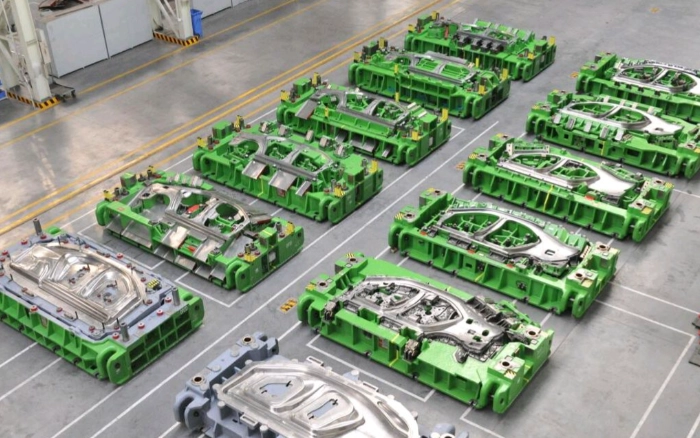
Ningbo Fangzheng's RMB 10 Million Shenzhen Move: A Software-Led Breakout Bid by a Traditional Mold Maker
Ningbo Fangzheng sets up a subsidiary in Shenzhen, crossing into software and big data, binding technical talent with equity, and seeking a digital transformation breakthrough.
When a listed traditional automotive mold manufacturer with deep expertise in steel casting and machining stretches its reach into the heart of the Pearl River Delta to register a smart technology entity focused on software and big data, this multi-million-yuan investment is far from a blind business expansion. Ningbo Fangzheng's cross-sector move to establish Shenzhen Saiweisi Intelligent Technology Co., Ltd. lays bare a pressing predicament: traditional auto parts suppliers, squeezed as price wars across the entire vehicle market cascade down the supply chain, are fighting to carve a path toward higher-value segments through digital and intelligent tools.
In the industrial chain of automobile manufacturing, molds have long been hailed as the mother of industry. Yet today, as the iteration cycle for new energy vehicles has been compressed from several years to just over a dozen months, traditional mold manufacturing is trapped in an unforgiving squeeze. Automakers' exacting demands on development timelines and procurement costs keep dragging down the gross margins of heavy-asset, long-cycle pure hardware mold processing. Any misstep can reduce a company to a mere subcontractor competing on low bids.
Turning the stamping expertise and process data accumulated in veteran engineers' minds over decades into reusable, deliverable industrial software and intelligent algorithms has become the core pursuit of established manufacturing players seeking a valuation reset and cost efficiency.
Peering through the equity structure of this new entity, the assembly of traditional industry and tech capital is laid out with remarkable precision in the underlying business registration records. According to Tianyancha business data, Shenzhen Saiweisi Intelligent Technology Co., Ltd. has a registered capital of 10 million RMB, with Fang Yongjie as its legal representative. Its business scope covers technical services, software development, big data services, and technical services for cloud-computing equipment.
In the shareholding map disclosed by Tianyancha, Ningbo Fangzheng Automobile Mold Co., Ltd. holds 51% of the shares, firmly securing absolute control, while Shenzhen Pingshiji Investment and Shenzhen Huxin Investment, both partnership enterprises, hold 29% and 20% of the equity, respectively.
A 51/49 Ownership Structure
This 51/49 equity split reflects a pragmatic approach to aligning interests.
Ningbo Fangzheng uses its just-over-half stake to achieve financial consolidation and strategic control, supplying the new company with resources that are particularly scarce: real-world automotive manufacturing scenarios and production-line validation environments. Meanwhile, channeling nearly half the equity to two Shenzhen-based partnership firms could provide room for equity incentives through limited partnership platforms for the external technical team, algorithm engineers, and local operations management.
Choosing Shenzhen as the base is also a strategic use of complementary regional strengths: Ningbo's home turf boasts a robust auto parts industrial foundation yet has limited access to top-tier industrial software and big data algorithm talent. By heading south to establish the entity in Shenzhen, the company can absorb the Pearl River Delta's software R&D strength at minimal friction cost, using lightweight digital technology to feed the heavy machinery production lines back north.
The Challenge of Crossing the Gap
However, bridging the divide from heavy-duty metal-stamping mold processing to the soft realm of virtual code and cloud-based algorithms has never been an easy gap to close. A registered capital of 10 million RMB, set against industrial software development projects that routinely demand hundreds of millions, remains a relatively lightweight trial fund. If, in actual operations, Saiweisi Intelligent Technology fails to truly tap into the previously inaccessible process data on automotive production lines—turning its intelligent technology into practical tools that directly improve mold yield rates and shorten calibration cycles—then this new company, bathed in the glow of big data, could easily devolve into nothing more than an internal service department for promoting marketable concepts or executing simple IT integration on behalf of its parent firm.
This multimillion-yuan move in Shenzhen signals to the entire industry the resolve of traditional manufacturers to self-rescue in the face of cyclical headwinds. With profit margins in pure hardware manufacturing squeezed to the limit, only those bold enough to seek incremental gains in software and data will be able to preserve their pricing power in the intense competition of the automotive supply chain.