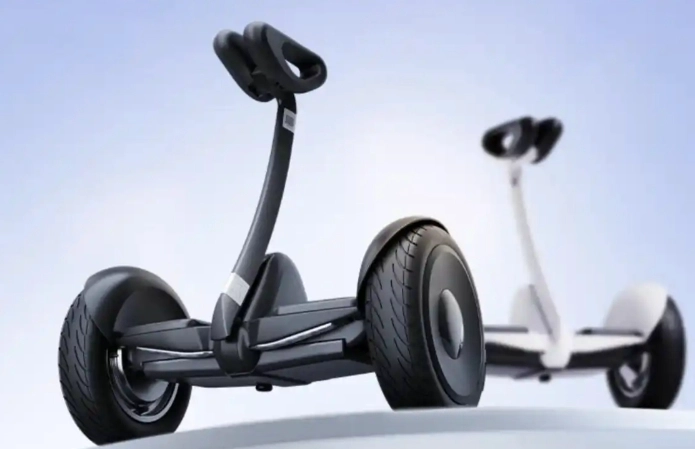
Ninebot's 'Hengqin Springboard': A Global Breakout Under Supply Chain Sovereignty
Ninebot establishes a supply chain company in Hengqin, leveraging policy dividends to integrate global resources and accelerate high-end electric motorcycle exports, building supply chain sovereignty.
While the public is still debating the low-end price war in the two-wheeled electric vehicle sector, Ninebot has quietly placed a key strategic piece in Hengqin, Zhuhai. Recently, Zhuhai Hengqin Ninebot Supply Chain Management Co., Ltd. was established with a registered capital of five million RMB. According to business registration information disclosed by Tianyancha, this new company, wholly owned by Ninebot (Beijing) Technology Co., Ltd., not only covers supply chain management in its business scope, but also prominently includes core operations such as motorcycle and spare parts retail. This is far from a routine regional expansion. It represents a precise strategic move by the short-distance mobility giant, which bills itself as a robotics company, in its bid to reclaim control over its global supply chain.
The choice of Hengqin itself is loaded with commercial subtext. As a key window for deep integration with Macau and outreach to Portuguese-speaking countries, Hengqin enjoys exceptionally favorable fiscal and tax policies, as well as inherent advantages in cross-border finance and trade facilitation. Ninebot's decision to establish a presence in Hengqin at this time is fundamentally driven by the fact that its overseas business has entered the "deep end." When a company consistently generates more than half of its revenue overseas, the challenge is no longer simple capacity expansion, but rather how to achieve greater cost efficiency and operational effectiveness by optimizing capital routes and logistics nodes in early 2026, amid increasingly entrenched global trade barriers.
The driving force behind this interest chain often lies in the fine print of the business scope. The inclusion of motorcycle and spare parts retail reveals Ninebot's attempt to execute a bold upward leap in its product lineup. For a long time, scooters have been its signature product, but their profit margins have remained constrained by the saturation of shared mobility services and the diminishing returns of low-tech entry barriers. In contrast, the premium electric motorcycle segment offers far greater pricing power and brand moats compared to scooters. The establishment of a dedicated supply chain management company in Hengqin is, in essence, Ninebot stocking up ammunition for a large-scale push into the global high-displacement electric motorcycle market. Using Hengqin as a springboard, Ninebot can more flexibly coordinate global component resources, avoid unnecessary tariff friction, and thereby establish a crushing cost advantage over local European and American brands.
Judging from the equity structure disclosed by Tianyancha, the parent company Ninebot (Beijing) injecting assets at this particular moment reflects its management's intense drive for "vertical supply chain integration." In the hardware competition landscape of 2026, the pure asset-light assembly model has lost its appeal as a growth story. What Ninebot needs now is a heavyweight capability that allows real-time control over everything, from chip selection and development of the three-electric system (battery, motor, and electronic control) to global reverse logistics. The team led by legal representative He Feilong carries on its shoulders not just the five million RMB in registered capital, but also Ninebot's ambition to build an independent, resilient global supply chain system after shedding its "Xiaomi ecosystem" label.
The contrast in this strategic layout is that although Ninebot has consistently emphasized its robotics DNA, its commercial harvest ultimately remains anchored in the granularity of "hardcore manufacturing." The establishment of the Hengqin company signals that Ninebot is accelerating the consolidation of its previously scattered procurement and logistics decision-making authority. In an era defined by algorithm-driven efficiency, whoever commands a shorter supply chain response time will hold the pricing power in a rapidly shifting market.
The ripple effects of this five million RMB investment will ultimately show up on Ninebot's increasingly rigorous global balance sheet. When a platform gains the ability to directly settle and manage its supply chain within a free trade zone, its bargaining power in the face of international logistics disruptions and currency fluctuations will undergo a qualitative shift. Any player trying to compete in this arena through traditional trade routes will feel a physical sense of efficiency being crushed when facing rivals armed with both policy dividends and technological sovereignty.
The ultimate goal of business is the efficient fusion of technological sovereignty and capital efficiency. Ninebot's move in Hengqin is a key signal of its transformation from a high-growth technology company into an industrial giant with global supply chain governance capability. In an era where embodied intelligence and short-distance mobility are redefining the truth, this seemingly modest business registration change is, in fact, a heavy anchor of certainty being driven into Ninebot's globalization journey. Having chosen to keep doubling down on the long race of hardcore manufacturing, Hengqin may well be the launchpad that allows Ninebot to leap over trade barriers and complete its final harvest in broader waters.