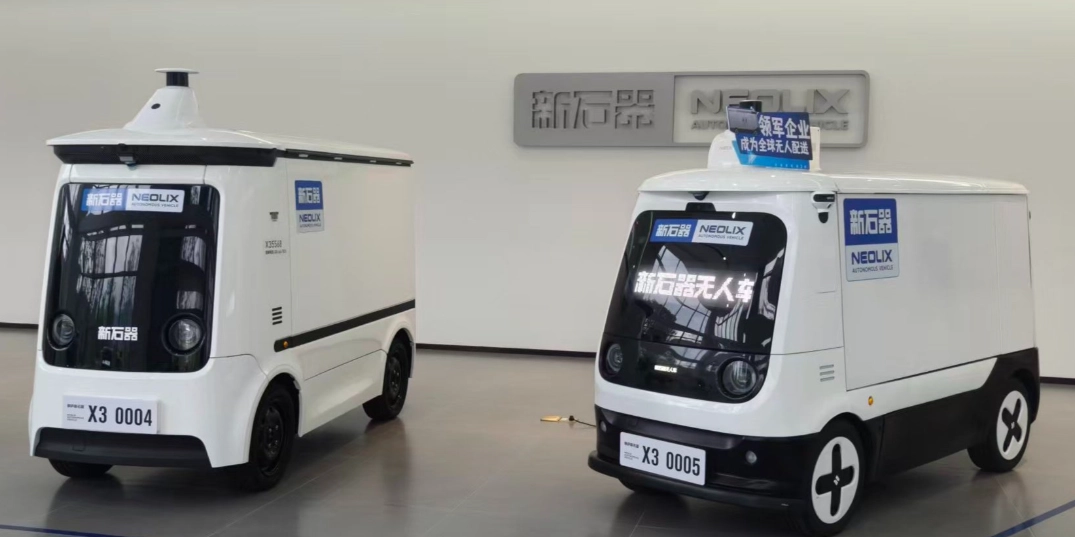
Neolithic Self-Driving Vehicles Plants $5M in Tianjin to Crack the Delivery Capacity Conundrum
Neolithic Self-Driving Vehicles has established a subsidiary in Tianjin with $5 million in registered capital, shifting its focus to becoming a delivery capacity operator that monetizes through device leasing and delivery services, exploring a new commercialization model for autonomous driving.
While various autonomous driving startups are still bragging about their billion-yuan financing rounds on the capital markets, Neolix's quietly placed subsidiary in Tianjin—with a registered capital of just 5 million yuan—looks almost shabby, even jarring. In a track where burning cash is treated as the core competitive moat, a leading company setting up a wholly-owned subsidiary in another city with a mere 5 million yuan is hardly about grand cutting-edge R&D.
This paltry seed funding directly exposes the most real survival reality of L4 autonomous driving in the deep end of commercialization: dropping the lofty tech facade and getting hands dirty earning hard money from food delivery and transportation capacity leasing.
Over the past few years, the investment logic in the autonomous driving industry has been built on the grand vision of replacing human drivers. However, with slow regulatory progress and the extreme difficulty of tackling long-tail scenarios, the commercial closed loop for passenger-vehicle autonomous driving remains distant. In contrast, low-speed autonomous delivery vehicles operating in closed campuses and specific public roads have become the only safe harbor capable of generating positive cash flow.
Neolix's move into Tianjin at this moment is essentially a precise strike on local road-rights dividends and real logistics scenarios.
Business Scope Reveals Transformation Ambitions
Following the underlying business registration information disclosed by Qichacha to dissect the new entity's business scope, its ambition to cover the entire industry chain is laid bare. In this long list of business items, beyond the conventional AI software development, the core profit anchor is firmly pinned on computer and communication equipment leasing, domestic freight forwarding services, and food delivery services. This extremely down-to-earth combination of businesses fully exposes Neolix's urgent shift from a pure hardware manufacturer to a transportation capacity operator.
Leasing Model Solves the Heavy-Asset Problem
Selling autonomous vehicles directly to courier depots or food delivery platforms is an extremely tough business. With per-vehicle costs often exceeding 100,000 yuan or more, such heavy capital expenditure is simply unbearable for last-mile logistics hubs whose margins are already squeezed to the bone. Since they can't afford to buy, switch to charging rent instead.
By establishing an entity with leasing qualifications and freight forwarding status, Neolix can legitimately deploy its fleet of autonomous vehicles to local hubs on daily or monthly leases, or even bypass middlemen entirely and build its own autonomous delivery network to take on same-city delivery orders from supermarkets and food delivery platforms.
The Ruthless Calculation Behind the Tianjin Test Bed
Choosing Tianjin as the test bed for this new business model involves extremely ruthless geographical and industrial calculus. Tianjin is not only a key modern logistics hub in northern China, but also boasts a large number of mature industrial parks and port hinterlands, providing ample real-world road testing and commercial fulfillment scenarios for low-speed autonomous vehicles. The 5 million yuan registered capital base is just enough to penetrate the local market with an ultra-light asset footprint.
Once this financial model based on equipment leasing and direct delivery fee collection proves viable in Tianjin, it can quickly shed the high-cost hardware manufacturing label and replicate a weather-proof service loop across other new first-tier cities nationwide.
This micro-scale layout on the banks of the Hai River is a cold correction to the profitability logic of the entire autonomous driving industry. The frenzy of capital always has its limits. When investors stop paying for illusory code, what determines whether an autonomous vehicle company survives is no longer the dazzling specs of stacked LiDAR sensors, but whether it can shave a few cents of profit margin off the per-delivery cost of every meal and package, in scorching heat and pouring rain alike.
With this 5 million yuan stake, Neolix silently declares that the second half of intelligent driving is not some sci-fi future of mobility, but a gritty ground war with traditional logistics over last-mile delivery fees.