The $47 Attention Lottery: Musk Toddler's Tiger Hat and the Pain of Long-Tail Cultural Products
A tiger hat worn by Elon Musk's toddler has brought sudden fame to a Guilin cultural-products company, exposing the fragility and supply-chain strains of small-batch creative firms in the attention economy.
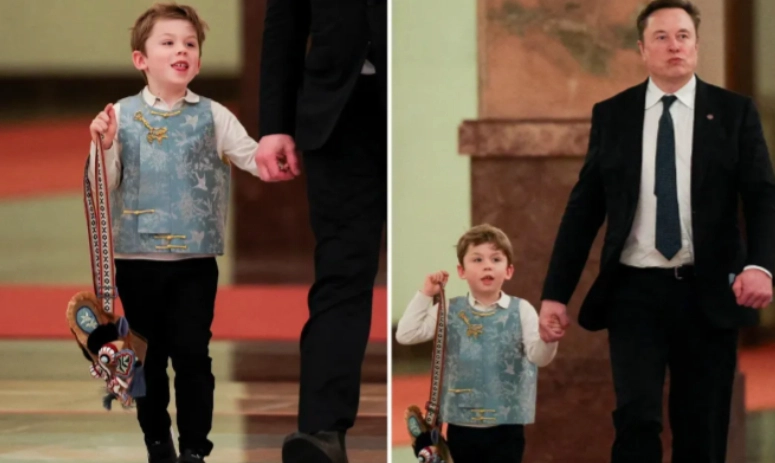
The tiger-head bag on Musk's youngest son's chest, priced at 338 yuan, overnight became the most absurd yet tender footnote where top-tier traffic from Chinese and American politics and business converges. Appearing alongside his father in the grand narrative of the 2026 high-level China-U.S. summit, this two-year-old's outfit inadvertently completed a cultural soft landing worth its weight in gold. And as the spotlight traced back along that thin strap, eventually coming to rest on a little-known small enterprise in Guangxi, this windfall of viral fortune mercilessly laid bare the coldest operational logic of the global attention economy.
According to data shown by Tianyancha App, Guilin Weiran Culture and Creative Co., Ltd., the company behind this hot product, has been quietly operating for eight years. With a registered capital of just 1 million yuan and a business scope sprawling enough to cover jewelry retail and cultural and artistic exchange, this small-scale conglomerate has, over the past nearly 3,000 days, been nothing more than a grain of sand in the vast red ocean of China's intangible cultural heritage and neo-Chinese creative products. The names of the three shareholders—Liu Siwei, He Jiliang, and Lou Huameng—were, until today, just those of countless creative founders struggling to stay afloat.
The deeper cause here is by no means the marketing miracle that outsiders are shouting about. A company based in Guilin with such restrained capital simply does not have the budget or the channels to leverage Musk family business connections. The real driving force behind this is China's highly mature, decentralized cross-border e-commerce capillaries, along with the discreet class penetration of neo-Chinese aesthetics among elite overseas circles. The consumption of Eastern symbols by the world's wealthiest is moving away from the past's custom Suzhou embroidery costing millions, toward everyday objects imbued with street-level vitality and exceptional value for money. For Musk, the 338 yuan price tag was an exotic emotional purchase; but for China's creative industry, it was a supply-chain spillover eight years in the making.
The industry broadly sees this as a revival of traditional craftsmanship or a victory for local creative products going global, but this is clearly a warm-hearted misreading. If we maintain the rigor and coldness of business journalism, we find that behind this flash-in-the-pan fame lies the extremely fragile life cycle of China's micro and small creative enterprises.
The pain point of the creative industry is that traffic is a mystical force, while supply chains are heavy industry. A company with only one million in registered capital lacks the foundation to support a sudden flood of orders. Once the "same as Musk" label is attached, what follows is often not industrial upgrading, but pixel-level copying by unbranded workshops across the internet and vicious price wars. The clear records of business changes and equity paths on Tianyancha prove that such companies have survived on flexible, non-standard product manufacturing. Once dragged into the grinder of mass industrial production, the most brutal zero-sum game becomes how to control costs and fend off counterfeits while preserving the essence of intangible cultural heritage.
This tiger-head bag completed a stunning cross-industry catwalk moment in early summer 2026, but that does not mean China's intangible cultural heritage has seized pricing sovereignty over global fashion. It is more like a weathervane, signaling to long-tail sellers深耕垂直领域 that in an era of global aesthetic fatigue, the more local and concrete a cultural carrier, the more likely it is to collide with a windfall at some unexpected technological or trade inflection point.
Musk brought a bag into the spotlight, but reviving an entire category of enterprises requires not just a single runway moment, but rather converting this kind of incidental attention dividend into a commercial sovereignty that can be standardized and delivered. This sudden fame will eventually cool down from the trending list, and for this Guilin company now etched into the Tianyancha archives, the real long haul is just beginning.