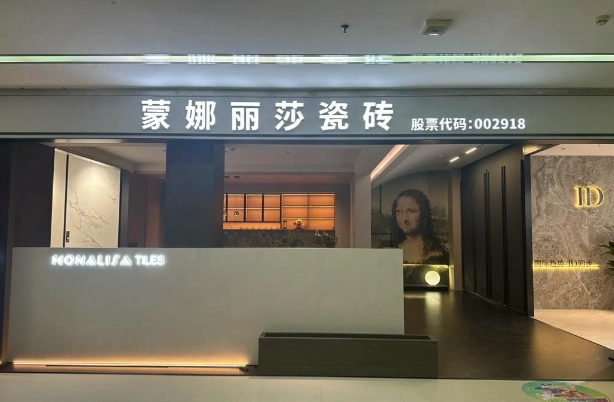
A Misidentified "Smile": Mona Lisa's Five Consecutive Limit-Ups Reflect Manufacturing Anxiety and AI Hype
Mona Lisa shares surged for five consecutive sessions after a stake was mistakenly linked to Nvidia supply; the company clarified there is no substantive connection, revealing the transformation anxiety and bubble risk behind AI concept speculation.
In the magical realist narrative of the A-share market, you never know who will be the next one draped in the AI cloak. Recently, Mona Lisa, the building ceramics giant crowned as the "King of Tiles," staged a five-consecutive-limit-up carnival in the capital market. However, amid all the clamor, the company's clarification announcement came like a bucket of ice water: its investee company, Zhuhai Jingci, is not an NVIDIA supplier, and the semiconductor materials business has not contributed any revenue or profit to the company.
This magical crossover from clay to chips has ripped open the coldest profit chain in the current capital market. A traditional building materials company, deeply dragged down by the real estate downturn cycle, was actually conspired by market rumors and packaged as a secret ally of the global AI computing power hegemon due to a low-key, marginal investment.
The Deep Root of Transformation Anxiety: The Food-and-Shelter Crisis in Traditional Building Materials
To see this storm clearly, one must confront the brutal shakeout that China's architectural ceramics industry is undergoing. With the collapse of the real estate high-turnover model in recent years, building materials giants that relied on the fine-decoration and whole-home-decoration channels of major developers have long been living on razor-thin margins. Flipping through Mona Lisa's latest financial snapshot, the first-quarter revenue decline and a single-quarter net loss of nearly 20 million yuan prove that the traditional building materials market has hit an unforgiving industry ceiling. This survival anxiety stemming from a pressured core business and a lack of new growth points is the strongest undercurrent driving this established giant to seek a second growth curve.
And the market's greed happened to find a gap at the technological inflection point of ceramic substrates. Recently, ceramic substrates, as a core material for advanced semiconductor packaging, have been hyped into a golden track amid the surge in AI computing power. When traditional architectural ceramics meets high-end electronic ceramics, a deceptive imagination of technology transfer ran wildly out of control with hot money fueling the flames.
The True Picture Under the Tianyancha Map: 50 Million Yuan Can't Buy an NVIDIA Ticket
Through the business map displayed by Tianyancha, we can precisely reconstruct the illusory nature of this capital frenzy. The source of this tsunami is Zhuhai Jingci Electronic Technology Co., Ltd., in which Mona Lisa holds a stake. According to Tianyancha change records, the registered capital of this company was recently increased from 20 million yuan to approximately 33.33 million yuan, a significant increase.
The capital increase shows that Zhuhai Jingci is indeed trying to maintain its R&D or production line setup for semiconductor discrete device materials by bringing in new funds. But if one takes this to mean it has secured a ticket to the top-tier computing power club, that is ignorance of the hard-core chip supply chain. Mona Lisa's total investment in this company is only 50 million yuan, and it has not been consolidated into its financial statements. Even colder data: Zhuhai Jingci's revenue last year was just over 5.9 million yuan, and its net profit was still in the red. A startup whose products are still in the R&D and sampling stage, with no batch orders at all, has been transformed by speculative funds into a key player capable of throttling NVIDIA.
This huge gap between narrative and reality reveals a pathological consensus in current A-share speculation: as long as something is tied to AI, scale can be ignored, and basic business common sense can be trampled underfoot.
Rejecting the Bubble Consensus: Don't Let Speculation Hijack the Real Economy's Self-Rescue
Business evolution has never had a lucky shortcut. From firing architectural tiles that cost a few yuan per square meter to manufacturing micron-level, high-performance semiconductor specialty equipment and materials, the technological gap, process barriers, and customer verification cycles cannot be easily bridged by a trial investment of tens of millions of yuan. Advanced electronic ceramics require extreme material purity control and stringent sintering environments, which are completely different industrial logics from the fast-and-loose approach of traditional building materials manufacturing.
Mona Lisa's overnight clarification is an extremely wise act of self-protection. In mid-2026, where data defines truth, any effort to mask the pain of the traditional core business through concept packaging will ultimately be exposed by cold, hard financial reports. The cross-industry self-rescue of traditional enterprises is certainly worthy of respect, but magnifying this trial run into a computing power myth is merely another precise harvest by bloodthirsty speculative capital amid the transformation panic of the real economy. When the tide recedes, the capital increase record left in the Tianyancha files remains just the starting point of a long R&D road, while those blindly following funds will be left alone in the ruins of a shattered myth to swallow the most expensive bill.