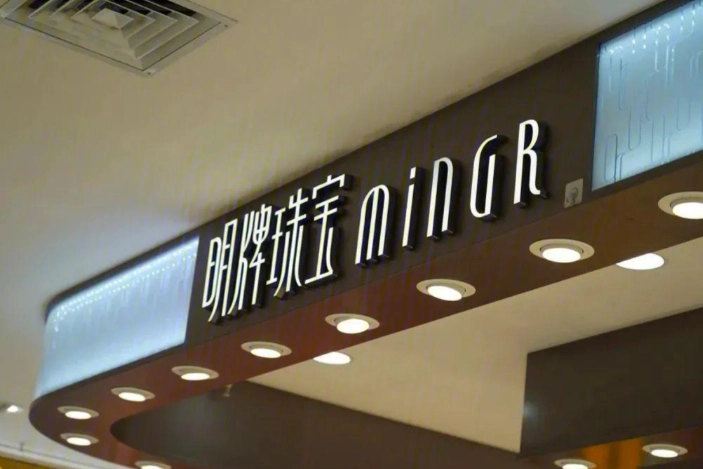
Mingpai Jewelry boosts its solar subsidiary's capital to 1 billion yuan, a cross-sector bet on battery manufacturing, leveraging capital strength to hedge main business risks and dive into green energy's deep end.
After years of fierce competition in the gold and jewelry red ocean, traditional jewelry giants are now channeling their on-book cash into cross-industry capital hunting grounds with unprecedented aggression.
Recently, a business registration change revealed by Tianyancha App has fully exposed Mingpai Jewelry's massive long-term strategy in the new energy sector: its core photovoltaic technology subsidiary, Zhejiang Riyue Guangneng Technology Co., Ltd., has undergone a capital adjustment, with registered capital leaping from RMB 800 million to RMB 1 billion. This 25% capital increase stands in stark contrast to its gold industry peers, who remain entrenched in traditional retail and are grappling with sluggish consumption, making the move appear both striking and strategically aggressive.
Most industry observers, accustomed to evaluating this Zhejiang-based jewelry giant through the lens of international gold price fluctuations, per-gram gold margins, and offline franchise store opening rates, tend to view this substantial capital injection as a routine regional book-balancing exercise or a tentative foray into new energy by a traditional manufacturer. Such a superficial interpretation completely misreads the systemic transformation anxiety facing Gao Xiaoliang and Mingpai's management as the marginal returns of the core gold business diminish and domestic photovoltaic cell technology reaches an inflection point for iteration, as well as their calculated move to forcibly buy future green energy output with heavy capital.
The real profit chain behind this jewelry giant's cross-sector pursuit of solar energy lies buried in cold corporate registration data. Tracing down the equity chain through the Tianyancha system, this Riyue Guangneng, established in March 2023, is jointly controlled by Mingpai Jewelry Co., Ltd. and Shaoxing Mingpai Jewelry Sales Co., Ltd. Its clearly registered business scope covers solar power generation technology services, photovoltaic equipment and component manufacturing, photovoltaic equipment and component sales, and battery manufacturing and sales—interlocking to precisely form a typical asset-heavy, high-tech manufacturing entity.
Why would a traditional retail giant that has long earned processing premiums selling gold bars and diamond rings now aggressively pour core assets into a cross-sector vehicle, and pin its operational granularity precisely on "battery manufacturing," a notorious money-burning black hole?
The core profit driver lies in the life-or-death logic of transitioning from "reaping dividends" to "buying out long-term hardcore tech assets" in traditional consumer retail.
Traditional gold and jewelry retail, despite its glamorous appearance, is essentially a slow-moving business heavily dependent on store expansion and highly vulnerable to upstream raw material price fluctuations. With franchise channels reaching saturation and younger consumers' spending habits undergoing dramatic shifts, the jewelry story alone is increasingly struggling to command higher valuation premiums in the capital markets. Mingpai's cross-sector decision in the past two years was precisely the ambitious "photovoltaic cell" play—directly building factories and committing to the most core and technically demanding segment of the PV supply chain: cell manufacturing.
By forcibly raising registered capital to the RMB 1 billion level at this juncture, Riyue Guangneng has bluntly revealed Mingpai Jewelry's ultimate defensive posture for the second half of this new energy battle: "hold the line, never retreat."
PV cells are currently in the deep-water zone of transitioning from PERC to next-generation technologies like TOPCon, where equipment depreciation is extremely rapid and upfront capital requirements for production lines are nearly unforgiving. This additional RMB 200 million in cash flow will be pragmatically deployed across two covert battlegrounds: first, in the brutally competitive cell capacity meat grinder, it will provide sustained cash flow oxygen for ramping up advanced capacity and direct raw material procurement, using sheer scale to hedge against potential turbulence in the core business; second, it will accelerate defensive positioning in high-margin upstream segments such as high-efficiency solar technology R&D, squeezing out every bit of technical waste across the green energy supply chain.
The endgame for traditional jewelry has long moved past the crude model of simply opening flagship street stores and coasting to profits.
As the dividends of traditional consumption fully recede, what ultimately determines the survival rate of a multibillion-dollar giant is no longer how many grams of gold are sold in a year at showrooms or counters, but whether its management can use the ample capital pool accumulated in earlier years to successfully weld shut, off-balance-sheet, a "green energy generator" that continuously feeds back high-tech premiums.
This RMB 1 billion venture investment foundation has completely stripped away the fashionable veneer of the traditional gold manufacturer. In the coming red-ocean battle, Mingpai Jewelry has played its hand: no longer relying solely on traditional retail to earn hard-won margins, but using capital as a scythe to truly stabilize the enduring premium of its balance sheet in the broader mire of PV cell manufacturing and emerging energy technologies.