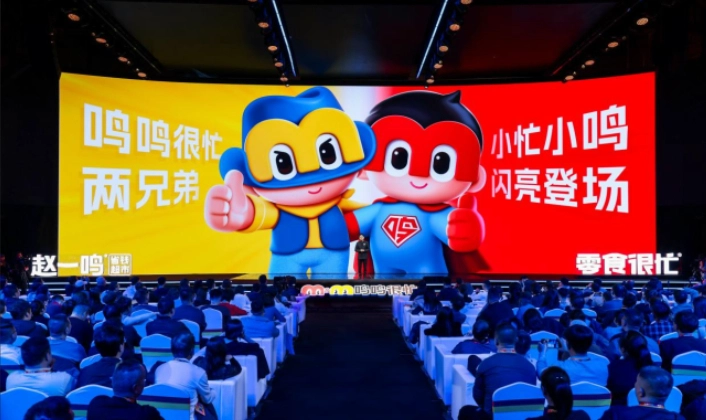
Mingming Henmang Bets Big with 220 Million Yuan: Bulk Snack War Enters Heavy-Asset Harvest Phase
Mingming Henmang ups capital to 220 million yuan, investing in supply chain and digitalization as bulk snack sector enters heavy-asset profit-taking phase.
In the commercial landscape of 2026, the snack war in lower-tier markets has long moved beyond the hand-to-hand combat of the grassroots era, shifting instead toward an extremely austere consolidation of capital and supply chains. Recently, an industrial and commercial registration change involving Hubei Mingming Henmang Commercial Chain Co., Ltd., a company affiliated with Mingming Henmang, once again sent a strong signal to the outside world. According to the Tianyancha app, its registered capital has risen from RMB 200 million to approximately RMB 220 million. This is not merely a numerical shift on financial statements; it is a key move by this bulk-discount snack giant to cement its dominance through capital during the deep-water phase of industry consolidation.
Founded at the end of 2019, the company's legal representative is Yan Zhou. Its shareholding structure clearly reflects the blockbuster merger that reshaped the industry landscape: shares are held jointly by Yan Zhou, Shanghai Niaowo Advertising Culture Communication Co., Ltd., representing the Zhao Yiming side, and Li Wei, among others. Following that epic merger in 2023, Mingming Henmang became an undisputed behemoth in China's bulk-discount snack sector. This latest 10 percent capital increase reveals its ambitious attempt in 2026 to leap from scale expansion to a closed-loop industrial ecosystem.
The Battle for Supply Chain Sovereignty
The reason bulk-discount snack retailers were able to sweep through and disrupt traditional supermarket and convenience store systems over the past few years lies in their violent dismantling of the conventional distribution chain. Traditional snack sales relied on multi-tiered agents, whereas companies like Mingming Henmang took the hard-discount route—leveraging massive procurement volumes to bypass distributors entirely and establish direct, one-way supply agreements with manufacturers.
By 2026, the competitive threshold has shifted from store count to supply chain responsiveness and digital control. This increase in registered capital is highly likely intended to support the construction of larger warehousing and logistics bases, as well as deeper penetration into the production lines of upstream core SKUs. In the face of extreme cost performance, whoever can complete the transformation from channel player to brand operator—or even semi-manufacturer—sooner will be able to squeeze out profits from the industry's razor-thin margins. The inclusion of urban distribution and delivery services in the business scope shown on Tianyancha is direct evidence of its effort to seize control over logistics.
Alignment of Will After Capital Consensus
At this delicate juncture in early 2026, any move at the capital level is no longer an isolated act. After round after round of rapid expansion, the bulk-discount snack industry has reached a point of market saturation. What was once a blue ocean has been stained red. At this stage, a capital increase typically signals that the backing investors have reached a high degree of consensus: namely, to strengthen the company's risk resilience and creditworthiness in a stagnant market, making final preparations for an upcoming IPO or an even larger round of mergers and acquisitions.
The greatest pressure facing Yan Zhou and his team is no longer the mushrooming imitators, but how to sustain the profit margins of tens of thousands of franchisees under the logic of high turnover. Behind the RMB 220 million in registered capital lies the rigid demand from the vast franchise system for headquarters credit backing. In the lower-tier markets of 2026, franchisee confidence is worth more than gold. The thicker the parent company's capital base, the wider its buffer zone when confronting extreme price wars or consumption fluctuations.
Technology Inflection Point and the Digital Game
Notably, competition in the bulk-discount snack space is evolving into a game of data. For Mingming Henmang in 2026, its core assets are no longer just the orange-and-green signs lining the streets of fifth-tier cities, but the massive torrents of sales data generated every day.
Through this data, the company can precisely reverse-engineer factory production schedules and, to some extent, define the next quarter's hit products. Following this capital increase, Mingming Henmang is highly likely to invest heavily in AI-driven inventory optimization algorithms and automated sorting systems. This shift from selling goods to selling efficiency is the only path to avoiding low-quality price competition. The food internet sales business shown on Tianyancha serves as the bridgehead for integrating online and offline traffic and feeding data back into the supply chain.
Profit in the snack industry has always been scraped out from between the cracks. In expanding its capital base this time, Mingming Henmang is essentially building a moat for the final showdown in the industry. While all the obvious platitudes are being debated, this company is telling the market through its formidable balance sheet that true downgrading is not just about lower prices—it is about elevating the efficiency of the entire business system.
The endgame of this contest is not about who has more stores, but about who can be the first to completely reorganize upstream production factors amid the digital wave of 2026. The mark Yan Zhou and his partners have left on Tianyancha is, in essence, a certificate of certainty issued to every competitor. When the snowball of capital rolls to this scale, so-called contingency ceases to exist—all that remains is the final reckoning of efficiency.
Congratulations on unlocking your 12-month mobile L2 exclusive eligibility claim. Claim now >>