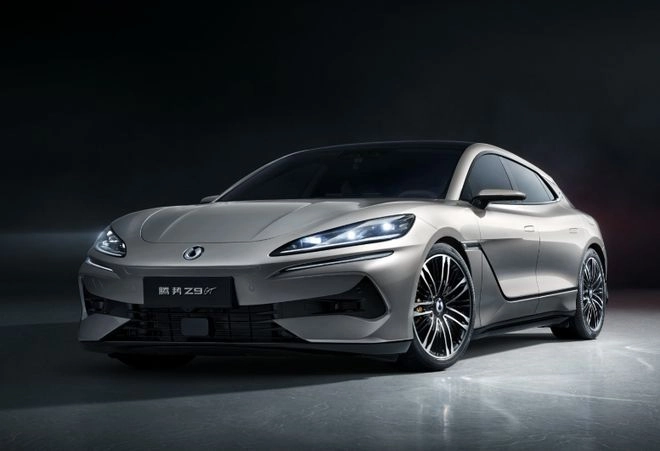
A Million in Registered Capital Buys Entry to Chengdu's EV Subsidy Program
Denza sets up a wholly-owned subsidiary with one million in registered capital to precisely align with Chengdu's new energy vehicle subsidy policy, achieving asset-light risk isolation and channel expansion.
By mid-2026, the competition in China's high-end new energy vehicle market has evolved from a pure configuration arms race into a brutal channel-level battle for territory at the pixel level. In the red ocean of luxury new energy vehicles priced above 300,000 yuan, players such as Huawei's Harmony Intelligent Mobility, Zeekr, and Li Auto are executing airtight encirclement of every regional hub. At this critical juncture of technological and market transformation, Denza, serving as BYD's spearhead for upward breakout, is accelerating the capillary expansion of its direct-sales network.
The latest business registration records clearly capture this strategic intent. According to Tianyancha App, Chengdu Denza Xingyuan Automobile Sales Co., Ltd. was officially established recently, with legal representative Li Xuan and a registered capital of just one million RMB. Breaking down the equity structure of this new entity, its core ownership is 100% controlled by Denza Automobile Sales Service Co., Ltd.
External observers and some industry analysts accustomed to tracking surface-level data tend to interpret this move as routine regional network expansion or a standard sales follow-up in the southwestern market. This shallow consensus completely overlooks the extreme compliance pressure and local subsidy arbitrage dynamics that direct-sales models face during downward expansion into lower-tier markets by late 2026.
The Million-Capital Shell and Local Policy Arbitrage
After BYD took full control of the Denza brand, its primary task was to thoroughly purge legacy dealer mindsets and build a tightly controlled direct-sales retail matrix. As the absolute consumption hub and bellwether for high-end vehicles in the southwestern hinterland, Chengdu has always been a must-fight battleground for major automakers. The deepest rationale behind Denza establishing a wholly-owned subsidiary here at this moment is the need for a fully compliant and agile local corporate shell to efficiently interface with the high-frequency new energy vehicle purchase subsidies and replacement policies rolled out by Chengdu municipality and its districts.
In today's automotive sales system, without a locally registered legal entity, automakers cannot issue local tax invoices to consumers in time, which often causes consumers to miss out on local cash subsidies ranging from several thousand to even tens of thousands of yuan. This new sales entity revealed by Tianyancha is, in essence, a policy absorption vehicle and local tax compliance hub tailored by Denza specifically for the Chengdu market.
Restricting initial registered capital to exactly one million RMB reflects BYD's highly seasoned risk isolation and asset-light approach in heavy-asset channel expansion. Compared to the traditional 4S dealership model that requires tens of millions in paid-in capital just to open, local sales subsidiaries under the direct-sales model do not need to bear high inventory financing costs or heavy land and property purchases. Their core assets are store leases and local employment contracts.
Risk Defense Under Channel Granularity Reorganization
By using independent micro-legal entities as forward outposts, Denza can rapidly penetrate major commercial districts and automotive industrial parks in Chengdu with minimal compliance friction and capital commitment. More importantly, BYD, with its vast scale, is using this ultra-fine-grained subsidiary network to build a rigid legal firewall. Whether it's compensation for personal injury in long-tail traffic accidents during test drives or consumer rights claims arising at local retail outlets, potential legal liability will be strictly contained within the one-million-yuan boundary of each entity, ensuring no cross-contamination to the broader parent company's fundamentals.
The evolution of business has always been ruthless. In this brutal cycle where delivery efficiency, real cash-generation capability, and absolute supply chain control define ultimate survival, old-era sales networks that relied on dealer inventory loading and lacked direct penetration of headquarters' will are destined to collapse under the relentless wave of price wars.
The latest Chengdu coordinate left in Tianyancha's records by Denza is a sobering ledger of a new energy giant's meticulous sovereignty penetration into regional hubs. As the reckless era of storytelling and concept-stacking comes to a definitive end, whoever can set aside pride first and stitch their direct-sales reach into local policies and long-tail compliance at the pixel level will be the one to truly tighten the safety lifeline ensuring long-term brand survival in the coming shakeout of the luxury vehicle market.