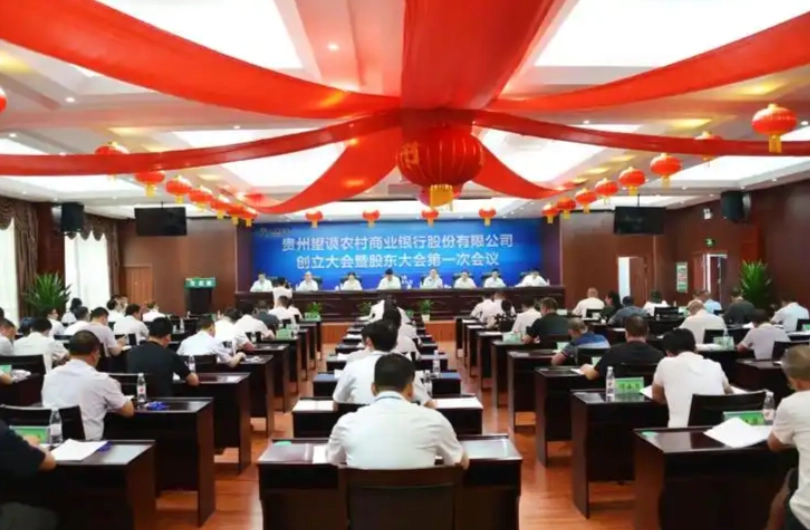
Qianxinan Rural Commercial Bank is set to be established with a 2 billion yuan registered capital by merging county-level rural credit cooperatives, aiming to mitigate risks and consolidate assets in response to local financial challenges.
When rural commercial banks in Xingyi, Wangmo, Xingren, and other parts of Guizhou jointly invested to assemble a prefecture-level financial institution with registered capital as high as 2 billion yuan in the southwestern border region, anyone who still interprets this as a routine license consolidation in local finance has thoroughly underestimated the urgency behind this reform of the rural credit cooperative system. The registration and establishment of Southwest Guizhou Rural Commercial Bank Co., Ltd. is by no means aimed at igniting a new wave of credit frenzy in lower-tier markets. Rather, at the intersection of accelerating risk exposure in county-level finance and the tough battle to resolve local government debt, this is a campaign to clear existing risk and defend the balance sheet, driven by provincial-level strategic coordination.
For a long time, the rural commercial banks and rural credit cooperatives scattered across various districts and counties have formed the most fundamental capillaries supporting local county-level economies. However, in the Southwest Guizhou region, which relies heavily on mountain-based economies, agricultural industries, and resource-driven development, these county-level legal entities operating independently have long faced the predicament of highly distorted asset structures. Constrained by the narrow industrial depth of a single county, credit lending by grassroots rural commercial banks tends to be heavily tied to local municipal infrastructure, agricultural development projects, and small and micro agricultural entities with extremely poor risk resistance.
Once the macroeconomic cycle turns downward or local fiscal liquidity tightens, the meager capital reserves of these small county-level entities are easily pierced through by non-performing assets. And under fragmented shareholding structures where each entity acts on its own, cross-regional liquidity adjustment and mutual risk rescue are almost impossible to achieve.
The Restructuring Logic Behind the Shareholding Structure
Looking through the underlying shareholding structure to dissect the restructuring logic of this new entity, the path of packaging and consolidating county-level assets becomes especially clear. Business registration data from Tianyancha shows that Southwest Guizhou Rural Commercial Bank is jointly funded by multiple regional financial entities, including Guizhou Xingyi Rural Commercial Bank, Guizhou Wangmo Rural Commercial Bank, and Guizhou Xingren Rural Commercial Bank. Its legal representative is Luo Xiang, with registered capital of 2 billion yuan.
The shareholder roster captured by Tianyancha shows that the new bank does not rely on an abrupt arrival of external capital, but rather directly converts the previously independent county-level rural commercial banks into founding shareholders of the parent platform, completing a bottom-up horizontal mega-merger of existing assets.
The Strategic Purpose of Horizontal Consolidation
The core purpose of this horizontal consolidation is to leverage the scale effect of a pooled capital base to forcibly expand the net asset foundation. The 2 billion yuan in registered capital not only directly raises the ceiling for single large-amount credit approvals across the entire prefecture, enabling the institution to take on higher-level real economy industrial projects, but also significantly repairs the capital adequacy ratio on regulatory indicators. The deeper strategic consideration is that by establishing a unified prefecture-level rural commercial bank legal entity, it can completely sever the over-entangled interest chains between past county-level rural credit institutions and local administrative will. It consolidates credit approval authority and risk control powers that were previously scattered across counties and cities into a central hub, establishing a unified, more transparent credit review firewall.
Challenges After the Merger
However, merging the old books of multiple districts and counties into a single balance sheet does not mean historic risks will naturally dissolve. Within Southwest Guizhou, Xingyi, as the seat of the prefectural government, and counties with relatively weaker economic foundations such as Wangmo, naturally exhibit a tiered gap in asset quality, loan-to-deposit ratios, and non-performing loan rates. In the early stages of restructuring, how to balance the distribution of interests between stronger counties and weaker counties under pressure, and how to prevent contagion of bad debts internally under a unified legal entity structure, are brutal tests that the new management must face.
The listing of Southwest Guizhou Rural Commercial Bank is another heavy blow in Guizhou's broader chess game of deepening rural credit cooperative reform across the province. It sends a cold signal to the market: in the critical period of financial deleveraging and resolving existing debt, the era of surviving in a corner through tiny county-level legal entities has come to a definitive end. Only by building a sufficiently wide asset moat through iron-fisted capital consolidation can local financial entities firmly hold the line against systemic financial risks through the long cycle of economic transformation.