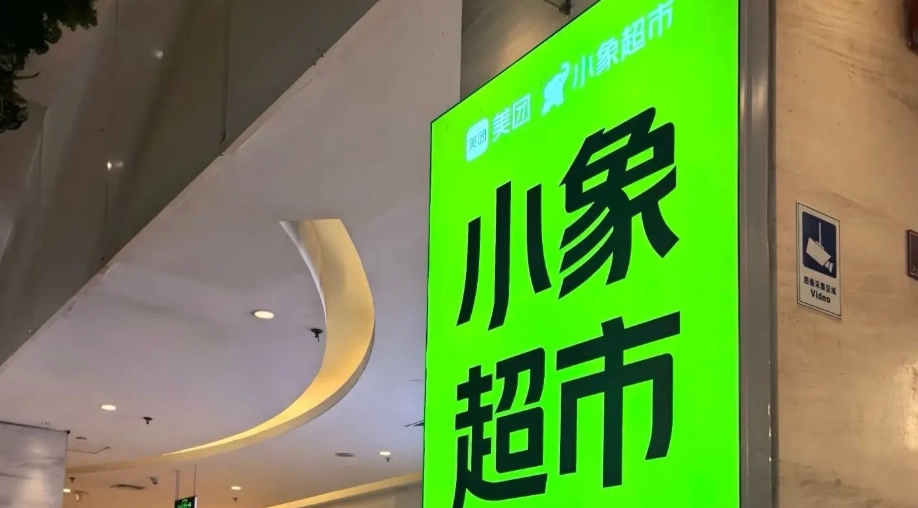
Meituan injects 10 million yuan into a new Zhenjiang entity, positioning itself in the immediacy retail down-market, vying for the fresh e-commerce dividend in the Yangtze River Delta hinterland.
When Meituan's instant retail arm extended its reach to Zhenjiang in southern Jiangsu, establishing Zhenjiang Xiangxian Technology Co., Ltd. with a registered capital of 10 million yuan as a wholly-owned subsidiary, what appeared to be a routine regional business registration actually lifted the curtain on the aggressive push by instant retail giants into non-core prefecture-level cities during an era of zero-sum competition. Outsiders tend to view the establishment of such front warehouses as a mild expansion of supply chain capabilities into third- and fourth-tier cities. But strip away that veneer of mildness and you will find that this is nothing less than a defensive positional battle fought by Meituan in its instant retail war against rivals such as JD.com and Alibaba, all in a bid to seize the last-mile fulfillment battlefield.
Looking back at the development trajectory of instant retail over the past few years, the land-grab in first- and second-tier cities has long entered a phase of intense, finely tuned competition over existing users. Whether it is Meituan's Xiaoxiang Supermarket, JD.com's Instant Delivery, or Alibaba's local life services instant delivery, all are facing the dual pressures of soaring customer acquisition costs and fulfillment density. In saturated first-tier markets, the marginal returns of burning cash to fuel scale growth are declining exponentially.
As a result, turning their gaze to affluent prefecture-level cities in southern Jiangsu—where consumer habits are already mature but front-warehouse density remains relatively sparse—in search of new incremental cash cows has become a tactical choice unanimously adopted by the giants.
Tracing the equity penetration path as captured by Tianyancha, this newly established Zhenjiang Xiangxian Technology Co., Ltd. is wholly owned by Beijing Xiangxian Technology Co., Ltd., and its business scope precisely locks onto core high-frequency categories including food sales, catering services, pharmaceutical retail, and food delivery services. The full set of qualifications disclosed on Tianyancha outlines Meituan's extremely clear commercial closed-loop logic in lower-tier markets: delivering fresh produce, daily necessities, and medicines to consumers through the front-warehouse model, using ultra-high-frequency, essential daily-needs categories to tap into local residents' everyday spending.
Choosing to bring the fight to Zhenjiang is a move of exquisite calculation.
As a key node city in the Yangtze River Delta urban agglomeration, Zhenjiang not only boasts relatively high per capita disposable income and mature online consumption habits, but its relatively compact urban geography is also highly suited to the front-warehouse-plus-courier fulfillment model. Compared with the delivery radii stretching several kilometers in large cities, the per-warehouse coverage efficiency in medium-sized cities like Zhenjiang is higher, and the marginal cost of logistics fulfillment is lower.
By investing 10 million yuan to establish an independent legal entity, Meituan can quickly build a compliant warehousing network locally, connect with local supply chains, and launch an all-around ecological encirclement directly against local regulators and brick-and-mortar merchants.
The deeper defensive logic lies in absolute control over the local retail base.
The current local retail market is no longer a simple traffic battle among individual platforms, but a multi-dimensional, three-dimensional war encompassing instant e-commerce, traditional supermarkets, and short-video-based local life services. Every time Xiaoxiang Supermarket sinks its roots into another city, it is effectively using capital-heavy front warehouses and fulfillment networks to drive a sturdy wedge between local users' phone screens and offline communities. By keeping high-frequency fresh grocery firmly in its own hands, Meituan can continuously feed core traffic into its ecosystem.
This 10 million yuan injection is a microcosmic snapshot of the instant retail track shifting from high-level narratives to street-level brawling. With the traffic dividends of big tech companies having fully peaked, every internet giant has no choice but to take off its suit and wade into the bustling streets of third- and fourth-tier cities, fighting inch by inch with mom-and-pop shops and local traditional supermarkets over supply chains and fulfillment rights. In this no-retreat battle of instant retail's downward push, whoever can optimize front-warehouse gross margins and delivery efficiency to the extreme will be the one to reliably capture the final dividends of fresh e-commerce in these hinterlands of the Yangtze River Delta.