Mech-Mind was oversubscribed 3,835 times yet broke below its IPO price on its first trading day, exposing the valuation cliff between lofty hard-tech valuations and the reality of losses.
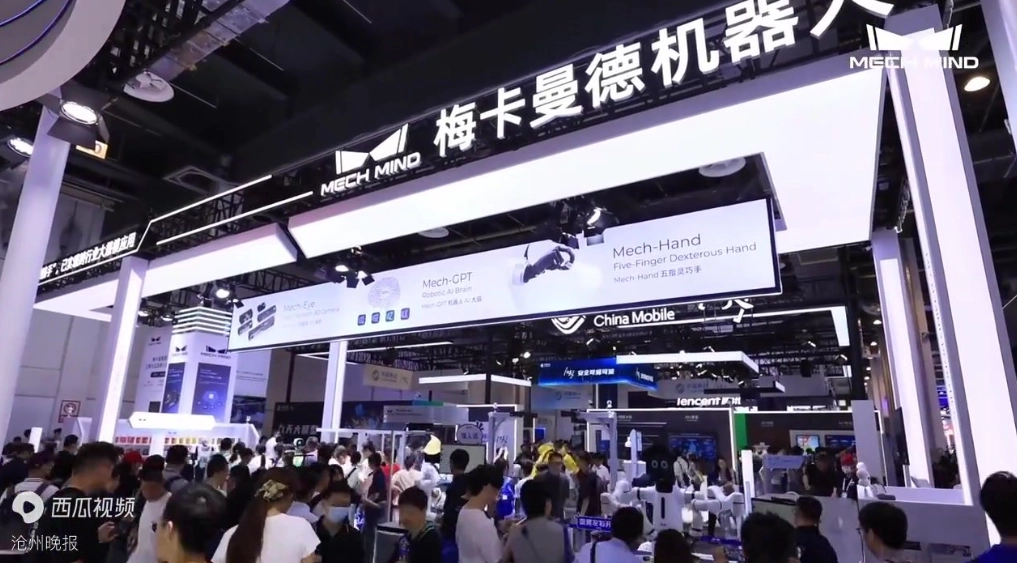
When Mech-Mind Robotics, crowned with the halo of "the first listed company in embodied intelligence eyes-brain-hands," rang the listing bell at the Hong Kong Stock Exchange, with its public offering oversubscription multiple climbing to an astonishing 3,835 times and its one-lot allotment rate a dismal 3%, almost every IPO-subscribing retail investor was anticipating a feast of soaring share prices. Reality, however, quickly threw a bucket of ice water on the feverish sentiment: it opened flat and drifted lower on the first day, fell more than 4% intraday, and closed with a market capitalization locked at around HK$12 billion.
Scarce chips were underwater the moment they listed. This extreme divergence between the oversubscription multiple and a first-day break below the issue price not only tears open the structural trap for hard-tech companies in Hong Kong IPOs, but also lays bare the pain of embodied intelligence shifting from a valuation frenzy in the primary market to harsh number-crunching in the secondary market.
The Industrial Automation Foundation Beneath the "Embodied Intelligence" Halo
In today's hard-tech lexicon, "embodied intelligence" has become one of the most cash-magnet labels. But if one strips away the glossy conceptual packaging and starts from the underlying industrial scenarios, the AI 3D vision guidance systems on which Mech-Mind built its business and which contribute the bulk of its revenue are still essentially rooted in the penetration of industrial robot automation. 3D industrial cameras plus software algorithms help robotic arms achieve grasping and positioning in disordered bins, and this is indeed an indispensable part of advanced manufacturing.
But fundamentally, what it serves are downstream automakers, logistics distribution centers, and 3C assembly lines that are extremely sensitive to cost reduction and efficiency gains. The procurement decisions of such customers are highly rational and even stringent, and consideration of the investment return cycle for a single piece of equipment far outweighs any so-called premium for cutting-edge technology.
Capital Foundation: The Shareholder Camp Revealed Through Tianyancha
Following the industrial and commercial records deposited by Tianyancha to pierce through the governance foundation of this newly listed entity, the track record of capital support from various parties over several years is laid out in full. Tianyancha industrial and commercial data show that the listing entity, Mech-Mind (Xiong'an) Robotics Technology Co., Ltd., has Shao Tianlan as its legal representative, and in the shareholder camp before the offering, Shenzhen Hanchen Venture Capital ranked as the single largest shareholder with a 13.63% stake, while Beijing Kuxun Technology, founder Shao Tianlan, and Suzhou Qiming Rongke held 8.52%, 8.44%, and 7.38%, respectively.
In the financing trail recorded by Tianyancha, top institutions such as Sequoia, Meituan, and Source Code Capital once crowded in, and multiple rounds of heavy capital injections pushed up its valuation level in the primary market.
This capital path of being lionized in the primary market and pushed to a market value of tens of billions is precisely the core hidden danger behind its valuation cliff at the opening in the secondary market.
Financial Records: High Gross Margin and a Bloody Run Side by Side
The financial records in the prospectus brutally reveal the company's true cash-generation pressure: from 2023 to 2025, although Mech-Mind's revenue grew from RMB 181 million to RMB 389 million, and its gross margin climbed from 39.1% to 64.6%, its cumulative net loss over the three years still exceeded RMB 1 billion. Even after excluding non-cash items such as equity incentives, its adjusted net loss in 2025 still exceeded RMB 100 million.
The crux of this bloody run is that behind the high gross margin lie enormous period expenses that devour profit. In 2025 alone, the company's selling expenses and R&D expenses combined consumed nearly RMB 280 million, even exceeding its total gross profit for the year. Given the highly fragmented nature of downstream industrial scenarios and the reality that they require substantial customized engineering support, robotic vision systems are still far from achieving the kind of profit explosion enjoyed by software vendors, whose marginal cost of code is zero.
Offering Structure: Cornerstone Lock-Up and a Buyer Gap
Even more intriguing is the offering structure of this IPO. In this offering, nine cornerstone investors, including Baillie Gifford, Taikang Life Insurance, and entities affiliated with BYD, splashed out US$186 million to lock up about 66% of the offered shares. By conventional logic, with cornerstone institutions locking down two-thirds of the supply and retail investors extremely reluctant to sell, it should be very easy to push up the share price against the backdrop of a tiny free float.
However, this deliberately tightened float control design instead exposed a gap in buying power amid a weak Hong Kong stock market environment.
Large funds in the secondary market are extremely shrewd. When a market value of tens of billions corresponds to annual revenue of less than RMB 400 million, and the price-to-sales (PS) ratio is pushed to a lofty valuation range of nearly 30 times, institutional investors are no longer willing to pay in advance merely for a grand embodied intelligence story. The cornerstone lock-up certainly prevented large-scale first-day selling pressure, but it also meant that incremental long-term buyers outside the public offering were severely lacking.
Once IPO-subscribing retail investors found that there was no expected surge premium at the open, the sentiment to lock in gains or stop losses to avoid risk would form a stampede, and just a few small orders could carve a deep decline into an extremely thin order book.
Warning: Cash Flow Calculations Are the Ultimate Judge
This first-day break below the issue price on the Main Board of the Hong Kong Stock Exchange sounded a warning bell for the entire hard-tech sector. The grand narrative of embodied intelligence may be able to create miracles of multiplying valuations within the closed arena of the primary market, but the ultimate adjudicating power of the capital market will always rest in the hands of cold cash flow calculations. When the "eyes-brain-hands" components cannot quickly offset high labor and R&D expenses in real factory workshops, no matter how crowded the IPO frenzy is, it ultimately cannot fill the huge chasm between financial reality and valuation illusion at the moment the bell is rung.