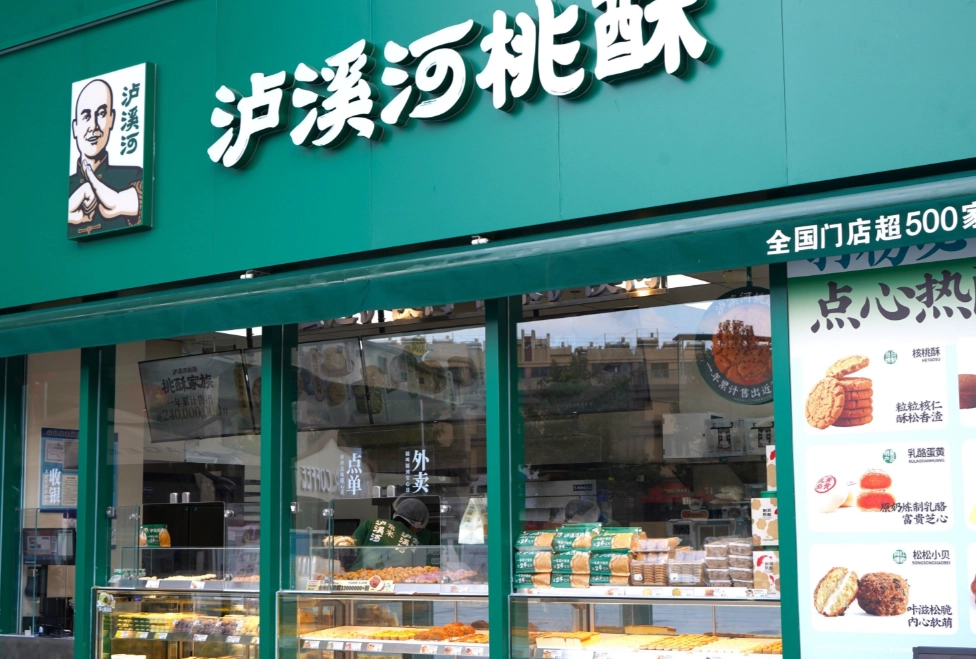
The Thin Margins Squeezed Into Plastic Bags: The Supply Chain Calculations Behind Luxi River's Move to Kunshan
Luxi River sets up a sales company in Kunshan to centrally purchase packaging materials and cut costs, with a logistics hub radiating across the Yangtze River Delta, reflecting the refined supply chain competition in the saturated bakery market.
After the new Chinese bakery sector weathered the industry storm of Tiger Head Bureau's bankruptcy and Mo Mo Dessert Shop's large-scale retreat, the public has long removed its rose-colored glasses from this once-thriving food and beverage category. However, as one of the few heavy players in the bakery space that has penetrated the wave of closures and continues aggressive store expansion, Luxihe's quiet establishment of a wholly-owned sales company in Kunshan, Jiangsu, deserves scrutiny under the microscope of its large-scale growth strategy.
This business registration move, involving a modest capital of one million yuan, may appear lightweight on the surface, but a closer look at the details of its business scope reveals that this is by no means an ordinary expansion of sales outlets. Rather, it is a heavy-handed escalation of internal competition by a chain bakery brand—after the mythology of internet-era traffic died down—pushing upstream toward consumables and logistics hubs to squeeze single-store losses to the absolute minimum.
Reviewing the life-and-death struggles of traditional Chinese bakeries, the underlying logic of survival has never lived in marketing copy, but rather in the deeply unglamorous supply chain fulfillment ledger. Under the dual pressure of consumer rationality and cost-performance competition, premium pastries priced at dozens of yuan per piece have entirely lost their footing, and the high-volume, low-margin model of selling peach crisps at two or three yuan each has become the industry norm. When product formulas and flavors struggle to create absolute differentiation in an increasingly homogenized competitive landscape, whoever can shave even one percentage point of gross margin from flour, oils, and the highly inconspicuous packaging and logistics costs will be the one who outlasts competitors in a prolonged price war.
The Packaging Consumables Battle Behind the "Sales Company"
Tracing the business blueprint of this new entity reveals its covert tactical intent. According to the Tianyancha App, Luxihe (Kunshan) Food Sales Co., Ltd., wholly owned by Luxihe Food Group, has a registered capital of only 1 million yuan, yet its business scope conspicuously includes the sale of plastic products, daily-use goods, and sundries. This list of categories recorded on Tianyancha—appearing entirely unrelated to bakery and pastry at first glance—precisely exposes the core pain point of chain restaurants after scaling: runaway costs in packaging consumables and operational miscellaneous items.
In a bakery chain operating hundreds of directly-owned stores nationwide, the daily consumption of low-value, high-turnover items such as takeout paper bags, plastic inner trays, blister packs, gloves, and utensils is astronomical. In the past, if these were procured in a decentralized manner by regional stores, not only would quality control standards vary inconsistently, but middlemen would also skim off profits at every layer. By establishing a dedicated independent sales legal entity, Luxihe is essentially driving group-wide centralized procurement and independent settlement of consumables—consolidating the entire system's packaging and auxiliary materials to negotiate lower prices, then distributing them to various battle zones through internal trade. This directly converts what was once a source of cost leakage into a profit-regulating valve tightly controlled by headquarters.
The Geographic Calculation Behind the Kunshan Move
Choosing to anchor this hub in Kunshan is likewise an exceptionally precise piece of geographic calculation.
As a golden corridor backed by Shanghai and tightly gripping the Suzhou-Wuxi-Changzhou axis, Kunshan boasts the most mature modern cold-chain warehousing and industrial logistics infrastructure in East China. By locating the sales and centralized procurement entity in Kunshan, the company can leverage the shortest trunk-line transportation radius to supply the Yangtze River Delta—its core home base with the highest consumption density and the highest concentration of stores—with high frequency and low loss rates. In the short-shelf-life bakery segment, where expiration dates are extremely tight and turnover rates are paramount, a closer logistics node means lower return-and-spoilage rates and faster replenishment response times.
This million-yuan registration move reflects the true nature of new consumer brands entering the brutal arena of surviving in a shrinking market. As the myth-making wave has fully receded, the survivors still at the table can no longer rely on storytelling to command valuation premiums. From the baking of a single peach crisp down to the centralized procurement and cross-regional allocation of a single plastic packaging box, reaching commercial tentacles into every tiny crevice of cost and wringing the towel repeatedly—that is the most solid defense line a chain brand can build in the red ocean.