Luo Yonghao's gossip has overshadowed Xibei's repeated capital increases, revealing the cash-flow battle behind how the restaurant giant is using capital infusions to weather the downturn.
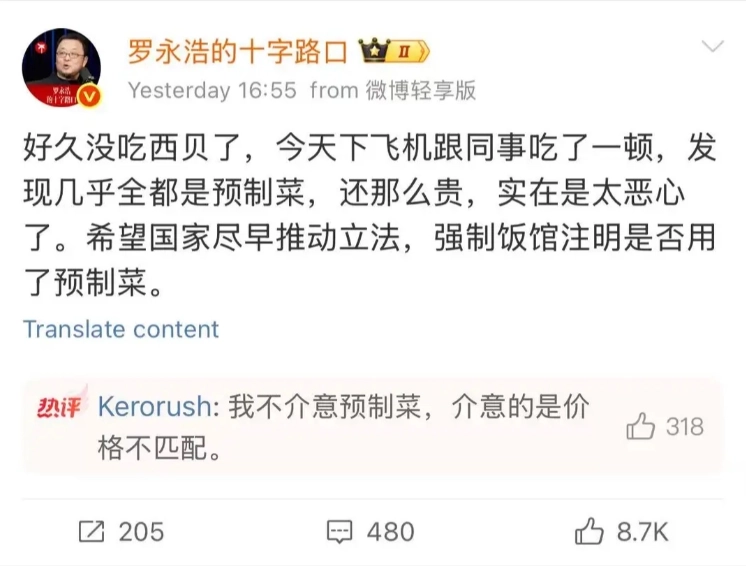
When Luo Yonghao posted a late-night rant decrying rumors of a kneel-down settlement and laid his litigation cards on the table, this internet farce—complete with a gleeful audience—successfully obscured the ferocious countercyclical expansion of restaurant giant Xibei at the capital level. The public fixed its gaze firmly on the gossip and grudges between two first-generation internet entrepreneur celebrities, yet few noticed that Jia Guolong, who once loudly proclaimed he would never take the company public, was quietly and frenziedly stockpiling provisions to survive the winter.
This is by no means a simple war of words, but a true microcosm of traditional asset-heavy dining forcibly extending its life through capital infusions as it faces an extremely involuted cyclical winter.
Structural Shifts in the Capital Foundation
Following the trajectory of commercial registration changes to strip away this entertainment veneer, Xibei's true capital foundation has already undergone structural shifts. A casual look through Tianyancha's business archives reveals that Inner Mongolia Xibei Catering Group Co., Ltd. had just completed a key Series A funding round in January of this year, with its registered capital pushed up from less than 90 million yuan to over 100 million yuan in one stroke. Then, just two months later in March, the company's registered capital was raised again to approximately 104 million yuan.
In a year when the catering industry broadly faces plunging average order values and a massive wave of store closures, an established chain giant intensively increasing capital twice in the first quarter conceals behind it far more than the simple business demand of opening a few new stores—it is a cash-flow defensive war concerning the company's very survival.
The Most Brutal Accounting Logic in the Restaurant Industry
To understand Jia Guolong's turnaround in attitude toward capital, one must confront the most brutal accounting logic in China's restaurant industry today. Over the past several years, Xibei, relying on extremely strong shopping mall dividends and a high-end fast-casual mindset, forcibly pushed the average order value of a Northwestern noodle meal above 100 yuan. In that golden era of consumption upgrading, ample store cash flow was enough to support internal rolling expansion, and capital's money seemed both expensive and superfluous.
However, when the foot-traffic dividend of commercial districts completely peaked and affordable restaurants and white-label chains in lower-tier markets launched price offensives with extreme supply chain costs, Xibei's massive direct-operated store network instantly transformed from a money-printing machine into a heavy-asset black hole devouring cash. Exorbitant mall rents, enormous central kitchen depreciation, and the rigid salaries of tens of thousands of employees—in today's era of cliff-edge drops in per-customer spending—are enough to crush any traditional enterprise that relies solely on endogenous profit circulation.
The Defensive Nature of the Capital Moves
Public opinion generally assumes that Xibei's intensive capital increases are aimed at reshaping its repeatedly failed fast-food sub-brands or entering the prepared-dish track, but such deductions that remain at the business surface level completely underestimate the defensive nature of this round of capital moves. In this long-cycle consumer retreat, securing Series A funding and continuously enlarging registered capital is fundamentally not for expansion, but to build a thicker net asset safety cushion in front of indirect financing channels such as banks, thereby exchanging for higher credit lines.
Jia Guolong is paying the price of equity dilution to buy Xibei a card that can keep it in the game until the end of this great restaurant industry reshuffle. When the weak players in the industry are forced out due to broken capital chains, only Xibei, with heavy capital in hand, can survive the cycle on the rubble and even harvest higher-quality store locations at low prices. This is no longer a culinary contest of dish development, but a pure survival game of whose capital chain can hold out one day longer than competitors'.
A Wake-Up Call for Restaurant Owners
This chain of capital maneuvers extending from gossip rumors has sounded the most piercing alarm for all restaurant owners still immersed in the past dream of high gross margins.The classical restaurant era of relying on single-store profitability for endogenous growth has completely ended. When even the industry's elder brother, who once resisted capital, has to bow his head and frantically absorb external funds to build moats, the competitive threshold of the entire track has been pushed to an extreme test of capital-raising capability.