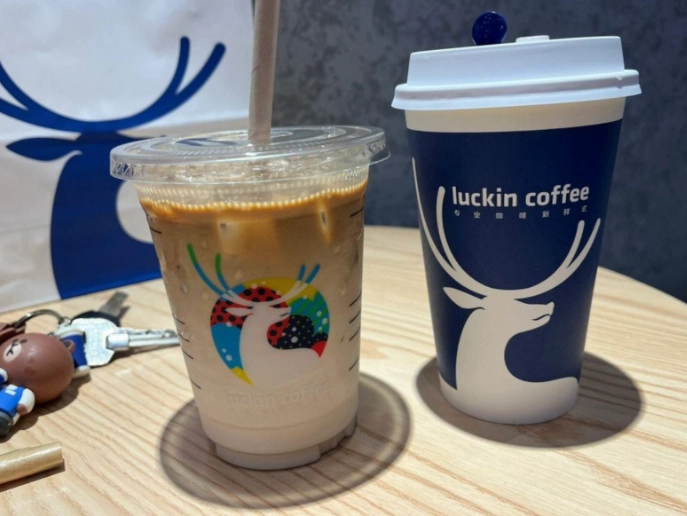
Luckin Coffee's Fully Owned Expansion: Supply Chain Centralization and Retail Boundary Crossing
Luckin Coffee has fully funded a trading company with a registered capital of 10 million yuan, aiming to leverage supply chain centralization for cross-sector daily goods retail, utilizing private domain traffic to monetize and address growth saturation in coffee sales.
As the new coffee sector enters the brutally competitive "price war" and "stock market meat grinder" phase, industry giants that once grew rapidly on capital are accelerating the consolidation of their defensive and offensive heavy assets deep into their home base.
Recently, a notice of a new company's establishment disclosed by Tianyancha App has completely exposed a core long-term strategy by Luckin Coffee in supply chain centralization and multi-category retail: Luckin Trading (Xiamen) Co., Ltd. has been quietly established with a registered capital of a robust 10 million RMB. At a time when the entire industry is fixated on per-cup gross margins and relies on crudely lowering franchise thresholds to polish financial report efficiency metrics, this fully owned, 10-million-level pure trading entity registration appears extremely solid and brimming with strategic ambition.
Most industry observers, accustomed to gauging this coffee giant by how long the "9.9 yuan coupon" can last, the frequency of co-branded new product launches, and the rate of 10,000-store expansion, tend to interpret this new company's establishment as a routine regional balance sheet adjustment or a pro forma move by the parent company to comply with local tax policies. This shallow understanding completely underestimates the systemic monetization anxiety faced by Guo Jinyi and Luckin's core management team amid the peaking growth of coffee as a single category and long-term volatility in the global coffee bean supply chain—as well as their deeper strategy of using the purest form of trading centralization to forcibly secure long-tail retail premiums.
This capital game, in which the company is cleaning up and advancing from coffee into full-category large-scale trading, has its real profit chain hidden in the cold industrial and commercial data slices of the Tianyancha system.
The Tianyancha industrial and commercial information clearly shows that this newly established Luckin Trading (Xiamen) Co., Ltd. is fully owned 100% by Luckin Coffee (China) Co., Ltd., with Li Rupeng, a key internal operator at Luckin, personally serving as the legal representative. Looking at its registered business scope in the Tianyancha system, an aggressively expansionist commercial blueprint jumps off the page: in addition to traditional catering management and food sales, food internet sales and daily necessities sales prominently occupy the core shelf space.
The driving force behind this move—absolutely controlled by the coffee parent company and precisely targeting the intersection of "trading" and "daily necessities"—is Luckin's urgent need to cross-monetize its massive App/mini-program private domain traffic pool and achieve extreme margin control.
In the current retail ecosystem, relying purely on reselling coffee as a single standard product is seeing its marginal benefits mercilessly squeezed under prolonged close-quarters competition among peers. The core assets Luckin has accumulated over the past several years are not just its tens of thousands of physical stores nationwide, but also its hundreds of millions of highly sticky, active private domain users. However, if these enormous traffic dividends are used only to sell coffee, their financial cash-generation capacity clearly cannot bear the market's expectations for cross-cycle premium valuation.
This 10 million RMB increment in the Xiamen entity is, in essence, Luckin forcibly welding an "independent trading hub" and a "cross-border traffic juicer" outside its own body.
By establishing a trading shell with full-network settlement functions in its Xiamen home base, Luckin can directly bypass the complex bandwidth of coffee store management and, as an independent legal entity, forcibly clean up and restructure its upstream supply chain. The "daily necessities sales" specified in Tianyancha bluntly reveals Luckin's astute calculations for heavy-asset positioning in peripheral merchandise and even cross-border new retail in the future. Whether it's self-operated nuts, snack foods, or popular IP trend toys and collectibles, all can be centrally procured and distributed nationwide through this clean trading entity, converting traffic into high-margin non-coffee business profits at extremely low logistics and customer acquisition costs, flowing steadily back into the parent company's financial statements.
The second half of the coffee story has long bid farewell to the false prosperity of blindly burning cash on subsidies and buying user time with grand narratives. When industry dividends have been completely drained, what ultimately tests a platform's survival caliber is no longer the flashy store numbers at press conferences, but the lasting cash-generation capacity of its balance sheet and the cleanliness of its core entity.