Rapid-Fire Brand Collaborations and the Loss of Quality Control: Luckin Coffee's Qixi Misfire and the Hangover of Fast-Moving Coffee's Traffic Obsession
Luckin Coffee's Qixi collaboration short film sparked plagiarism allegations, exposing deep-seated quality control issues beneath fast-moving coffee's reliance on marketing hype, highlighting the need to guard against missing risk controls amidst traffic frenzy.
When Luckin Coffee's co-branded animated short film, released for the Qixi Festival, was immediately hit with plagiarism accusations — with netizens alleging it stitched together multiple classic anime scenes — public opinion quickly turned its focus to the professional ethics of the collaborating creators and the awkward statistic of losing 50,000 followers in a short time. However, framing this controversy solely as a creative borrowing misstep by the individual creator completely ignores the fact that in the breakneck race of ready-to-drink fast coffee, which relies heavily on marketing hype, the assembly line operating on a weekly content turnover cycle is now facing severe backlash from quality control failures.
This is by no means a random case of plot similarities, but rather an industrial weakness inevitably exposed by fast-paced marketing's extreme squeeze on content review capacity.
In the current ready-to-drink coffee market, the 9.9 RMB price war has squeezed supply chain efficiency and product margins to the limit. Relying solely on the flavor differences of coffee beans is simply not enough to sustain a sense of novelty across a scale of 20,000 stores. To maintain extremely high repurchase rates and social media visibility, co-branding has become the most relied-upon traffic stimulant in fast-moving consumer coffee.
From popular films, TV series, and gaming IPs to trendy artists, Luckin maintains an extremely high-frequency product launch pace. However, this high-turnover logic of treating cultural products as disposable marketing materials carries inherent risk-control blind spots. When the marketing team's KPIs are strictly locked onto chasing holiday trends and speeding up content production, deep-review mechanisms for external partners' originality and material copyrights get severely marginalized under fast-approaching launch deadlines.
Tracing the underlying business blueprint to examine this coffee giant's operational framework, the friction in execution at its massive scale becomes clear. According to business and judicial data recorded by Tianyancha, Luckin Coffee (China) Co., Ltd. has a registered capital of up to $1.225 billion, demonstrating strong capital depth and supply chain management capability. However, in Tianyancha's legal litigation records, the company also shows a dense history of multiple commercial transaction disputes and contract dispute cases.
These judicial traces embedded in a massive operating system are a true reflection of the frequent interest conflicts between this ultra-large chain enterprise and various external suppliers and partners during its multi-front expansion and rapid growth.
The model of relying on co-branding to create hits is showing signs of diminishing marginal returns.
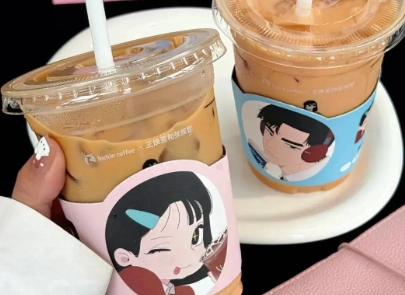
Young consumer groups' tolerance for brand marketing is shrinking rapidly. They are eager to pay for high-quality content that genuinely resonates emotionally, but they are also highly prone to strong moral backlash against crudely made, pieced-together marketing gimmicks. Lucking has the supply chain and distribution network to blanket streets across the country with co-branded cup sleeves and merchandise overnight — but once a copyright issue emerges in the content end, this highly penetrating channel advantage instantly transforms into an amplifier for negative public opinion.
The failure of the Qixi co-branded short film and the collaborating influencer's loss of followers serve as a warning to all consumer brands attempting to sustain buzz through intensive marketing. When 9.9 RMB coffee becomes a purely traffic-driven business, and the brand's moat relies solely on outsourced creators' inspiration and influencer popularity, any single quality-control lapse can instantly erode hard-earned consumer goodwill. After the fervent marketing frenzy subsides, figuring out how to install truly rigorous risk-control brakes on the high-speed product launch machine is the answer this 10,000-store giant must deliver once it comes out of its traffic hangover.