Luckin China shows $1.2 billion in paid-in capital but only four people on social insurance, revealing it is really an offshore capital settlement and investment holding shell with ambitions for supply chain and fiscal scheduling.
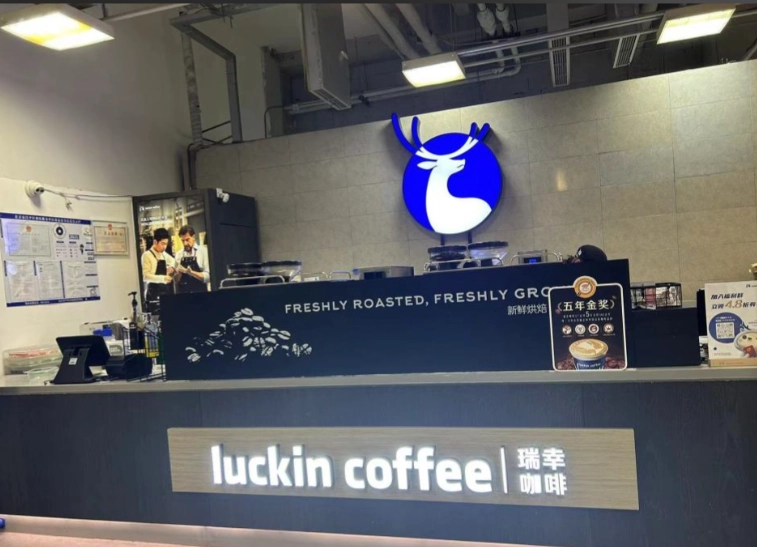
When the spotlight is trained on the asset foundation that underpins Luckin Coffee's more than 20,000 stores nationwide and quarterly revenue exceeding ten billion yuan, the most startling business cross-section is laid bare: as its top-level domestic controlling entity, Luckin Coffee (China) Co., Ltd., the latest annual report discloses that the number of people enrolled in social insurance is merely 4.Of the approximately US$1.225 billion in registered capital, the actually paid-in amount reached as high as US$1.215 billion, an astonishing contribution fulfillment rate of 99%.
A giant foreign-invested entity with nearly the full amount of more than 8 billion yuan already received, yet it has only 4 registered employees paying social insurance, while its business scope, alongside catering and food sales, also unusually incorporates a full set of heavyweight capital and logistics licenses such as "corporate headquarters management, international freight forwarding, domestic freight forwarding," and "engaging in investment activities with its own funds."
If this were merely regarded as a data entry discrepancy, it would completely misread the essence of governance that the new retail coffee empire built after its rebirth from the ashes:This is by no means a physical chain store on the front line steaming milk foam, but an offshore hub mother port that integrates offshore capital accumulation, foreign currency settlement channels, cross-border allocation of green coffee beans from overseas, and domestic heavy-asset investment.
From Single-Store Gross Profit to a Multinational Supply Chain and Fiscal Scheduling Project
For a long time, the public's understanding of chain restaurant enterprises remained at the level of rolling snowballs step by step through the gross profit of a beverage costing a dozen or so yuan per cup. However, once chain stores broke through the 20,000 mark, the lifeblood of the enterprise no longer depended on the physical turnover of a single store's cash register, but evolved into an extremely vast multinational supply chain and global fiscal scheduling project. The main producing areas of green coffee beans are far away in Brazil, Ethiopia, and Yunnan; roasting plants are located in Kunshan, Jiangsu, and Xiamen, Fujian; and tens of thousands of affiliated stores and directly operated stores consume hundreds or thousands of tons of highland milk, syrup, and straw packaging materials every day.
How to establish an absolutely compliant capital moat among multinational procurement, offshore equity dividends, and massive small-amount domestic transactions determines the design form of the top-level capital architecture.
Foreign-Funded Foundation and Equity Penetration: The Origins of US$1.2 Billion in Paid-In Capital
Following the traces left at the underlying commercial level to penetrate the governance skeleton of this coffee leader, its deep foreign-funded foundation is clearly documented in Tianyancha records. Tianyancha business registration data shows that Luckin Coffee (China) Co., Ltd. was established on March 28, 2018, with Guo Jinyi as its legal representative, registered capital of approximately US$1.225 billion, paid-in capital of approximately US$1.215 billion, and a registration status of surviving.
The equity map penetrated by Tianyancha shows that the enterprise is 100% wholly owned by Luckin Coffee (Hong Kong) Co., Ltd. within an overseas offshore structure, making it a typical limited liability company (sole proprietorship by a Hong Kong, Macao, or Taiwan legal person).
A foreign-funded paid-in scale of up to US$1.215 billion is rare among domestic new consumption entities.
This genuine foreign currency contribution mainly accumulated from Luckin's early Nasdaq IPO fundraising, targeted capital increases by industrial shareholders such as Centurium Capital during successive debt restructurings, and the continuous injection of overseas capital into the domestic entity.It constitutes the most solid legal ballast for Guo Jinyi's team to undertake the revaluation of all domestic assets after thoroughly clearing the financial fraud litigation of the Lu Zhengyao era and completing the Chapter 15 restructuring proceedings under the U.S. Bankruptcy Code.
The Geometric Gap Between 4 Social Insurance Enrollees and US$1.2 Billion Paid-In: A Corporate Shell and Capital Bridge Platform
However, the enormous geometric gap between the social insurance enrollment scale of 4 people and US$1.2 billion in paid-in capital directly reveals the essence of this entity:It is an extremely pure "corporate shell resource and capital bridge platform."
Tianyancha data shows that Luckin Coffee (China) Co., Ltd. has made outbound investments in as many as dozens of core subsidiaries. The hundreds of thousands of baristas across more than 20,000 stores are ingeniously dispersed under branch companies or labor service outsourcing companies in various provinces and cities nationwide; software algorithms, ordering mini-programs, and digital systems are deposited in technology entities such as Luckin Coffee Information Technology (Xiamen);
while the tens-of-thousands-of-tons roasting production lines and green bean processing belong to independent supply chain manufacturing companies in Jiangsu or Fujian.
The 4 registered core personnel under the parent entity are essentially core gatekeepers stationed in Xiamen responsible for multinational legal affairs, offshore company secretarial work, foreign exchange registration and verification, and custody of the group's highest authority seals.This extreme separation of assets and employment not only firmly isolates the food safety customer complaints, work-related injury and social insurance disputes, and lease disputes faced by directly operated and franchised stores from the investment entity, but also greatly compresses the administrative friction costs of the multinational parent entity.
Freight Forwarding and Investment Licenses: A Closed Loop for Global Direct Procurement and Domestic Blood-Making Functions
A more seasoned strategic foreshadowing lies in the qualification puzzle of "international freight forwarding, domestic freight forwarding, and engaging in investment with own funds."
The acquisition of an international freight forwarding license directly opened up the closed loop for global direct procurement of overseas green coffee beans. In recent years, Luckin has signed large-scale long-term agreements in Brazil and Ethiopia for hundreds of thousands of tons of high-grade green bean procurement. If it relied on third-party freight forwarding companies, it would not only be marked up layer by layer and have the intermediate margin earned by others, but would also lose priority in cabin allocation when global shipping is tight.With dual qualifications in international and domestic freight forwarding, the parent entity can directly connect with multinational ocean shipping companies and customs clearance systems in its own corporate capacity, completely eliminating intermediary costs in self-operated cross-border green bean logistics and squeezing supply chain costs from overseas plantations to the domestic Kunshan roasting plant to the extreme.
The approval to "engage in investment activities with its own funds" then confirms its blood-making function as a domestic investment holding platform.The US$1.2 billion in paid-in ammunition held by the parent entity can legally and compliantly serve as a domestic capital pool, injecting capital downstream at any time to establish wholly owned roasting bases, take equity stakes in packaging and materials factories, and even launch strategic mergers and acquisitions in downstream cold chain logistics, without the need to go through cumbersome overseas foreign exchange approval procedures for every major investment.
Growth Ceiling and Real-World Reefs
However, pulling back the cloak of this almost perfect capital settlement and licensing hub, hidden growth ceilings and real-world reefs still lie ahead.
The first is the infinite approach of the domestic 9.9 yuan price war to the limit of supply chain cost control. Under the bombardment of close-quarters combat from competitors such as Cotti Coffee, the gross profit per cup of coffee has been compressed to a thin-margin space.Although the US$1.2 billion capital foundation has built an extremely solid barrier for equipment procurement and self-built roasting, once the procurement costs of green beans, fresh milk, and packaging materials are squeezed to the limit, the room for diluting costs solely through economies of scale is rapidly narrowing.
A more severe test lies in the regulatory scrutiny and valuation realization of returning to the mainstream U.S. capital market.
As management publicly expresses expectations of returning to the main board of U.S. stocks, the gaze with which international institutional investors examine Luckin will no longer be satisfied merely with impressive quarterly revenue of several billion yuan, but will examine the compliance transparency of its asset architecture by more demanding standards.For a top-level foreign-funded entity with only 4 employees paying social insurance to support capital aggregation spanning tens of thousands of nodes, a massive cross-border green bean freight forwarding operation, and complex subsidiary scheduling, the fairness of its related-party transaction pricing and the compliance of its cross-border tax planning will all face extremely rigorous piercing audits under global accounting standards and domestic and foreign tax authorities.
Business Implications: A System-Level Project and the Ultimate Proof
This business registration cross-section, polished over eight years and crystallizing US$1.2 billion in paid-in capital, releases the most profound business implication to the entire Chinese chain retail and outbound capital sector:Competition among modern consumer brands is no longer a small business decided simply by the number of stores, but a system-level project firmly locked in place by top-level fiscal and tax compliance, cross-border logistics licenses, and heavy-asset supply chains.Controlling a multi-billion-dollar capital mother port with a lightweight establishment of 4 people demonstrates the exquisite use of governance leverage by industrialized chain enterprises.
But as the price war turns bayonet-red and the bell of returning to the main board of U.S. stocks draws nearer,how to prove to global capital that this complex machine composed of an offshore foreign-funded shell and nationwide heavy-asset factories can maintain flawless compliance health over the long term is the ultimate proof Luckin must provide after thoroughly emerging from the shadows of history.