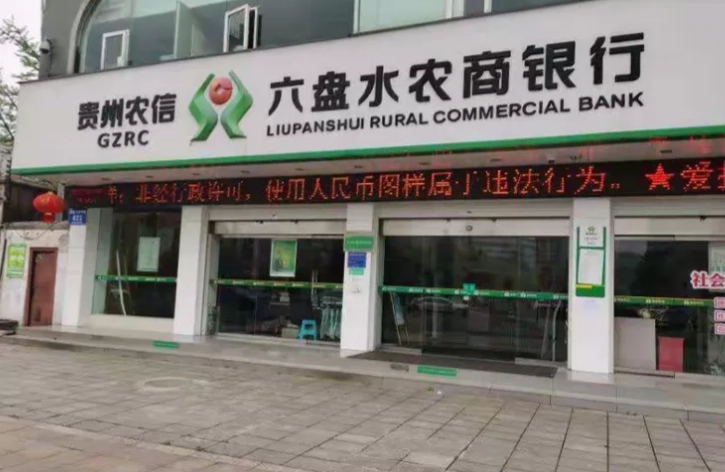
Nearly 2 Billion Yuan Capital Restructuring of Liupanshui Rural Commercial Bank: Southwest Rural Credit Risk Resolution and Asset Integration
Liupanshui Rural Commercial Bank undergoes nearly 2 billion yuan capital restructuring, with provincial and municipal state capital jointly resolving existing risks, integrating county-level institutions, and reshaping risk control and credit systems.
When a rural commercial bank with registered capital approaching two billion yuan was formally registered in a major southwestern city, dismissing it as just another routine expansion by a local financial institution would be to completely underestimate the deeper debt-resolution logic and financial de-risking intent behind this capital restructuring. The establishment of Guizhou Liupanshui Rural Commercial Bank Co., Ltd. with a scale of nearly 1.992 billion yuan is by no means aimed at launching a new round of blind expansion in the credit market. Rather, against the backdrop of deepening rural credit cooperative reform and preventing and defusing risks at small and medium-sized local financial institutions, it represents a coordinated effort by provincial and municipal capital to clear legacy burdens and restructure creditworthiness.
For a long time, Liupanshui, as a resource-based city, has seen its underlying financial system come under enormous asset quality pressure amid industrial transformation and slowing investment. County-level rural credit cooperatives and other micro legal entities have long suffered from dispersed equity structures and weak internal controls, with their asset sides weighed down by substantial loans to local government financing platforms, non-performing assets tied to real estate and mining, and complex interlocking private guarantees.
In a cycle of slowing economic growth and accelerated credit risk exposure, small-scale grassroots rural credit cooperatives with feeble risk-resistance capacity can easily evolve into localized liquidity risk points. Consolidating weak institutions scattered across districts and counties into a unified municipal-level rural commercial bank through top-down administrative coordination and capital injection is the most effective lever available to regulators for interrupting risk transmission and repairing balance sheets.
Equity tracing: interlocking interests of provincial and municipal state capital with industrial capital
Examining the capital foundation of this new entity through the underlying equity structure, the interlocking interests between provincial and municipal state capital and industrial capital are extremely tight. Tianyancha equity information shows that Guizhou Liupanshui Rural Commercial Bank is jointly held by 14 shareholders, bringing together not only provincial-level core credit hubs such as Guizhou Provincial State-owned Capital Operation Co., Ltd. and Guizhou Rural Commercial Joint Bank Co., Ltd., but also local public utility state-owned enterprises like Liupanshui Water Affairs Co., Ltd., as well as market-oriented entities such as Guizhou Mo'er Investment.
The equity matrix captured by Tianyancha clearly illustrates a typical multi-tiered risk-sharing model: the entry of provincial state capital and the provincial rural commercial joint bank directly endows the new bank with high-level credit endorsement and risk-control guidance authority; the participation of quality operating state-owned assets such as municipal water utilities injects stable cash flow and underlying assets into the bank; and the involvement of private investment institutions formally satisfies the statutory governance requirements of mixed ownership.
Capital restructuring: expanding the net asset base to absorb the non-performing loan black hole
The fundamental purpose of this combination of capital measures is to forcibly absorb the black hole of historically accumulated non-performing loans by expanding the net asset base. Registered capital of nearly two billion yuan can directly boost the institution's capital adequacy ratio, granting it valuable negotiating power and a strategic buffer period when facing regulatory assessments and provisioning requirements. More critically, with Guizhou Rural Commercial Joint Bank rolling out unified management and clearing networks across the province, the newly established Liupanshui Rural Commercial Bank will completely abandon its previous fragmented, free-wheeling operational state and be brought under a more rigorous, digitized internal control framework covering credit approval, large-ticket lending, and risk pricing.
Risk warning: capital accumulation alone cannot change true debt-servicing capacity
However, packaging the old debts of multiple districts and counties into a brand-new legal entity shell is merely the first step in this restructuring campaign. Capital accumulation can quickly polish paper financial metrics, but it cannot instantly improve the region's true debt-servicing capacity. If the new bank fails to completely sever excessive administrative interference in credit allocation and remains dependent on traditional infrastructure and collateral-based lending in subsequent operations, then this substantial capital pool assembled by provincial and municipal governments could still be eroded again by a future rebound in non-performing assets.
The debut of Guizhou Liupanshui Rural Commercial Bank is a landmark footnote in the process of resolving accumulated financial risks in the southwest. It sends a clear signal to the market: in the deep waters of regional financial liquidity tightening, the era of small, scattered legal entities scraping by is over. Only through iron-fisted equity consolidation, the introduction of high-caliber state capital as ballast, and the reshaping of risk-control logic within a stringent institutional framework can small and medium-sized banks preserve their final liquidity lifeline through the harsh cycle of change.