Liangpin Puzi has increased its capital to nearly 400 million yuan and reshuffled its board, as its self-rescue through price cuts faces profit losses and supply chain restructuring challenges.
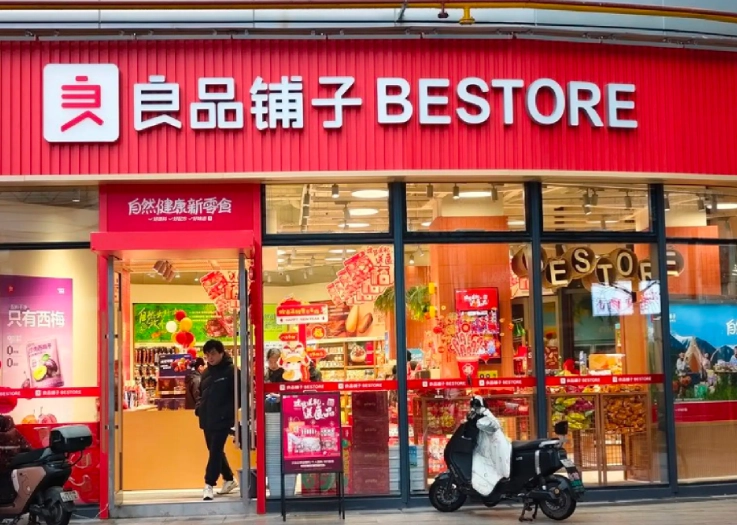
Against the backdrop of bulk snack retailers sweeping across China's lower-tier markets with an extremely brutal price offensive, Bestore, once firmly seated in the top spot among high-end snack brands, quietly completed a business registration adjustment in late autumn that concerns both its capital foundation and its center of power. The company's total investment increased from 360 million yuan to approximately 398 million yuan, a gain of 10.55%, accompanied by a key reshuffle of core board seats.
This nearly 40 million yuan capital injection is by no means a routine financial statement embellishment. Rather, it is a breakwater that this snack giant founded in Wuhan is trying to build for the deep waters of its transformation through capital reinforcement and a board reshuffle, amid a brutal cycle in which it has resorted to across-the-board price cuts to survive and its channels have been besieged by bulk retail systems such as Mingming Henmang.
Following the traces left in the business registration underpinnings to penetrate the equity foundation of this established fast-moving consumer goods giant, its capital lineage is clearly preserved in Tianyancha records. Tianyancha business registration data shows that Bestore Co., Ltd. was established in August 2010, with Cheng Hong as its legal representative, and its business scope broadly covers the entire traditional fast-moving consumer goods chain, including bulk food, prepackaged food, and the wholesale and retail of agricultural and sideline products. In the shareholder roster penetrated by Tianyancha, core entities such as Ningbo Hanyi Venture Capital Partnership and Ningbo Liangpin Investment Management Co., Ltd. are closely entrenched, jointly controlling the central hub of control over this listed company.
However, an even more telling change lies in the filing replacements among senior management. Former director Wang Jiafen has exited, and Ma Teng has formally joined the board.
As a celebrated figure in China's fast-moving consumer goods and retail sectors, Wang Jiafen once led multiple rounds of modern corporate system reform in the traditional retail system in her role as the "iron lady" of Bright Dairy. Her departure and the new director's entry directly reflect a profound shift in the focus of Bestore's internal governance: the old experience centered on channel premiums and big-brand storytelling has already lost its original guiding halo amid the storm in which current consumer behavior has thoroughly embraced extreme cost-effectiveness and direct factory-to-consumer sales of white-label goods.
What has taken its place is an executive team with hands-on operational capabilities in more aggressive supply chain cost reduction, refined product selection, and channel disintermediation.
This dual variation of capital and personnel precisely corresponds to the triple commercial tug-of-war in which Bestore is deeply entangled.
The first is the collapse of its high-end mindshare and the profit bleeding after across-the-board major price cuts. Over the past several years, Bestore relied on high-quality nuts, exquisitely packaged gift boxes, and prime locations in shopping malls to support extremely high brand gross margins. However, as the snack industry moved from incremental growth into a battle for existing stock, bulk snack collection stores halved the prices of core nuts and preserved fruits to the bottom line with a playbook of "white-label direct sourcing, small profits but quick turnover, and community encirclement."
Although Bestore quickly rolled out the self-rescue banner of its "largest-scale price cuts in 17 years" after a management change, with an average price reduction of more than 20%, after terminal prices plunged, the per-store gross profit that originally supported high store rents and a vast franchise supervision system was rapidly thinned out. Capital increase and share expansion became a rigid backstop for stabilizing the debt-to-asset ratio and maintaining supplier credit.
The second is the collapse of sales per square meter as the traditional large direct-operated and franchise store model faces close-quarters combat with bulk stores. Compared with平价 snack stores rapidly proliferating in streets and alleys, Bestore's hundreds to thousands of offline stores face high decoration depreciation and rigid employee expenses. Although discounted individual products have brought back some foot traffic, the increase in units sold cannot fully offset the sharp shrinkage in average customer spending.
How to reshape franchise contracts and procurement rebate mechanisms without harming the interests of existing franchisees is a real problem that urgently needs to be resolved behind this capital increase.
The deeper ailment lies in the absolute constraints that the OEM model places on supply chain bargaining space.
Bulk snack giants place cash-and-carry orders directly with source factories through the scale of thousands to tens of thousands of stores, and can still achieve extremely rapid turnover even after compressing gross margins to single digits. Although Bestore holds multiple core product selection standards, a large number of its underlying products still rely heavily on OEM factories for white-label production. When fluctuations in upstream raw material prices combine with two-way squeeze from downstream price wars, the OEM factories' own profits have already been squeezed dry. Bestore must both maintain strict quality control standards and forcibly fight price wars with white-label goods, leaving its buffer space in the middle extremely narrow.
This autumn's capital infusion and board reshuffle send the most severe warning to China's entire leisure snack sector: the golden age of earning high gross margins through brand premiums and information asymmetry has completely ended, and the endgame of the snack business is ultimately a contest measured in millimeters over supply chain costs and inventory turnover efficiency. Using real gold and silver to increase capital and expand shares has won Bestore a precious breathing window in the quagmire of price cuts.
But if it cannot complete a bottom-level reconstruction between the OEM model and direct sourcing from the source, relying solely on book capital increases and executive rotations will still not be enough to stop the all-out encroachment of the low-price storm on the traditional snack empire.