Kunlun Wanwei says heterogeneous data can cost as little as 10 yuan per hour, versus 2,000 yuan for real robot data, using game scenes and video clips to build world models and lower the barrier for multimodal AI training.
At the WAIC event on July 19, Fang Han, Chairman and CEO of Kunlun Wanwei, made a remark that didn't cause much of a stir at the time, but on closer reflection, it's quite interesting.
He said: The cost of collecting real-world robotic data is 500 to 2,000 yuan per hour. The current cost of heterogeneous data is less than 50 yuan, with a target of reducing it to 10 yuan per hour.
This isn't just about showing off cost control—it reads more like a statement of technical direction. If data costs can be driven down to one-tenth or even one-twentieth of current levels, the data moat in this industry no longer holds.
 Fang Han, Chairman and CEO of Kunlun Wanwei
That same day, Kunlun Wanwei released three product lines: the Riemann Robot Model 1.0, the world model Matrix-Game 3.5, and the music model Mureka v9.5 & O3. The two lines may seem divergent, but they both point to one core question: Can heterogeneous data replace real-world data and prove viable in the multimodal AI era?
This is a deliberate strategy, and the key card happens to be hidden in Kunlun Wanwei's most unassuming identity: it's an AI tech company that started out in gaming.
The Foundation Built by the Gaming Business
Most people still remember Kunlun Wanwei for its work in gaming, browsers, overseas expansion, and social products. But looking at the company through the lens of AI training data, you'll find a foundation that's hard for others to replicate.
1,200 game scenes and 5 million video clips.
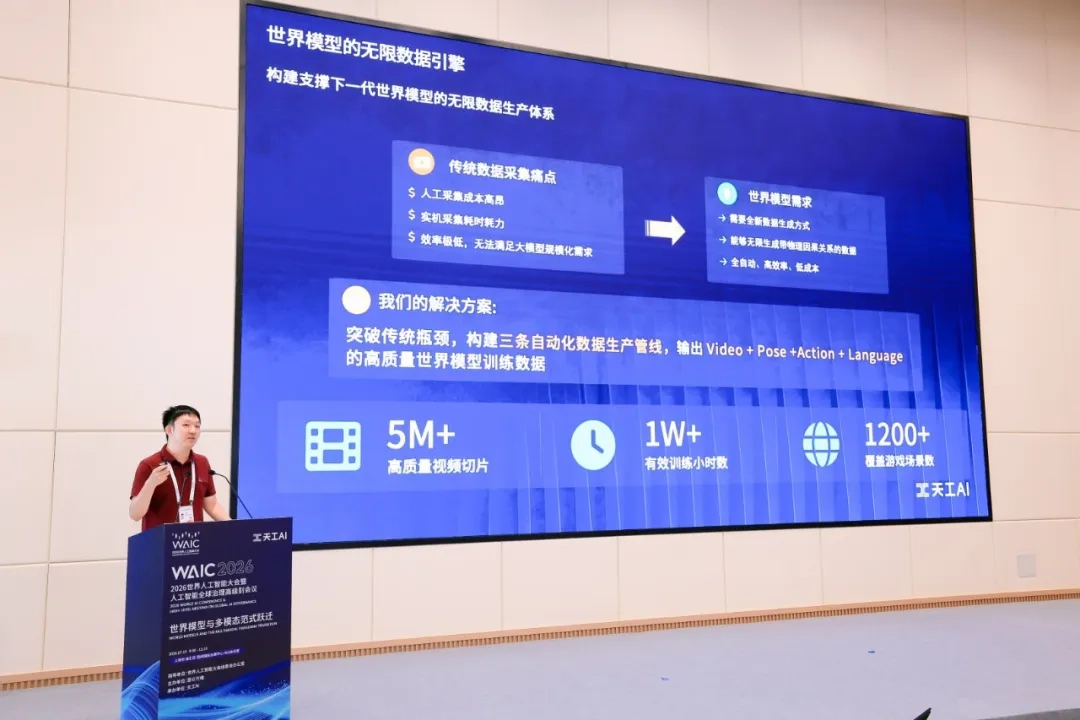 Cheng Yu, Chief Scientist at Skywork, presenting the world model Matrix-Game 3.5
These two numbers are worth examining closely. The 1,200 game scenes cover indoor spaces, streets, outdoor terrain, industrial settings, commercial venues, and more—assets accumulated over more than a decade of running the company's gaming product lines. These scenes were originally designed for gameplay, but from an AI training perspective, game scenes happen to possess what synthetic data is hardest to construct: diversity.
The 5 million video clips come from a different direction. Kunlun Wanwei built a pipeline that automatically mines internet gaming videos, uses VLM scoring to filter for high-quality segments, and then automatically splits them into shots, which become training material for video generation models. The value of these video clips lies in the fact that they carry real-world motion patterns: how people walk, how objects fall, how lighting changes over time. This information is difficult to fully recreate with pure game engine rendering.
The two sources combine to form heterogeneous data: game-rendered scenes provide diverse 3D environments and controllable physics parameters, while real video clips provide real-world motion dynamics. The goal of mixed training is to let the model learn from both types of data simultaneously.
The process of generating data from game engines is far more complex than the phrase "rendered scenes" suggests. Each game scene requires semantic annotation first—interactive objects, navigation areas, and occlusion relationships are each labeled in layers. Then, virtual cameras are programmatically controlled to move through the scene, capturing footage from different angles and lighting conditions to generate training data with action labels. Randomized parameters are key: lighting conditions, object materials, and camera viewpoints all need deliberate random variation to prevent the model from only recognizing the specific art style of a particular game. The compute cost of this pipeline itself isn't high, but building the annotation and randomization infrastructure takes time—that's the real barrier behind the 10-yuan cost.
Matrix-Game 3.5's data system goes beyond this. Among its three existing production pipelines, one is built on Unreal Engine, introducing agent-based autonomous exploration for millisecond-level synchronized data collection; another handles automated control and data collection for AAA commercial games like GTA V, Red Dead Redemption 2, and Cyberpunk 2077. The three pipelines work together to cover the full spectrum from controllable synthetic data to real-world material, which also explains the origins of the 5 million clips and 1,200 scenes.
10 Yuan vs. 2,000 Yuan: What Holds Up and What Raises Questions
10 yuan versus 2,000 yuan sounds impressive at first glance, but when you dig into it, some parts hold up well, while others deserve a second look.
The 1,200 game scenes and 5 million video clips are the product of years of gaming business accumulation—an asset moat that other companies would struggle to replicate in the short term. You could buy a game engine and generate synthetic data, but scene diversity and accumulated scale aren't something you can catch up on in a year. The heterogeneous data strategy has also already produced measurable results in actual training.
The questions are on the other side.
Are 1,200 scenes enough? Kunlun Wanwei didn't elaborate on this in its public announcements. Whether the number of scenes is sufficient to cover different deployment environments such as factories, hospitals, and homes hasn't been independently verified by third parties. The evaluation standards for training data, environmental complexity, and baseline comparison methods weren't disclosed in detail either, and all of these factors affect the reliability of the conclusions.
The more fundamental issue is the physical gap. Game engine physics simulations have matured considerably over two decades of development, but there's still a gap between game physics and the physical complexity of real environments. Fabric deformation, liquid flow, and non-rigid body collisions are often computationally compromised approximations in games. If video world models need to support real-world physical reasoning, the transfer error between simulation and reality, once amplified, will show up directly in generation quality. Currently, there isn't enough public data to quantify how large this gap is within Kunlun Wanwei's system—this hole hasn't been filled yet.
There's also a structural issue: heterogeneous data covers the training distribution, but the long-tail scenarios in real deployment environments barely exist in the training set. A rare part shape in a factory, a specific floor material in a nursing home—these scenarios are almost never present across 1,200 game scenes. Part of the reason real-robot data is expensive is precisely because it can systematically capture these edge cases that synthetic data misses. The 10-yuan strategy can handle common scenarios, but whether it can cover the long tail remains an open question.
What Problem Is Matrix-Game 3.5 Solving?
Long-sequence consistency is the hardest hurdle in video generation. By the time the model generates frame 100, it often has already forgotten the details in a corner of frame 1.
Matrix-Game 3.5's solution is called patch memory: explicit memory units are introduced inside the model, with each unit corresponding to a spatial patch in the scene. When generating a new frame, the model first queries the memory for the corresponding patch, then combines it with current context to generate content. Memory reads and writes are local and sparse, keeping computational cost manageable, while local consistency in the scene is explicitly maintained. No matter how the camera moves, object positions and spatial relationships in the frame stay stable and coherent. The technical specs are 5 billion parameters, 720p resolution, 20 frames per second, with real-time generation achievable on a single card—meaning the model already has real-time interactive capability.
Training is done in three stages.
The first stage is causal adaptation, using game scene data for domain adaptation to establish a mapping foundation between synthetic and real distributions. The second stage is consistency distillation, using multi-step distillation to accelerate and compress the diffusion model's sampling process. The third stage is distribution matching distillation, using real video data to calibrate the model's deviations in motion smoothness and physical plausibility. To put it simply: first, let the model learn the rules in the game; then, compress the sampling process through multi-step distillation; finally, calibrate perception with real video. After these three steps, the model has both the diversity that comes from synthetic data and the perceptual calibration from real data.
Within the world model framework, patch memory is meant to let the model maintain a continuously self-consistent state of the physical world—a distinction that's critical for downstream applications that need to understand physical causality. But whether this state can truly achieve physical fidelity is a question that no current world model has yet answered definitively.
At the launch event, Huang Xiaoming mentioned watching an AI-generated film made by a friend, and Wang Luodan shared her experience of using AI to create short films, saying she once stayed up drawing random generations until 4 a.m., repeatedly adjusting the visual results. The two examples show that video generation has progressed from "watchable" to "usable," capable of supporting the industrial-scale production of entertainment content. For Kunlun Wanwei, this commercial path is familiar: first train the model on game scene data, then use the model to generate entertainment content, and let the entertainment content in turn validate the model's practicality.
What Problem Are Mureka v9.5 & O3 Solving?
From the SkyMusic 1.0 beta to Mureka v9.5 & O3, Kunlun Wanwei's music model has followed a path from "a complete piece" to "controllable creation" and then to "multimodal creation." The early SkyMusic mainly validated one thing: can AI generate a song that sounds like a legitimate track? The bar at that stage was low—as long as it produced sound, had a melody, and didn't distort, it passed. Later, with successive versions, Kunlun Wanwei shifted focus from "generation quality" to "creative controllability," letting the user's intent be accurately reflected in the final music. Mureka v9.5 is the current milestone on this path.
v9.5's label is "the AI music with the least AI flavor," and that positioning is itself a judgment. The biggest problem with current AI-generated music isn't whether it can produce sound—it's that it sounds like AI. The root of this "AI flavor" is that most music generation models treat generation as a one-shot forward pass: input a prompt, output audio, with no process of review or refinement in between. Arrangements tend to be over-layered, emotional dynamics lack depth, and the overall texture feels stiff.
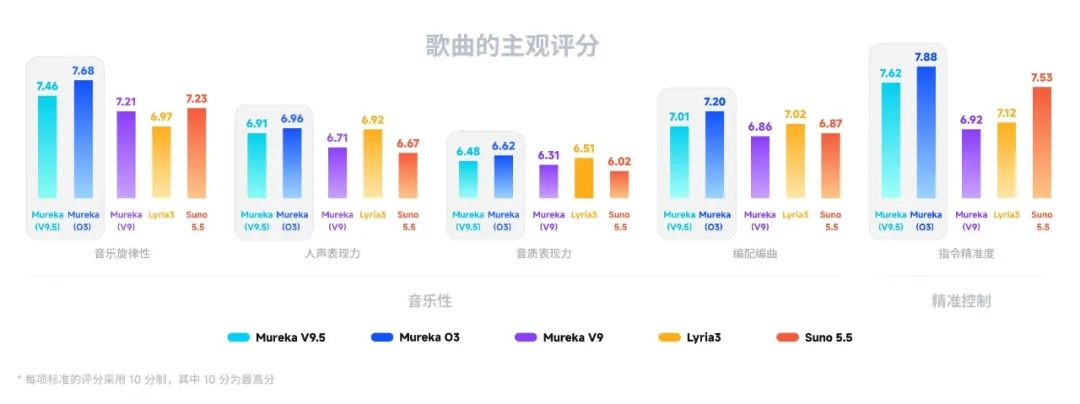 Subjective scoring of songs
Mureka v9.5's technical approach is called MusiCoT. CoT stands for Chain-of-Thought, a concept originally from the language model field, referring to having the model explicitly work through reasoning steps before arriving at a final answer. MusiCoT transfers this logic to music generation: before outputting the final audio, the model first generates a path describing the musical structure and emotional progression, then generates the audio content based on that path. This path acts as an internal creative outline, locking in the song's section structure, instrument layers, and emotional arc, with subsequent audio generation unfolding within that framework. Based on evaluation results, v9.5 shows across-the-board improvements in melody, vocals, sound quality, and arrangement, with instruction accuracy rising from 6.92 to 7.62. It no longer treats "fuller and more complex" as the only standard, but instead handles arrangement and emotion more sparingly within a realistic musical framework.
The further O3 version builds on MusiCoT by introducing a higher reasoning compute budget, giving the model more room to deepen its process during the inference stage. Applied to music generation, O3 continuously reviews during generation whether the current expression aligns with the established emotional and structural goals, correcting itself when it doesn't, until the generated result aligns with the internal path. This is the same line of thinking as Matrix-Game 3.5 using patch memory to maintain consistency—both turn generation from a single forward pass into a feedback-driven process with explicit self-supervision. The cost of MusiCoT plus test-time scaling is higher inference cost, but for music scenarios that require highly customized output and strong emotional expression, that cost is worth paying.
At the product level, Mureka has evolved from a single model into a complete creation platform. The multi-version creation feature lets the same idea quickly generate multiple versions, with users able to preserve and swap elements across melody, vocals, and structure to pick the line closest to their vision and refine it further. The Character feature lets users create a dedicated artist persona from a voice clip or a photo, spanning the full pipeline from songs to music videos—addressing the issue of AI music personalization. AI scoring automatically analyzes a video's scenes, actions, and emotions to generate music that fits the content better. Mureka Agent is an integrated entry point that lets users invoke all capabilities—generation, remixing, extension, MIDI export, and more—through a single natural language conversation, with no need to switch interfaces. Together, these features are aimed at lowering the barrier to creation.
The Direction Has Logic, but the Gaps Remain
The physical gap between synthetic data and the real world, and the long-tail scenarios that game scenes can't cover—these two issues currently have no public answers. The 10-yuan strategy is a convincing direction, but it's not yet a fully validated conclusion.