Kuaimal Food Relaunches with New Leadership and 890M Heavy Asset Bet on Instant Retail Efficiency
Ele.me's Kuaimal Food has changed leadership, placing a 890 million yuan heavy asset bet on instant retail, shifting from traffic dividends to self-operated efficiency, focusing on supply chain costs and profitable models.
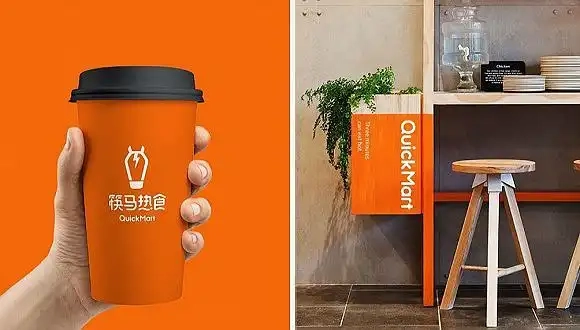
As the food delivery boom peaks and instant retail shifts entirely into hardcore supply chain competition, the "secret legions" under major tech giants are facing their coldest round of personnel and strategic restructuring. Recently, business registration data from Tianyancha showed that a core entity under local life services giant Ele.me — Shanghai Zhuan Shan Culture Media Co., Ltd. — underwent a seemingly low-key but highly consequential industrial and commercial change: Jia Su stepped down as legal representative, succeeded by Zhou Guanghao.
This change at the helm of a core subsidiary instantly thrust "Kuai Ma Hot Food" — a super chess piece hidden within the local life services infrastructure — back into the spotlight of capital reckoning.
Many observers are accustomed to viewing Ele.me through the lens of pure food delivery or shelf-based e-commerce, and tend to dismiss this subsidiary leadership change as routine management turnover. Such a superficial reading completely underestimates how Alibaba Local Life Services Group is restructuring its defense lines around offline instant hot food and instant retail (near-field e-commerce) while locked in close-quarters combat with Meituan Flash Purchase, Xiaohongshu, and Douyin's same-city grocery operations.
To see through the deeper causes and interest chains behind this leadership handover, one must use Tianyancha to penetrate the capital-beast nature of this newly changed entity.
This company, named "Shanghai Zhuan Shan Culture Media," operates under the well-known brand "Kuai Ma Hot Food." Digging into its foundation, its registered capital of 890 million RMB is staggering, and it is 100% wholly owned and controlled by Ele.me's parent entity — Lazada Network Technology (Shanghai) Co., Ltd. Beyond its business scope in cultural media and organizational cultural exchange — which sounds extremely asset-light — its real profit engine lies in internet sales and its high-density offline deployment of physical hot food outlets.
Why would a heavy-duty main force holding nearly 900 million RMB in capital choose to change its top leader at this moment?
The core driver points directly to the technological inflection point and survival pressure of the instant retail industry shifting from "traffic dividends" to "self-operated efficiency." Traditional local life platforms merely act as "asset-light matchmaking intermediaries," profiting passively by charging merchant commissions and delivery fees. But in the high-frequency, high-ticket, experience-heavy hot food and instant fulfillment track, the delivery speed and quality-control friction of traditional food delivery can no longer satisfy the increasingly discerning consumption rigidity of today. As a new retail self-operated brand incubated by Ele.me, Kuai Ma Hot Food's core logic is to throw heavy assets at offline smart hot food micro-fulfillment centers and supply chains, compressing the delivery time of a hot meal to just over ten minutes.
In this deep-water zone demanding refined cost extraction and supply chain restructuring, former head Jia Su leaned more toward product and strategy-level initiation and incubation. The newly appointed Zhou Guanghao, however, must confront harsher financial metric reckoning — how to rapidly convert the nearly 900 million RMB in massive upfront investment into a long-term viable per-store profitability model and healthy cash flow recovery, all while squeezed by sky-high rents and delivery costs in first-tier cities.
When the growth myth of public-domain traffic collapses, what tests a tech giant's long-term endurance is no longer the DAU frenzy inside its app, but its precision in cost control across every micro-fulfillment center and every hot food supply chain link.
The 890 million RMB registered capital is both Ele.me's deepest moat and a heavyweight gamble it cannot afford to lose. This leadership change at Kuai Ma Hot Food is a clear strategic gear-shift signal: the second half of the local life services civil war has fully abandoned the barbaric era of subsidizing markets. Whoever can first complete team and efficiency cost-reduction overhauls deep within the muddy offline supply chain will be the one who truly stabilizes profit flows across the entire industry chain in the coming battle for near-field dominance.