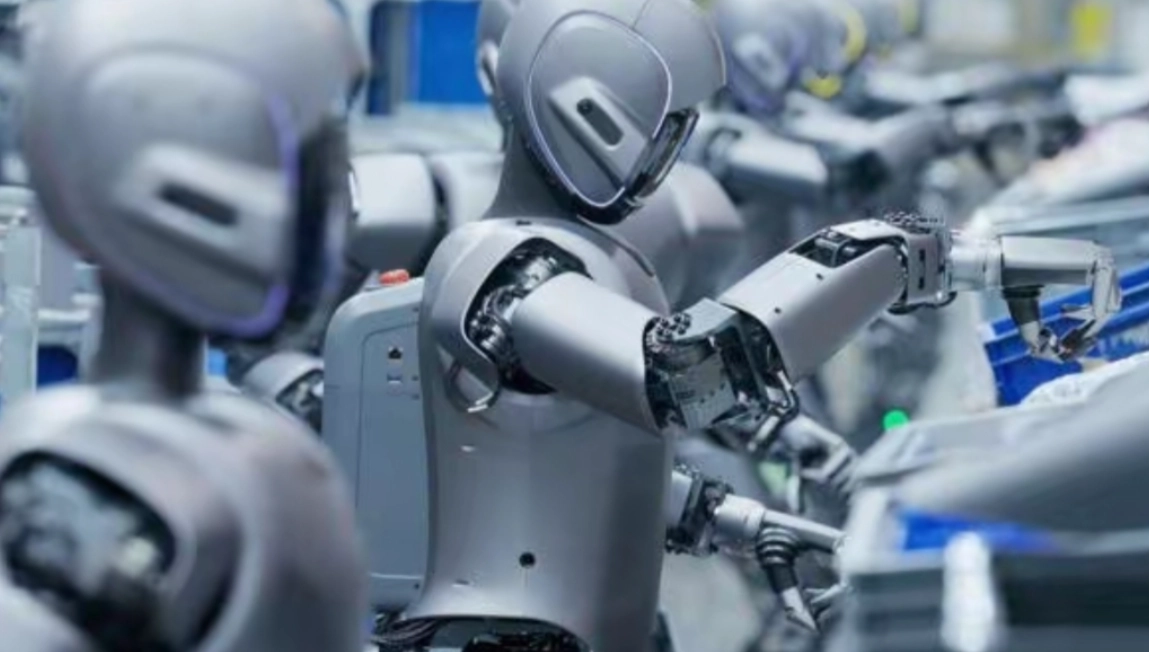
Cyborg Workers Hit the Factory Floor: Flexible Stand-ins Forced by Extreme Cost Pressures and a Million Fake Frenzies
Humanoid robots entering factories are actually a flexible production self-rescue driven by cost pressures. A million companies flooding in hides bubbles, and data sovereignty becomes a life-and-death challenge.
When humanoid robots from Xiaomi and AgiBot start moving materials and inspecting battery cells on car assembly lines, public discourse is all too eager to dress this up as a futuristic tech-industrial experiment. Peel away that idealistic veneer, however, and this is hardly some early arrival of cyberpunk — it's a brutally cold-blooded supply chain survival maneuver, forced upon domestic new-energy automakers locked in a cutthroat price war, as they squeeze single-vehicle manufacturing costs and production line retrofit expenses to their physical limits.
Traditional automobile manufacturing has long achieved a high degree of robotic arm automation. But those industrial devices bolted permanently to the floor carry an inherent fatal fragility: they are rigid, single-purpose machines. In the past, a gasoline-powered model could sell for five years without a redesign, making the return on investment for dedicated production lines extremely high.
But in today's red-ocean new-energy market, vehicle model lifecycles have been brutally compressed to twelve months or even less. Every redesign entails retrofit costs for non-structured scenarios running into tens of millions of yuan, with timelines measured in months. The entry of humanoid robots precisely targets this pain point of "flexible manufacturing."
They don't require tearing down and rebuilding physical production lines; they can directly fill the gaps in non-structured scenarios that are dirty, hazardous, or difficult. This logic — replacing hardware reconfiguration with software iteration — is the underlying driver that makes automakers willing to tolerate currently exorbitant hardware costs, even opening their factories for robots to undergo real-world testing.
But with a promised land of 750,000 units in deployment demand, the breakneck capital markets are now inflating an enormous industrial bubble.
Millions of players flood in, an industrial bubble emerges
Examining this idol-making movement through the macro business registration records compiled by Tianyancha reveals an extremely fractured industrial reality. Tianyancha Pro data shows that the number of currently active robot-related enterprises in China has surpassed 1.165 million, peaking in new registrations in 2025. More than a million players flooding into a track where core underlying components remain unconquered and commercial closed loops are still being explored defies common sense in itself.
By geographic distribution, Guangdong, Jiangsu, and Shandong account for over 40% of the enterprise share. This further confirms that the vast majority of this million-strong army lacks the R&D capability for underlying AI large models and complex gait algorithms. In essence, they are traditional metal fabrication, servo motor, and system integrator firms from the Yangtze River Delta and Pearl River Delta, draped in a "humanoid robot" guise, engaged in a collective arbitrage and subsidy hunt driven by capital FOMO and local investment-attraction policies.
Data assets: The real make-or-break challenge
Setting aside the inflated numbers on the manufacturing side, the true life-or-death challenge for humanoid robots entering factories lies hidden in invisible data assets.
The industry's biggest bottleneck right now isn't the hyped-up cost of dexterous hands — it's the severe scarcity of high-quality interaction data. For humanoid robots to evolve from "being able to move" to "being able to work," they must be fed massive amounts of real-world operational data to train embodied intelligence large models. But for leading automakers, core production line process parameters, material takt times, and error data are absolutely confidential business secrets.
This creates an extremely delicate game of interests: robot companies are desperate to enter automaker production lines to "suck blood" — collecting data for free to iterate their large models — while automakers guard against leakage of core data, trying to reduce robot companies to nothing more than pure hardware contract manufacturers. Unless the automakers' data blockade can be broken, or a viable mechanism for data rights confirmation and profit-sharing is established, the vast majority of robot companies lacking real-scenario data feeding will end up as nothing more than expensive, exquisite toys that do backflips at trade shows.
Using humanoid devices to reshape the intelligent manufacturing ecosystem is, at its core, a reshuffling of control over factory floor operations and data sovereignty. On this capital assembly line riddled with calculations, the survivors will not be the million integrators who merely piece together hardware, but the data plunderers who can truly break through scenario barriers and drive embodied intelligence deep into the dust of the workshop floor.