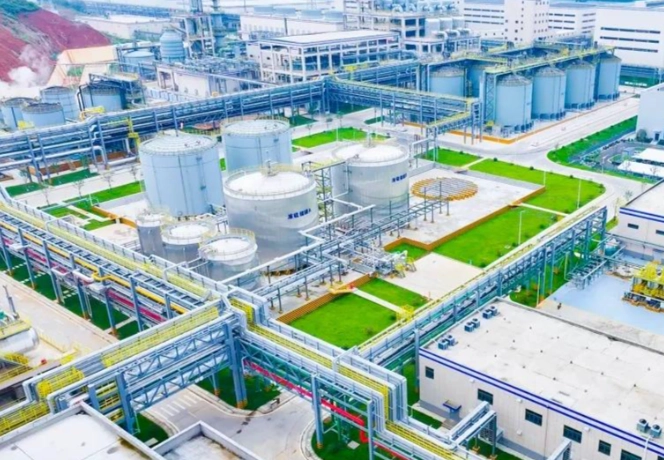
Billion-Dollar Chemical Hunt: The Phosphate Calculus and Capacity Reshuffle Behind Hubei Yihua Chuxing Ecology's Doubled Expansion
Hubei Yihua increases capital in Chuxing Ecology to 1.7 billion yuan, leveraging heavy assets to monopolize phosphate resources, squeezing small and medium chemical enterprises, and accelerating industry oligopolization.
When Hubei Yihua dramatically increased the registered capital of its subsidiary Chuxing Eco-Technology from over 700 million RMB to 1.7 billion RMB—more than doubling it in a stunning expansion—capital markets that dismissed this as just a routine financial adjustment completely missed the extremely aggressive land-grabbing logic currently driving major chemical giants in an oversupplied, red-ocean market. With traditional fertilizers and basic chemicals facing severe overcapacity, and environmental regulators tightening the screws with each passing day, pouring nearly one billion yuan of real money into a regional sub-entity is far more than simply expanding a few urea or ammonium phosphate production lines.
This is a survival war disguised as an eco-technology play, using extreme heavy-asset barriers to monopolize upstream resources and crush smaller competitors.
For a long time, outsiders have typically viewed legacy chemical giants like Hubei Yihua as stuck in low-value-added agricultural chemical sectors. But the real competition has long since shifted to less visible battlegrounds. With new energy materials aggressively consuming upstream phosphorus and fluorine resources, old-line chemical players have awakened to a stark reality: if they cannot move quickly into fine chemicals and new materials, their fertilizer core business will eventually be shattered by cost pressures.
And the biggest obstacle to making that leap is not technology—it is the strict control local governments exert over core mineral resources and energy consumption quotas.
In the calculus of local governance, cheap mining rights are no longer being approved in a loose, indiscriminate manner. For a giant to secure the most critical phosphate mine allocations and new energy consumption permits, the only bargaining chip is a massive commitment of real investment, coupled with the establishment of a high-tech-labeled industrial park.
Tracing the corporate registration changes documented by Tianyancha, the tactical mission of the Chuxing Eco-Technology entity becomes crystal clear. According to the underlying data from Tianyancha, this wholly owned subsidiary of Hubei Yihua was established in late 2023, initially serving as an early chip to lock in regional project quotas. Within its registered business scope, alongside traditional chemical products and fertilizer sales, a core hidden line was quietly inserted: new materials technology R&D.
In just over two years, the registered capital has suddenly surged to 1.7 billion yuan. This unannounced capital expansion silently signals that the project has moved from paper-based planning and approvals into the physical deployment phase of heavy-asset equipment. This 1.7-billion-yuan foundation is Hubei Yihua's heavyweight pledge of commitment to local governments, securing a death grip on regional chemical resources.
This sudden swelling of capital is also a cold purge of marginal players in the industry.
Today's chemical industry is an extremely exclusive, capital-intensive grind. Environmental equipment upgrades costing over a billion yuan, closed-loop hazardous waste treatment systems, and the introduction of new materials production lines have driven the price of admission far beyond the reach of small and mid-sized enterprises. By concentrating massive capital into Chuxing Eco-Technology, Hubei Yihua is essentially weaponizing its own balance sheet to artificially erect a suffocating financial wall.
Within the same chemical park or resource belt, when a leading company demonstrates such terrifying capital depth and integrated throughput capacity, smaller chemical plants that once relied on reselling raw materials—lacking deep-processing capability and environmental headroom—will completely lose their pricing power for inputs and ultimately be forced to cede market share as their cash flows break.
This nearly one-billion-yuan capital increase tears open the true face of traditional chemical giants in their transition period. The so-called eco-technology and new materials transformation was never a pastoral vision of R&D innovation; it is resource plunder built on the crushing weight of massive capital. As the industry cycle hits bottom in biting winds, Hubei Yihua has used the most primitive and most violent form of capital stacking to buy itself a ticket to the oligopoly table.
In this knife-fighting world of heavy chemicals, there is no nimble overtaking on a curve—only production capacity hegemony hammered out with tens of billions in real money.