13 Billion Capital Reload: The Shipbuilding Supercycle and Capital Battle Behind Hengli Heavy Industry's Surge
Hengli Heavy Industry increases its registered capital to 13 billion yuan, leveraging the shipbuilding supercycle for expansion and building a capital moat to capture the high-end market.
When a listed company shell whose main business was once daily-use ceramics directly raised the registered capital of its heavy-industry assets under its umbrella from 6.9 billion yuan to 13 billion yuan, the nearly 90% capital increase sent enormous ripples through the industrial capital market. This massive capital expansion by Hengli Heavy Industry Group Co., Ltd. is by no means an ordinary bookkeeping numbers game. It represents a heavy saturation attack to seize dominance in the deep-sea arena launched by the private petrochemical giant after completely restructuring the assets of its listed platform, during a super-cycle in the global shipbuilding industry that occurs only once in several decades.
The global shipping and shipbuilding industry is currently undergoing a historic boom driven by old vessel replacement, green dual-fuel power substitution, and the reshaping of geopolitical trade routes. From very large crude carriers and large container ships to high-tech-threshold LNG carriers, berth schedules at major shipyards are already locked in years ahead. However, modern large-scale shipbuilding is a quintessential capital-devouring heavy industry.
The construction cycle of a large vessel with capacity for over ten thousand TEUs often spans several years. The front end requires enormous upfront capital for steel plate procurement, main engine sourcing, and dry dock expansion, and additionally requires issuing large-amount advance payment guarantees to shipowners and financial institutions. Without an extremely strong net asset base serving as credit backing, a shipyard simply cannot secure billion-dollar-scale mega orders in international bidding.
Tracing the transformation of this industrial giant through the underlying corporate structure reveals an extremely clear trajectory of capital maneuvering. Tianyancha business registration data shows that Hengli Heavy Industry Group Co., Ltd., established in July 2022, is 100% wholly owned by Guangdong Songfa Ceramics Co., Ltd. Behind this hierarchical relationship captured in Tianyancha lies the record of a complete classic capital operation—from rescuing and revitalizing the assets of the former Dalian STX restructuring back in the day, to completing the securitization and injection of the heavy-industry assets through the listed company.
From an initial startup capital of several billion yuan that was progressively increased to 13 billion yuan, the essence is the deep binding of the parent group's ample funds accumulated from its core petrochemical business with the listed company's financing channels, forging an unbreakable capital moat for the shipbuilding segment.
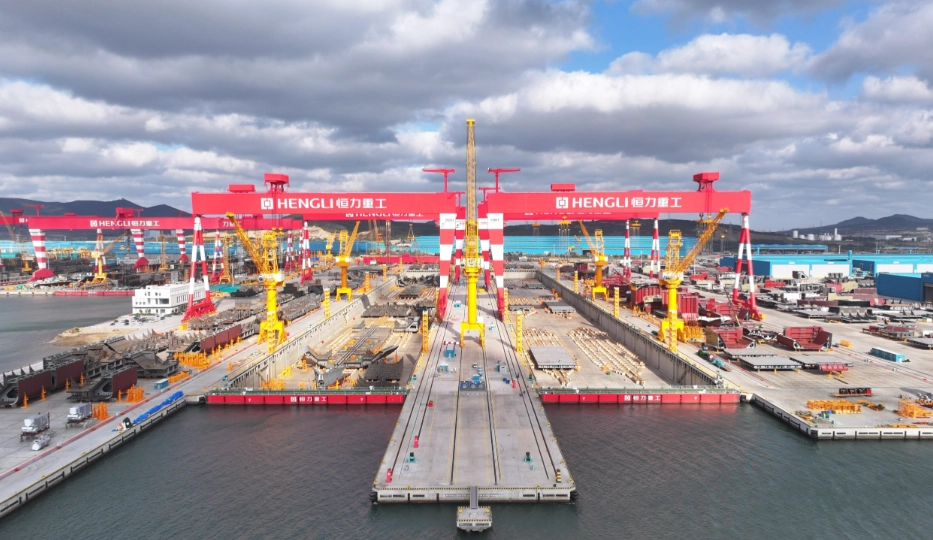
This massive capital injection directly corresponds to the real-world demand for capacity expansion at Hengli Heavy Industry's Changxing Island base. Acquiring idle assets from traditional large shipyards is only the first step. To compete head-to-head with the CSSC-affiliated giants and South Korea's top three shipbuilders in high-end vessel segments, it is imperative to invest real money and resources in ultra-large dry docks, intelligent steel structure processing workshops, and high-end marine engine manufacturing.
Particularly in the core component segment of marine propulsion—a long-standing bottleneck area—Hengli is attempting to build a complete full-industry-chain closed loop, from upstream steel processing and midstream core main engine manufacturing to downstream complete vessel delivery. This heavy-asset, large-formation style of operation must rely on the high credit limits and anti-cyclical capability generated by the massive registered capital.
The shipbuilding industry has long been notorious for its brutal cyclicality, where peak-period frenzied order intake and trough-period cliff-like stagnation are often separated by only a thin line. Hengli's choice to advance at full speed with a heavy posture of 13 billion yuan at the industry's cyclical high point is a high-risk gamble that severely tests strategic resolve. It sends a cold signal to the market: during the window when global shipbuilding capacity is extremely tight, only those who can leverage the most solid capital base to absorb high-value-added orders and deliver high-end capacity at the fastest speed can establish insurmountable scale barriers at the peak of this cycle, and firmly secure a seat at the table among the first tier of private shipbuilders.