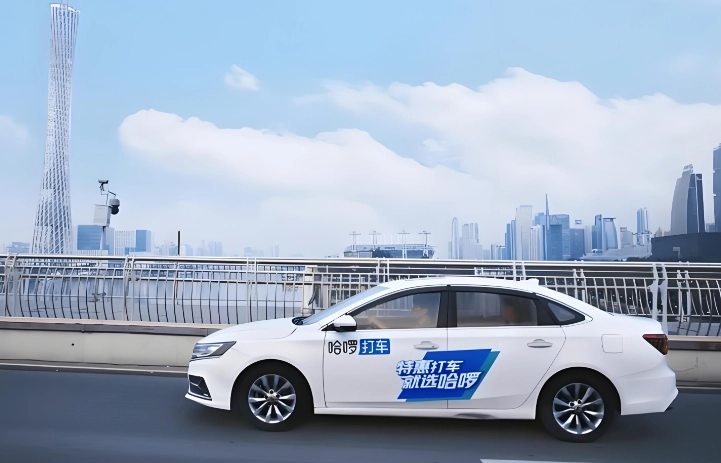
Hello Travel Acquires Insurance Brokerage License: Financial Closed-Loop Battle of the Two-Wheeler Traffic Juice Extractor
Hello Travel fully acquires an insurance brokerage license, channeling its mobility traffic into financial monetization, realizing a profit closed loop from ride fees to financial commissions.
As the street-level battle in the shared mobility sector shifts from fleet size to the exceedingly opaque depths of financial statements, the traffic giant that once scraped by earning a dime or two per ride is now charging with full resolve into the lucrative heartland of financial licensing.
Most onlookers accustomed to scanning a code to unlock a bike and treating Hello as nothing more than a transportation tool tend to interpret this cross-industry acquisition as the standard business expansion of a major internet company. This simplistic reading completely underestimates the long-term profitability anxiety gripping the two-wheeled mobility sector as it grapples with heavy-asset depreciation and the toll of high-frequency dispatch inefficiencies. Shared bikes were never a business you could simply sit back and cash in on—it is, at its core, an extraordinarily expensive traffic-squeezing machine. Hello's aggressive move to secure an insurance brokerage license is not about tacking a few insurance links onto its app. It is an attempt to forcibly channel its massive but low-value mobility traffic into the underlying pipeline of financial monetization.
The real capital transaction blueprint behind this scheme—one that interweaves traffic cleansing and financial harvesting—is buried in the cold, hard data of corporate registry changes. Tracing through the equity restructuring visible on the Tianyancha system, the original shareholders of Sichuan Yi'an Insurance Brokerage Co., Ltd. have been fully removed, replaced by Shanghai Junfeng Network Technology Co., Ltd., a subsidiary under Hello's umbrella, which now holds a 100% controlling stake. This veteran insurance brokerage entity, founded in 2004 with a registered capital of 50 million yuan, has weathered two decades of industry consolidation and possesses a fully compliant operational foundation. Hello did not opt for a trial stake—it swallowed the company outright, laying bare a defensive strategy aimed at severing third-party intermediaries entirely and internalizing the entire insurance premium profit chain.
Why must internet mobility platforms wade into the deep end of insurance?
The core driver is the collapse of marginal returns on traffic monetization.
Under the traditional business model, every accident insurance policy triggered by a user's ride required the platform to pay hefty channel fees to external insurers or brokerage channels. The high-frequency ride orders generated by hundreds of millions of registered users feed a fragmented premium pool of astronomical proportions. In the past, Hello was effectively working for traditional financial institutions, using its own heavy-asset fleet to build someone else's profits. Now, with this hard-won license, Hello directly commands absolute control over product design, pricing power, and commission settlement.
The deeper profit chain lies in the precision feeding of big data. Hello's leverage is not just its two-wheeled bikes—it also spans ride-hailing, four-wheeled car services, and even local living services. A platform that tracks your daily commute routes, consumption radius, and travel frequency every day understands your risk exposure better than any traditional life insurance agent ever could. Once this highly granular behavioral data is connected to an independent insurance brokerage license, it can push customized accident, auto, and even health insurance to hundreds of millions of users in lower-tier markets at near-zero customer acquisition cost. This completes a full species-level evolution—from selling sweat equity by collecting ride fees to selling data and collecting financial commissions.
Traffic always ends at finance, but finance is anchored by licensing.
In an era of tightening regulation and exhausted traffic dividends, this insurance brokerage license backed by 50 million yuan in registered capital is not merely a monetization tool—it is a hardened risk-defense firewall that Hello has welded into place for the even fiercer battles ahead in local living services and mobility. The wild-growth era of internet wealth creation is over. On the table ahead, whoever can first transform the dirty, heavy lifting into compliant financial cash flow will be the one who truly survives the quagmire of heavy assets.