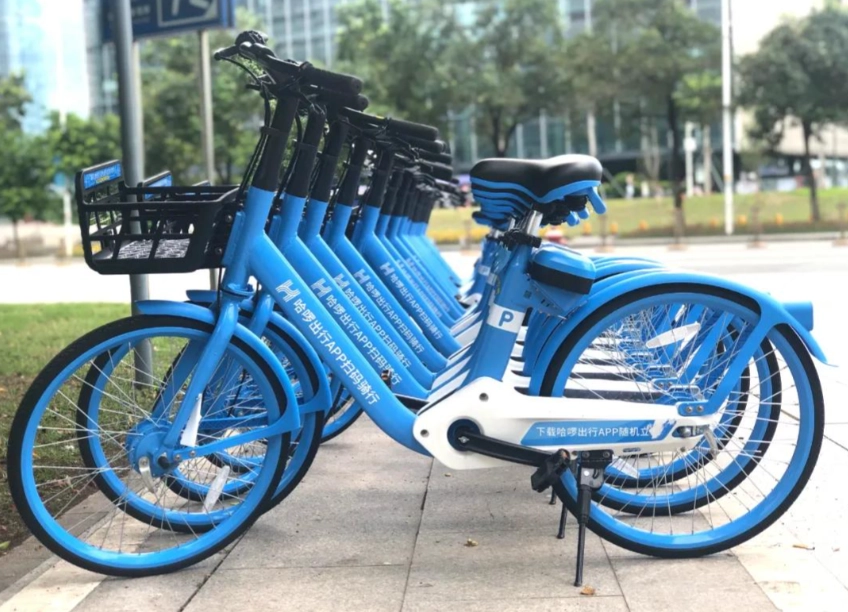
Capillary Warfare in Lower-Tier Markets: The Grid Ambitions and Compliance Firewall Behind Hello's Move into Shanwei
Hello has set up a subsidiary in Shanwei with a registered capital of just one million yuan, using legal isolation and compliance positioning to lay out local ride-hailing and power supply operations, seizing energy franchise rights in lower-tier markets.
When the ride-hailing market in first- and second-tier cities falls into an absolute zero-sum struggle by mid-2026, the battle lines of internet giants are pushing ever deeper into the capillary networks of third- and fourth-tier cities. Recently, Hello TransTech's move to establish a new company in Shanwei, Guangdong, sent ripples through the local life-services track. The new entity, named Shanwei Hajie Network Technology Co., Ltd., boasts an unusually broad business scope, spanning value-added telecommunications, travel services, ride-hailing, and even power supply operations, effectively bundling the entire local micro-ecosystem into one package.
Casual industry observers tend to interpret such moves as the typical regional expansion of a giant acting on inertia. That kind of surface-level, technically correct chatter completely obscures the underlying arbitrage and risk-isolation strategies that shared-mobility platforms are now deploying under the twin pressures of stringent compliance and peak traffic saturation.
A One-Million-Yuan Capital Shell: Dissecting the Legal Isolation Wall Behind Tianyancha
To crack the core code of this downward push, one must cut straight to the top-level corporate structure. According to the latest underlying business registry data on the Tianyancha system, the newly established Shanwei Hajie Network Technology Co., Ltd. holds registered capital of just one million yuan, at the absolute low end, wholly controlled by Hello TransTech's affiliate, Shanghai Hello Puhui Technology Co., Ltd., with Wang Zhixin serving as legal representative.
A paid-in capital of one million yuan is negligible against the vast scale of the mobility market. But that is precisely where the old-school internet giants show their extreme sophistication in asset planning and long-tail risk avoidance.
The non-standard environment of third- and fourth-tier cities is rife with enormous uncertainty, from local enforcement discretion to capacity disputes. If the parent company were to charge directly into local markets, any single maximum penalty from a local traffic authority could easily trigger cross-regional financial contagion. This wholly owned micro-subsidiary, as traced through Tianyancha, is essentially a rock-solid legal firewall erected by Hello. It uses the smallest possible corporate boundary to absorb the brunt of regional operations, strictly capping all uncertain compliance costs and asset wear-and-tear within that one-million-yuan paid-in ceiling, thereby ensuring the absolute safety of the parent company's financial statements.
The Dual Logic of Power Supply and Ride-Hailing: Staking Claims to Local Resource Franchises
What truly exposes the strategic ambition behind Hello's latest move is the inclusion of electricity supply services and online ride-hailing operations within its business scope. The fact that these two licensed categories are packed into a single one-million-yuan company is deeply rooted in the rigid deadlines for local licensing compliance and the underlying restructuring of two-wheeled battery-swapping infrastructure.
Under the current regulatory net, local transportation bureaus have long since closed the gray channel for cross-regional remote operations. To legally deploy ride-hailing capacity in Shanwei, a platform must have an independent local legal entity to apply for a local operating permit. Establishing this subsidiary is the ticket Hello must pay to bring its ride-hailing business to the surface in full legal compliance.
Meanwhile, the targeted positioning of the power supply business fully betrays Hello's commercial calculus of evolving from a pure tool provider into a distributed energy operator. By 2026, traditional bike-sharing ride revenue has long since hit its ceiling. What truly possesses long-term cash-generating efficiency is the battery-swapping and charging network hidden behind the vehicles. By legally embedding power supply within its corporate license, Hello is attempting to upgrade scattered swap-cabinet assets into an institutionalized local micro-grid, converting unstable rental income into a sticky, long-tail energy franchise.
Business evolution has always been ruthlessly unforgiving. The latest Shanwei coordinate Hello has left on Tianyancha stands as a sobering memorandum on how mobility giants use micro-entities to stake claims on local licenses and hunt for resources. In this downward scramble, only players that move first to secure localized compliance and infrastructure binding can tighten the safety line that guarantees perpetual asset cash flow amid tighter regulatory radar and the brutal purge of existing capacity.