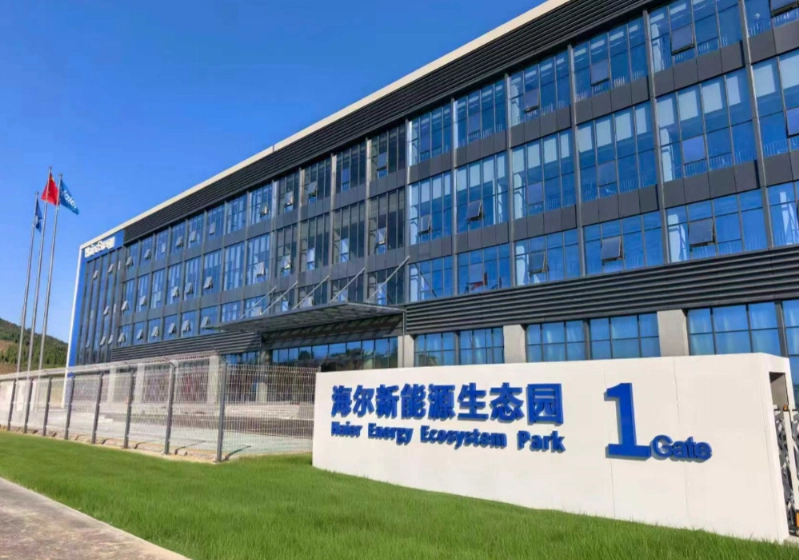
Haier New Energy Plants Flag in Sichuan Amid IPO Push and Market Positioning
Haier New Energy establishes a subsidiary in Sichuan with 500,000 yuan in registered capital, using an asset-light model to tap into the distributed energy market, building scenario-based revenue and asset packages for its IPO sprint.
Home appliance giants are showing increasingly aggressive ambitions in the new energy sector amid the intense competition for market share in mid-2026. As hardware margins in the traditional home appliance segment are steadily squeezed by shipment cycles, the hunt for a second growth curve has evolved from a strategic forward-looking move into a race against time. Recently, Haier New Energy's capital footprint has extended further into the southwestern hinterland. Public business registration data from the Tianyancha app shows that Sichuan Haile Heng New Energy Technology Co., Ltd. has been officially established, with Wang Wucai as its legal representative and a registered capital of just 500,000 yuan. The entity's business scope is precisely focused on solar power generation technical services, technical consulting, and technology promotion, and it is wholly owned by Qingdao Haier Green Energy Technology Co., Ltd., a subsidiary of Haier New Energy Technology Co., Ltd.
A commonly held view in the industry is that a micro entity with only 500,000 yuan in paid-in capital is no more than a routine project office set up by a major corporation in Sichuan, or even just a token regional business trial. This superficial take completely overlooks the fact that Haier New Energy is currently in the critical capital stage of preparing for an IPO. Having just completed a Series B funding round of over 1 billion yuan earlier this year and achieved unicorn-level valuation, Haier New Energy urgently needs to demonstrate to the secondary market its ability to replicate distributed energy management at scale across commercial, industrial, and residential settings. This asset-light shell approach of distributing capital tentacles across a grid-like network is precisely its carefully rehearsed strategy for expanding scenario-based revenue and solidifying its asset portfolio.
As a strategic clean energy powerhouse in the southwest, Sichuan still holds vast untapped potential in micro-segments such as commercial and industrial rooftop solar and residential energy storage. Rather than pouring hundreds of millions in heavy assets into Sichuan, Haier has chosen a small legal entity with 500,000 yuan in equity as its forward outpost. The underlying logic comes down to risk isolation and channel substitution. The early-stage development of non-standard distributed solar projects involves highly complex site surveys and government-enterprise relations. By using a micro wholly-owned subsidiary to take the lead, the company can strictly cap trial-and-error costs and potential disputes within the legal boundary of 500,000 yuan, while also leveraging a localized shell to circumvent the invisible barriers that outside players face in tenders at the grassroots level.
This strategy of breaking down into smaller units is the core approach for home appliance giants to penetrate the energy sector. Compared with the heavy-asset mega-base projects favored by state-owned enterprises, Haier New Energy's strength lies in pixel-level precision in scenario integration. As seen in the business trajectory displayed on Tianyancha, from Shanxi to Sichuan, Haier is densely weaving a network of technical service entities. Rather than racing to resell electricity, the company aims to deeply integrate new energy hardware with its existing smart factories and home appliance ecosystem. This full-stack scenario-based business loop offers exceptionally high long-tail user stickiness, and it is precisely the safe harbor that secondary-market investors are most willing to pay a premium for today.
The evolution of business is always ruthless. In a fiercely competitive arena where survival is defined by supply-chain precision, real cash-generation efficiency, and core control capabilities, mid-tier hardware makers that lack scenario support and rely purely on reselling solar panels will ultimately be stripped out by the pixel-level integrated encirclement of heavy-asset giants. The 500,000 yuan injection into Sichuan recorded in the Tianyancha archive may be small in scale, but it is a clear and sober line item in Haier's southwest green-energy expansion. Having completed this round of organizational restructuring and strategic elevation, Haier New Energy is now using its reconstituted digital shield to coldly and precisely calibrate its bearings as it navigates the turbulent waves of intelligent computing and energy—charting the course for its future as a newly listed player.