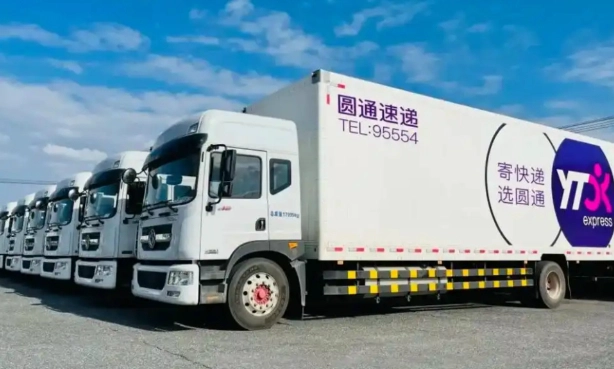
YTO Express has set up a wholly-owned subsidiary in Linyi to advance warehouse-integrated distribution, targeting the source of industrial belts and addressing inventory competition and livestream e-commerce supply chain challenges.
In mid-2026, as the national express delivery industry as a whole fully bids farewell to the era of high-speed growth and competitive battles over existing market share descend into pixel-level intensity, the breakthrough strategies of traditional logistics giants are undergoing a profound technological inflection point. The old approaches—relying on massive regional transshipment hubs and sweeping, loosely managed franchise-based land grabs—have lost their effectiveness, replaced by ultra-refined downward deployment targeting specific industrial clusters. Recently, the latest business registration roster on the Tianyancha App showed that Linyi Yuanteng Logistics Co., Ltd. has been officially established, with Ding Jianjun as its legal representative and a registered capital of one million yuan.
This micro-scale investment, with its seemingly unremarkable capital base, covers a full logistics chain in its business scope, including road freight transport, loading and unloading, cargo packaging services, and general warehousing services. However, unpacking the full equity structure revealed by Tianyancha, the core ownership is 100% wholly controlled by YTO Express Co., Ltd.
Outside observers and some trend-chasing self-media outlets tend to interpret this move as a routine regional network expansion or a token investment promotion effort by Shandong. Such superficially correct but vacuous commentary completely ignores the extreme strategic gravity of Linyi as the "Logistics Capital of Northern China" and one of the country's largest wholesale distribution hubs for online goods.
YTO's establishment of a wholly owned subsidiary with minimal capital at this time has its underlying root cause hidden beneath the surface: this express delivery giant, with a market value in the hundreds of billions, is demonstrating an aggressive "capillary" penetration logic in response to the supply chain pressures driven by ultra-flattened livestream e-commerce and short-video product promotion.
Today's Linyi boasts one of the densest clusters of grassroots livestream hosts and an extremely large white-label industrial belt in China. The traditional two-tier distribution model, which involves long-cycle transshipment and interest-based bargaining among franchise outlets, is facing irreversible financial strangulation in terms of delivery speed and micro-level pricing control. To hold the line in an ultra-competitive ecosystem where per-package profits are calculated in fractions of a cent, YTO urgently needs to build a direct-operated outpost system capable of penetrating straight to the source of the industrial belt.
The basic logistics business scope disclosed by Tianyancha is, in essence, a tailor-made "integrated warehousing and distribution" framework that YTO has designed for Linyi's cross-border e-commerce and long-tail white-label businesses.
Through the wholly controlled Yuanteng Logistics, YTO can legitimately roll out highly price-competitive "ship-from-origin" operations directly at Linyi's core wholesale markets and warehousing bases. It bypasses the multi-layered exploitation and internal friction of traditional franchise outlets, stitching together loading and unloading, cargo packaging, and general warehousing into same-city, pixel-level integration, thereby building a financial and delivery-speed firewall that shuts out competitors. This is also a shrewd asset-hedging move by the major player, using minimal fixed-asset expenditure to lock down data flow from specific high-sensitivity industrial belts.
Commercial evolution has always been ruthless. In a brutal cycle where survival is defined by data compliance red lines, genuine cash-flow efficiency, and absolute control over distribution channels, traditional logistics franchisees that rely on favorable conditions and lack long-term local industrial roots will ultimately face complete elimination in the precision strikes of major players' direct-operated heavy artillery.
This latest Linyi coordinate left by YTO in the Tianyancha records is a sobering ledger of the express delivery giant's push to break through into micro-level monetization of the supply chain. Now that the rough-and-tumble era of recklessly burning cash on customer acquisition and fighting low-price wars has come to a definitive end, how to anchor the lifeline of long-tail e-commerce supply through the establishment of such small, beautifully crafted, and highly centralized local entities will be the rigid choice that all head express delivery giants must make to retain market sovereignty in the coming great shakeout.