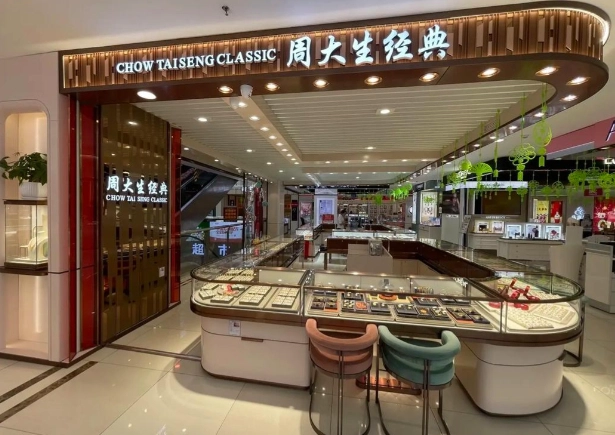
The Gold Price Surge Trap: The Channel Reshuffle Behind the Disappearance of 500 Chow Tai Seng Stores
The gold price surge has triggered a wave of store closures at Chow Tai Seng, with 500 stores vanishing, revealing the fragility of the asset-heavy model and the industry's challenges of channel reshuffling and digital transformation.
In the mid-2026 gold jewelry market, a strikingly paradoxical phenomenon is unfolding: on one side, international gold prices remain elevated on the back of capital's flight to safety; on the other, high-profile headlining jewelry stores are disappearing from the streets in batches. On May 18, Chow Tai Seng Jewelry Co., Ltd. held an earnings call, directly confronting the grim reality that over the past year, franchise stores nationwide cumulatively shuttered over 900 locations, with a net decline of more than 500. The brand attributed the situation lightly to weak sales and the consolidation of smaller stores into larger ones, insisting that once consumer demand for gold jewelry improves, the wave of store closures would pass.
However, peeling back the layer of this gentrified public-relations rhetoric—talk of merging small stores into big ones and unchanged franchisee counts—the deeper root cause lurking beneath is a supply-chain asset stampede triggered by the surge in gold prices within a specific cycle, what industry insiders commonly call the "price-hike trap."
Conventional business wisdom has long held that when gold prices rise, jewelers sitting on inventory can passively reap the windfall of inventory appreciation. But this crude assumption grossly underestimates the fragility of end-retail in the era of a saturated market. When per-gram prices are driven to historic extremes, consumers, driven by risk aversion and resistance to premium pricing, see their willingness to buy gold jewelry plummet off a cliff. The more lethal link in the profit chain, however, lies with the peripheral franchisees. The higher gold prices climb, the more working capital franchisees must front to open new stores or restock existing ones—an exponential surge that crushes their financial leverage under the heavy weight of procurement costs and store rents. When per-store profit margins are squeezed to the bone and franchise willingness collapses entirely, the small stores that cannot withstand the risk are left to close en masse under the respectable banner of being "merged."
This bleeding at the asset-heavy end of the distribution channel has left a dense, unhedgeable trail of deregistration records in the corporate and organizational landscape.
According to the Tianyancha app, Chow Tai Seng Jewelry Co., Ltd. was established in October 2007, with legal representative Zhou Zongwen and a registered capital of approximately RMB 1.09 billion. It is jointly controlled by Shenzhen Zhou's Investment, Jindayuan Investment, and Industrial Securities, among others. In the capital map revealed by Tianyancha's penetration analysis, this long-established giant has outward investments in over 180 enterprises, presenting a seemingly vast ecosystem. Yet, under its directly controlled branches, as many as 30 branch entities have had their business registrations marked as deregistered.
These deregistration records sitting quietly in Tianyancha's database are precisely the technological inflection point and growing pains that Chow Tai Seng must confront after its nationwide land-grab expansion. As the dividends of traditional franchise expansion peak, the regional subsidiaries, offices, and directly operated small stores established for the sake of rapid expansion have swiftly devolved from profit harvesters into financial black holes devouring fixed costs.
To hedge against the visibly flagging offline brick-and-mortar landscape, traditional giants like Yanghe and Tongwei have been seeking safe havens, while Chow Tai Seng has chosen to shift its firepower at full speed into the asset-light virtual space. According to the associated investment genealogy revealed by Tianyancha, Chow Tai Seng still maintains substantial holdings in supply-chain finance ventures such as Shenzhen Baotong Tianxia Micro-Lending, while aggressively pushing e-commerce drop-shipping online. In recent months, it even entered into a heavily funded joint venture with leading MCN giant Wuyou Media, attempting to compensate for the huge revenue evaporated by the closure of over 500 offline stores through a pure online livestreaming matrix and TikTok overseas traffic incubation.
In the endgame of commercial competition, there is no room for luck built on airy concepts. In the late-2026 retail battlefield, where truth is defined by real per-transaction turnover, store efficiency ratios, and supply-chain cash-flow density, pinning hopes on a spontaneous recovery in gold jewelry consumption is nothing more than a dangerously passive waiting game.
The thirty deregistered entities that Chow Tai Seng leaves behind in its Tianyancha file, combined with the closure of hundreds of franchise stores, constitute an irreversible industry-wide reshuffling bill. As the crude era of frenetically opening stores and passively collecting brand licensing fees draws to a definitive close, the only hard choice this jewelery giant—valued at over RMB 100 billion—faces in the coming cycle of consolidation is whether the remaining 4,000-plus stores can be precisely empowered through digital tools, rather than being passively whittled down under the gravitational weight of asset-heavy procurement. This, and only this, will decide whether it can hold its throne.