From Restaurant Kitchens to Physical World Foundation Models: QuantGroup's Physical AI Sells Capabilities
QuantGroup positions itself as a provider of physical world foundation models, not building robots but selling general AI capabilities that can be reused across scenarios, betting on a scalable commercial path.
The embodied intelligence industry is undergoing a wave of positioning differentiation.
Some companies sell robot hardware, some sell complete solutions, and QuantGroup sells foundation models for the physical world. The business logic behind this choice is straightforward: hardware iterates, scenarios change, and what can truly be reused across scenarios and generate ongoing revenue is the underlying AI capability that enables robots to understand the physical world.
Right now, an industrial transformation is pushing robots out of showrooms and into real-world environments, bringing a business judgment to the surface: whoever masters the ability to make robots quickly adapt to new scenarios secures the ticket to scale.
First, let's look at how concrete this transformation is right now. In June, the General Office of the Ministry of Industry and Information Technology and the General Office of the State-owned Assets Supervision and Administration Commission jointly issued the "Notice on Jointly Carrying Out the 2026 Special Action for Humanoid Robots and Embodied Intelligence Real-Scene Practical Training." Ten provinces and municipalities plus all central state-owned enterprises are participating, with scenarios spanning three major areas—industrial, service, and special applications—covering real environments such as production and manufacturing, inspection and analysis, warehousing and logistics, food and beverage retail, healthcare and elderly care, and safety production and emergency rescue. Each province and municipality must report no fewer than 20 key scenarios, and each central state-owned enterprise no fewer than 10, with verification reports due by the end of November. The policy's eight-character requirement is "minimal intervention, reuse of existing assets"—no modifying environments to accommodate robots; robots must prove they can do the job under current conditions. This requirement has pushed the industry out of showrooms and squarely into real-world scenarios.
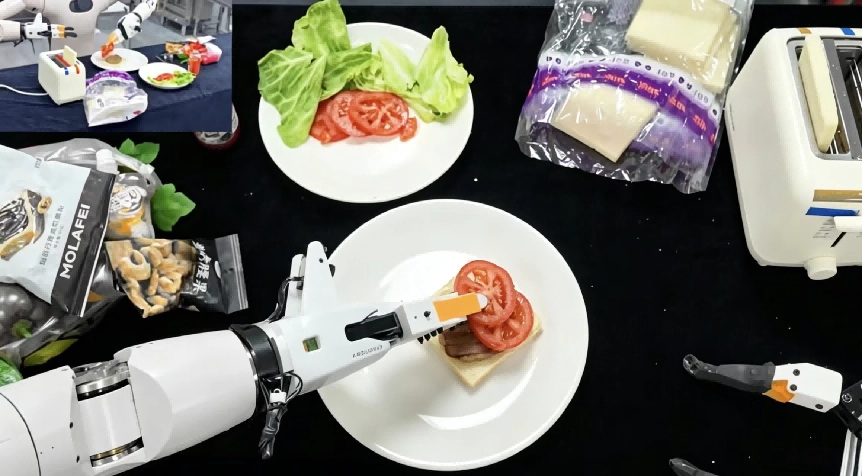
QuantGroup recently completed four rounds of embodied intelligence technology validation in commercial kitchen scenarios, from flexible sandwich preparation, autonomous shopping-bag sorting, and steak seasoning with salt found across multiple drawers to coordinated multi-device milk tea preparation—all deployed in real, dynamic operational conditions rather than laboratory environments. At a stage where much of the industry is still releasing demo videos as results, this pace ranks among the front-runners. Its commercial positioning: a provider of open-life-scenario world models that are cross-scenario and cross-hardware. It does not lock into hardware, does not lock into scenarios, and instead builds a universal AI capability layer that robots from different manufacturers can all call upon.
QuantGroup's own technical documentation draws a concise distinction: pushing robots from "motion automation" to "task-level autonomous operation." The former executes actions according to fixed programs; the latter understands task goals and autonomously completes the full loop of perception, decision-making, and execution. Between these two phrases lies the core question of how far the entire industry can run. Why the market is willing to pay for physical-world foundation models, and whether capital believes the model can work and how far the track can go, all ultimately point to the same thing: who can make robots reusable across scenarios and drive the marginal cost of each new scenario down to nearly zero.
Global capital has already validated this once
There are two conventional approaches in the industry. One is selling hardware—one-time delivery, where the customer buys the robot and handles subsequent maintenance and scenario adaptation themselves; every new scenario requires re-tuning parameters and re-deploying, so the marginal cost of scaling never drops. Another is selling solutions—bundled services combining hardware, software, deployment, and maintenance, billed per project; this can go deep but is hard to scale wide. And there is a third: selling capability.
The logic of selling a capability layer is: train once, reuse across scenarios. A physical-world foundation model does not care which company's robot is running beneath it, nor what scenario sits above it. What it provides is a universal capability that lets robots understand the physical world and make real-time decisions. Once this capability works, it can be called like an API across different hardware platforms. Each additional scenario carries a marginal cost near zero—something the other two approaches cannot achieve.
It solves rapid cross-scenario transfer, not automation within a single scenario. The policy requirement to "validate one, deploy a batch, and drive a broader area" means scenario owners will not customize environments for new robots every time. Whoever can make a robot work out of the box in unfamiliar scenarios holds the key to scale.
The RaaS model makes sense within this logic. Pay for utility rather than hardware—sell capability, not robots—and customers pay for the results of the robot's work, not the robot itself. The value of the physical-world foundation model is amplified in this model: it is the core technology asset that makes RaaS viable.
Capital values exactly this. Hardware companies are valued on volume times margin; solution companies on number of projects times price per project; physical AI model companies on call volume times usage duration. The latter has far greater headroom, because its ceiling is not hardware production capacity or project delivery capability, but the generalization capability of the model itself.
Across the Pacific, this judgment is being validated with real money.
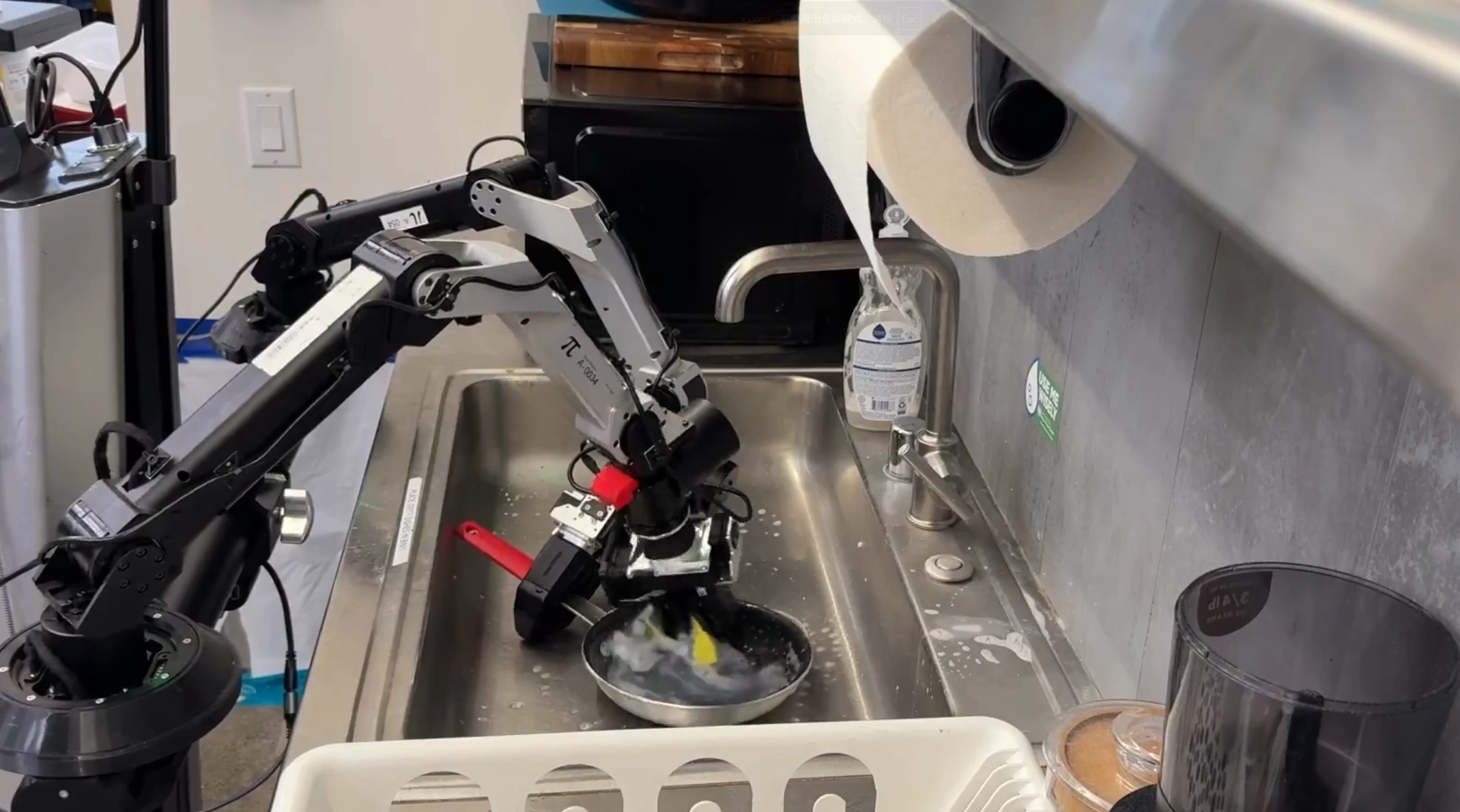
In November 2024, Physical Intelligence raised $400 million at a $2.4 billion valuation, with investors including Jeff Bezos, OpenAI, Sequoia Capital, and Khosla Ventures. The company does not build robot hardware—it only builds general-purpose AI models that let robots understand the physical world. In eight months, its valuation jumped from $400 million to $2.4 billion—a sixfold increase.
Skild AI's trajectory is even steeper. Founded by former Meta AI researchers, the company likewise does not touch hardware, only building the general-purpose brain for robots. Its Series A valuation was $1.5 billion in July 2024; less than a year later, the Series B hit $4.7 billion, followed by a Series C led by SoftBank and NVIDIA at a $14 billion valuation. At that point, the company's annual revenue was just $30 million. $30 million in revenue, $14 billion in valuation—that gap is not betting on revenue growth; it is betting that physical-world foundation models will be called upon by all robots in the future.
The capital markets are voting with their feet: the valuation logic for physical-world foundation models has already been validated by the world's top-tier investment institutions.
QuantGroup's position in physical AI is akin to Anthropic's position in large language models—letting different hardware platforms call the same AI capability layer. Physical Intelligence and Skild AI have already demonstrated how high the valuation ceiling is on this path. What QuantGroup aims to do is build the same type of technology moat in the Chinese market.
Covering dining and home services—these are application avenues for life-scenario world models, not the commercial endpoint of the foundation model itself. The commercial value of a foundation model lies in how many scenarios can call it, how many hardware platforms it can support, and how much recurring revenue it can generate.
There is another choice in the industry: the showcase route. Carefully designed lab demos, four-axis cameras, polished release cadence. But technical feasibility and commercial feasibility are two different things: facing dynamic operational conditions every day in a real kitchen, bearing the responsibility for output consistency and operational stability—that is validation on an entirely different level. QuantGroup chose the latter.
Validating business logic in a restaurant
Demos that work in a lab can be filmed; demos that work in a kitchen can generate revenue. All four rounds of QuantGroup's technical validation were deployed in real kitchens.
Sandwiches involve soft ingredients without fixed shapes—bread, lettuce, sauces. Press too hard and they break; too lightly and they fall. Squeeze too much sauce and it overflows; too little and it spreads unevenly. The robot must continuously grasp, spread, and place within the same workflow, relying on compliant control that perceives ingredient shape in real time and adjusts force at any moment—no crushing, no damage, and standardized output throughout.
Shopping-bag sorting has no preset workflow. What is in the bag, how much is in it—the robot does not know in advance. It can only judge task progress in real time, identifying, grasping, and sorting items one by one across multiple categories, deciding the next step as it goes. There is no fixed script; the robot relies entirely on its current state to complete a task from start to finish. This tests autonomous decision-making without a script.
The steak seasoning task best reveals comprehension. The robot initially does not know where the salt is; like a person, it must search drawer by drawer, determine which drawer holds the salt, where it is positioned, what posture to use to pick it up, and then complete the seasoning with millimeter-level precision. No one tells it the steps; it is given only one goal—"find the salt and season"—and the rest of the search, positioning, and manipulation is entirely its own reasoning. This tests the full reasoning chain from understanding the goal to executing the right actions.
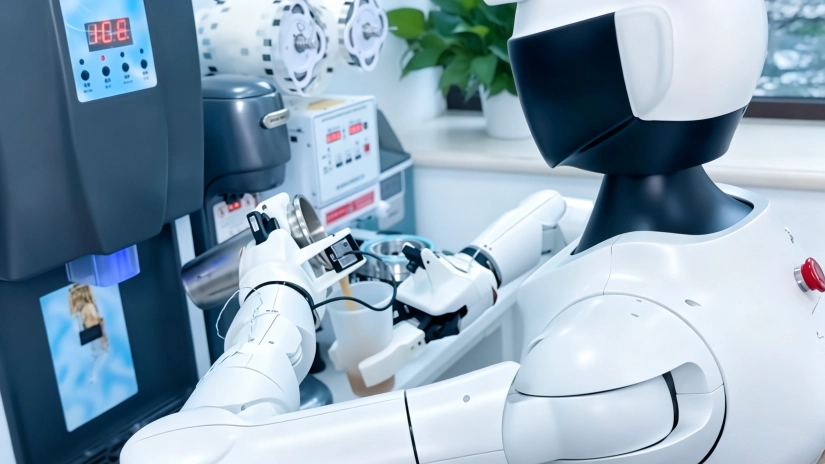
Milk tea tests system coordination. The robot is not just operating on its own; it must alternately cooperate with the tea machine, blender, and sealer: no spills when receiving the drink, no splashes when stirring, precise alignment when sealing, while controlling liquid sloshing and positional drift in real time. Several devices form a single production line—if any link fails, the whole line stops.
After completing four rounds of validation, the next bet is on cross-scenario reuse. QuantGroup's technical path uses layered software and hardware architecture, with the physical-world foundation model not tied to any specific hardware. After working with Manufacturer A, it can interface with Manufacturer B—the same foundation model capability runs across different hardware platforms. This is the prerequisite for RaaS to scale: the physical-world foundation model, as a technology asset, can be continuously called and continuously generate revenue. The unstructured manipulation, open-environment adaptation, and long-chain autonomous operation capabilities honed in commercial kitchens are, in theory, precisely the underlying capabilities needed in warehousing and logistics, inspection and analysis, and healthcare and elderly care—domains equally full of dynamic variables.
The deeper layer of imagination lies in "intelligent species"—any physical terminal equipped with perception modules, capable of AI-driven decision-making, and able to autonomously complete physical interactions can connect to the physical-world foundation model and become an intelligent carrier. This concept extends the reuse path from dining to a far broader hardware space.
Data accumulation is the only thing money cannot buy
Whether QuantGroup's business logic can work depends on two things: whether the technical capability of the physical-world foundation model can support cross-scenario reuse, and whether the company can build moats in data accumulation and systems integration.
QuantGroup is not a hastily assembled team. Its prospectus is clear: foundations in automated machine learning and NLP were already in place. Moving digital-world decision-making capabilities into the physical world is an extension, not a fresh start.
The data accumulation moat comes from a multi-path collection system. On the B2B side, commercial scenario deployment with robot hardware partners captures full-process operational data in real scenarios such as dining. On the consumer side, smart hardware deployment naturally accumulates multi-dimensional behavioral and environmental data through daily use of multiple product categories. Add user exchange-based collection and co-created scenario data sharing. Four parallel paths turn data collection from a single point into a system.
Physical-world data does not accumulate automatically like web clicks. Behind every piece of valid operational data is the labor cost of hundreds of real-world robot trials and errors. This kind of data cannot be quickly purchased with money; it can only be accumulated slowly through time and real operations. Whoever first accumulates enough operational data in real scenarios will iterate their foundation model faster and push down the cost curve earlier. Once this virtuous cycle starts spinning, latecomers are not just chasing a technology gap—they are chasing a time gap.
This makes the competitive logic clear: what matters is not whose single-point technology is flashier, but who first completes the virtuous cycle of data accumulation. QuantGroup chose dining as its first core validation scenario, using the highest-difficulty, people-centric complex scenario to force the technology system to iterate in reverse.
Globally, the leading landscape has not yet taken shape. The players that have emerged so far have validated scenarios that lean toward standardization—concentrated in warehousing, logistics, and household tabletop tasks. QuantGroup chose commercial kitchens, where variable density is far higher, the generalization value is theoretically greater, and the validation difficulty is also higher. Domestically, startups are also entering industrial and logistics scenarios, forming two differentiated paths against QuantGroup's dining scenario. Which path leads more directly to a general physical-world foundation model remains an open question, but heavy bets are being placed on both.
In this policy-driven window when the industry is being pushed from showrooms into real scenarios, whoever first accumulates data and validation records in real scenarios—that position itself carries meaning. With RaaS receiving official endorsement, QuantGroup, as a Hong Kong-listed entity, gains an additional layer of credibility through its listed-company platform in financing capability, compliance transparency, and sustained long-term investment.
From imagination to cash flow
The commercial imagination of physical-world foundation models ultimately must clear two hurdles.
The first: can the marginal cost of cross-scenario reuse truly approach zero? QuantGroup has run through technical validation in four commercial kitchen scenarios, but from dining to more life-service scenarios, how high the adaptation cost is for each transfer, and how many real-machine trial-and-error runs lie behind that data, is not publicly available. Based on the limited cases in the industry, whether cross-scenario adaptation costs are low enough directly determines whether physical-world foundation models can go from imaginative to cash-generating. If costs cannot come down, the business model will inevitably fall short.
The second is more fundamental. The physical world is far more complex than the digital world, and when migrating from simulation environments to real scenarios, there are always gaps that are hard to eliminate. Whether QuantGroup can use its full-stack, self-developed systems integration capability to narrow that gap to a commercially acceptable range will determine whether the commercial value of physical-world foundation models can truly be released.
The signals from the market side are certain. The national special action is concrete when you look at it: 10 provinces and municipalities plus all central state-owned enterprises, scenarios covering industrial, service, and special applications, no fewer than 20 per province and municipality and no fewer than 10 per central state-owned enterprise, with reports due by the end of November. This means that in the coming months, a batch of companies will be bringing real-scenario operational data to trade for policy recognition and the next round of orders. With official backing for the RaaS model combined with this countdown, "selling capability" being more aligned with the industrial direction than "selling hardware" is no longer just a statement—it is an inflection point happening now.
QuantGroup's long-term path is clear: from scenario deployment and data sales for initial accumulation, to outputting model calls and value-added services to smart hardware manufacturers, then moving into the computing power track, forming a revenue structure of foundation model plus computing power that matches capital market valuation logic. The premise of this path is that the technical capability of the physical-world foundation model can support cross-scenario reuse; the core is whether the compounding advantage can be continuously strengthened. If both happen, the commercial value of physical-world foundation models moves from concept to cash flow.
Finally
Something has not happened yet, but once it does, the real clock on this track starts ticking.
QuantGroup's physical-world foundation model capability layer connects to a new external client, in a brand-new scenario, getting a robot to do a job it could not do before. That transaction is not internal validation or a technical demo—it is a third-party client voting with its own money.
On that day, the physical-world foundation model stops being an "imaginative story" and becomes a "platform that is starting to generate value." Until then, all valuations remain just valuations.