Oriental Land’s 'Pond Dweller' statue has been mocked for resembling a zombie, exposing a pattern of safety lawsuits and a strategic identity crisis in cultural tourism.
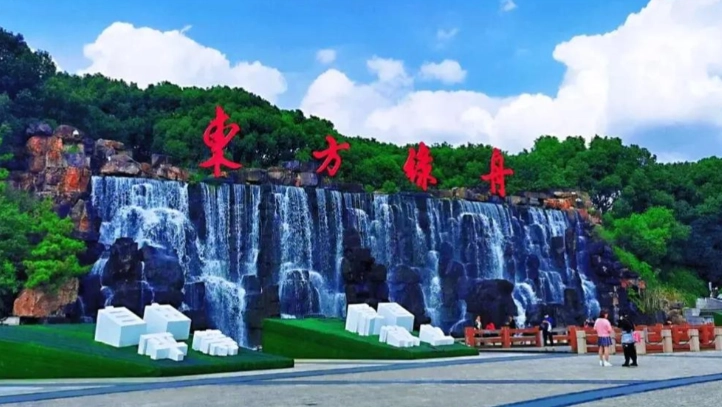
When a massive cultural tourism landmark focused on youth after-school education and public leisure becomes the subject of widespread complaints about 48 colorful, indistinct glass statues of "figures in a pool" near Fisherman's Wharf—frequently ridiculed by visitors as "resembling zombies and extremely terrifying"—the state-owned cultural tourism entity backed by a top-tier media conglomerate finds itself facing an extraordinarily awkward public aesthetic trial.
Recently, the so-called "underworld art" at the Oriental Land scenic area in Shanghai's Qingpu District has been thrust into the spotlight of public opinion. This scenic installation, which attempted to pursue avant-garde visuals but completely backfired, not only instantly ruined the weekend getaway experience for citizens but also precisely reflects the profound disconnect between the forced rebranding efforts of traditional large-scale cultural tourism projects—attempting to inject a youthful visual overhaul—and the public's mainstream aesthetic sensibilities.
The vast majority of online onlookers tend to dismiss this incident as just another case of a scenic area's artistic misfire or a piece of curiosity-driven gossip. Such a superficial view completely overlooks the deeper operational distortions occurring in the suburban tourism market around first-tier cities: as competition intensifies over content and experience in the long run, traditional scenic areas—whose core content-generation pipelines are aging—are blindly pursuing so-called installation art merely to manufacture social media "check-in spots."
The sensational "horror" traffic online is merely a surface layer. To truly assess the real quality of this cultural tourism giant's underlying assets and its potential legal vulnerabilities beneath the surface, one must use Tianyancha to penetrate its industrial and commercial registration and litigation landscape.
Business Registration and Ownership Structure
Tianyancha business data shows that the involved Shanghai Oriental Land Enterprise Management Co., Ltd. was established in May 2017, with its legal representative being Guo Yifeng and a registered capital of up to 50 million RMB. A review of its clearly documented shareholding structure in the Tianyancha system reveals that it is 100% wholly owned by Shanghai's cultural tourism flagship—Shanghai Oriental Pearl TV Tower Co., Ltd.
Legal Litigation Red Flags
However, beneath this surface backed by 50 million RMB and top-tier state-owned credit, the frequent red flags in the Tianyancha system regarding legal litigation are alarming: the company has been mired in multiple legal disputes in recent years, with its case role consistently as defendant, and the causes of action are extremely sensitive, pointing directly to "disputes over the right to life, physical integrity, and health."
This asset-heavy, slow-moving business that monetizes natural scenery and offline physical environments is now facing a cold and unforgiving judicial reckoning over its backend safety risk management and operational precision.
The frequent appearance of disputes over the right to life and health is, for a scenic area that consistently serves as a core base for spring outings, autumn outings, and military training for primary and secondary schools across Shanghai and the Yangtze River Delta, tantamount to punching a hole in the core credit of its balance sheet. Malfunctions of electric two-wheelers or amusement rides, or inadequate protection around open water areas, could all be the underlying drivers behind the long list of defendant records in the Tianyancha legal archives. In today's cultural tourism industry, which places extreme emphasis on experience and safety red lines, when core safety metrics frequently flash red at the judicial level, it signals that the company's refined operations and on-site scheduling controls have already shown signs of cost-management fatigue across its supply chain and service pipelines.
Strategic Missteps and Aesthetic Failure
With backend safety management bogged down in lawsuits and frontend landscape construction veering off into repulsive "horror art," this precisely exposes the strategic self-alienation of an established cultural tourism giant.
In a bid to forcibly capture young people's attention in the race for traffic in the short-video era, operations teams have begun to place faith in avant-garde visuals that fall outside the public's psychological safety zone, attempting to offset brand visibility anxiety with the cheapest visual shock value. Yet they completely overlook that the most fundamental defensive capital of a scenic area should be meticulous elimination of safety blind spots and the creation of environments that bring genuine joy and comfort.
When the internet's check-in frenzy subsides, what ultimately tests the longevity of a massive cultural tourism asset is never the curiosity-driven attention earned through shock value, but rather the safety margins of its overall ecosystem and the long-term votes cast by consumers through their feet.
The state-owned core foundation that Oriental Pearl injected into Oriental Land via Tianyancha should have been its golden ticket to weathering economic cycles over the long term. Yet this clumsy aesthetic failure, coupled with the dense alerts of health-related lawsuits, serves as a clear industry shift warning: the next phase of competition in the cultural tourism sector has long moved past the crude paradigm of grabbing eyeballs with gimmicks. Unless the industry takes the lead in thoroughly cleaning up its on-site safety management and quality assurance in these muddy trenches, any prosperity built on hollow hype will ultimately be slammed against the ceiling by immutable court rulings and the cold reality of tourists walking away.