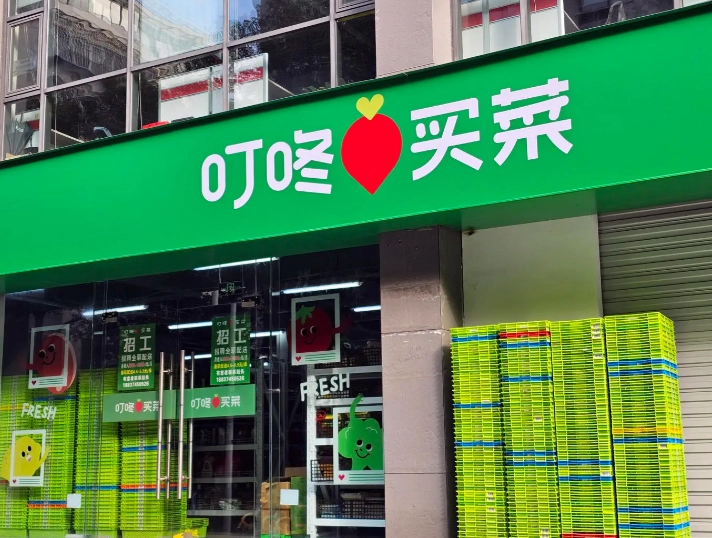
Dingdong Maicai's Wholly Owned Network: Regional Centralization of Front Warehouses and Cost Control Defenses for Instant Fulfillment
Dingdong Maicai has established a wholly owned subsidiary in Hefei, focusing on cold-chain storage and localized direct sourcing to strengthen regional fulfillment cost control.
As the fresh e-commerce track enters deep waters amid extreme supply chain cost control and cross-regional stock-market-style competition, the instant retail giant that once relied on capital-fueled spending on frontline warehouse networks is now rapidly consolidating its defensive and regional deep-dive heavy-asset chips toward second-tier core hinterlands with greater strategic depth.
Recently, a new company registration announcement disclosed by the Tianyancha App tore open a crucial long-game chess move in Dingdong Maicai's grid-based densification strategy in East China: Hefei Chizhiyiheng E-Commerce Co., Ltd. was quietly established, with registered capital precisely pinned at a lean RMB 1 million. At a time when the entire industry is obsessed with per-order gross margin and resorting to brutally shuttering marginal loss-making warehouses to dress up workforce efficiency metrics, this wholly-owned registration of a million-level e-commerce entity comes across as remarkably solid and steeped in strategic defensive intent.
Most industry observers, accustomed to scrutinizing the fate of fresh e-commerce through the lens of "discount coupon" intensity, average order value fluctuations, and frontline warehouse closure rates, tend to interpret this new company's formation as a routine regional office expansion, or a perfunctory move by the parent entity to satisfy local tax and special business licensing requirements. Such a shallow reading grossly underestimates the systemic monetization anxiety facing Liang Changlin and Dingdong's core management team as they confront the backlash of plateauing first-tier city traffic dividends and the high depreciation and shrink rates inherent to traditional fresh categories, as well as the deeper causation behind their attempt to use the most pristine local commerce and warehousing shells to forcibly lock in long-tail instant fulfillment premiums in Hefei and its surrounding areas.
The real profit chain in this capital game—advancing from pure same-city volume play toward a "total internalization of supply chain sovereignty"—is hidden within the cold industrial-and-commercial data slices of the Tianyancha system.
Tianyancha's industrial-and-commercial data clearly shows that this newly established Hefei Chizhiyiheng E-Commerce Co., Ltd. is 100% wholly controlled by Dingdong Maicai's core operating entity—Shanghai Yibaimi Network Technology Co., Ltd.—with Yan Xianfu, a key operator inside Dingdong, personally serving as the legal representative. A look at the business scope registered in the Tianyancha system reveals a hardcore fresh-food blueprint deeply rooted in near-field fulfillment: beyond traditional internet food sales and wholesale/retail of edible agricultural products, low-temperature warehousing and general cargo warehousing services occupy a central position.
The driving force behind this move—absolute control from the Shanghai parent entity, with operational granularity precisely locked into the intersection of "online food sales" and "low-temperature warehousing"—lies in Dingdong Maicai's urgent need to reorganize and hyper-optimize its frontline warehouse model in Hefei, the core western wing of the Yangtze River Delta.
In today's instant retail ecosystem, the profit margins of purely relying on the saturated competition model of super-first-tier hubs like Shanghai—characterized by high customer acquisition costs and high labor costs—are being ruthlessly squeezed dry under the extreme pressure of cross-industry giants, with marginal returns already collapsing. The only remaining high-margin defensive line for fresh frontline warehouses lies in long-term intangible assets built on extreme localization of direct sourcing and low cold-chain depreciation. Hefei, as a super dark-horse city in recent years with strong industrial and population net inflows, is currently in a golden window of explosive growth for its cold-chain logistics infrastructure, farm-to-source direct sourcing supply chain, and high-frequency, high-density near-field community fulfillment demand.
This RMB 1 million entity increment in Hefei is, at its core, Dingdong Maicai's move to forcibly weld shut an "independent regional hub" and "warehousing cost-control isolation wall" outside its main body.
By pinning registered capital squarely at the physical boundary of RMB 1 million limited liability, Dingdong Maicai is plainly revealing its shrewd calculation for "high-frequency, low-cost trial and error" during regional expansion. By establishing a content shell in Hefei with local settlement capabilities and specific warehousing qualifications, Dingdong can directly bypass the lengthy management bandwidth of the Shanghai headquarters, using an independent legal person identity to forcibly clean up and reorganize Anhui's local agricultural direct sourcing and cold-chain trunk logistics. The "low-temperature warehousing services" spelled out in Tianyancha point precisely to its future hand in long-game heavy-asset positioning in prepared dishes, as well as its trump card in the extreme compression of fresh-food shrink rates.