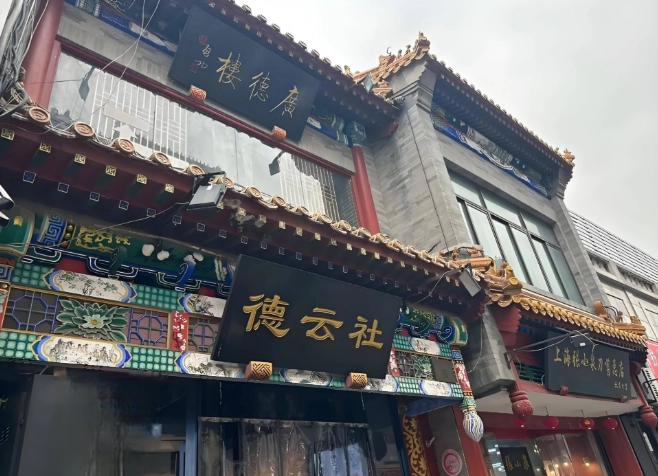
The Ad-Lib on Red Songs and the Shell Company: Deyun She's Compliance Black Hole and Insular Capital
Deyun She faces investigation after Guo Degang's ad-lib about revolutionary songs, exposing the clash between traditional crosstalk and modern compliance systems, with fragile capital and failed risk isolation.
In a cross-talk performance born from the streets, improvisational banter was once the muscle memory that performers relied on to survive. However, when Guo Degang used that survival skill from an unrefined era on a Wuhan stage to riff on revolutionary songs laden with profound political and historical seriousness, the ensuing investigation instantly tore apart the facade of the modern cultural empire that Deyunshe had painstakingly cultivated for years. This controversy is by no means a simple case of loose lips or a performance mishap—it brutally exposed the irreconcilable, life-or-death rift between the underlying production methods of a traditional cross-talk troupe and the modern content compliance systems required as it evolves into a highly capitalized, industrialized entertainment conglomerate.
Over the past decade-plus, Deyunshe has fully capitalized on the traffic dividends of defying tradition and achieving grassroots upward mobility. They pulled cross-talk out of institutional gala stages and brought it back to theaters, relying on boundary-pushing ethical gags and risqué jokes. This non-standardized content production, which depends heavily on performers' real-time improvisation, fueled Deyunshe's initial capital accumulation.
But as this teahouse-based troupe swelled into an entertainment behemoth monopolizing China's commercial performance market, the censorship logic it faced had long undergone a qualitative shift.
Capital Fragility and the Corporate Matrix
If you dismantle this colossus through its underlying commercial architecture, you'll find that its capital fragility is completely at odds with its surface-level prosperity. Using the corporate transparency data aggregated by Tianyancha, it's clear that Guo Degang is associated with ten companies, including six active entities such as Deyunshe (Tianjin) Co., Ltd., in which he holds supervisory roles or equity stakes, while several others have already been quietly dissolved.
This complex cross-regional corporate matrix is essentially Deyunshe's attempt to use the legal shells of modern corporations to isolate and disperse the highly concentrated risk tied to individual IP.
But this physical-level risk isolation is meaningless in the face of a content compliance storm.
Personality-Driven IP and the Absence of Content Risk Control
At its commercial core, Deyunshe has yet to escape the mold of feudal personal dependency and "personality-driven IP." Whether it's Guo Degang himself or his traffic-generating apprentices nurtured by fan culture, the entire group's valuation and cash flow are tightly bound to the mouths of a few specific individuals. In the modern entertainment industry, film and TV productions can mitigate policy risks through multiple rounds of script reviews and post-production editing, but Deyunshe relies heavily on live theater's "on-the-spot riffs."
This kind of improvisation, which can go off the rails at any moment to cater to live audience emotions, is tantamount to walking a tightrope with a ticking time bomb under today's increasingly stringent ideological and cultural market regulatory grid.
Regulatory Red Lines and Path Dependence
The reason tampering with revolutionary songs tripped the regulatory alarm is that Deyunshe's management still harbors an extremely arrogant path dependence. They attempt to use the street-smart comedic rules of operating in gray areas to undermine the serious bottom lines of the modern cultural market. The heavy-handed crackdown by local cultural and tourism authorities is not merely an administrative penalty for unreported content; it is a dimensionality-reduction strike against the entire unrefined monetization model of traditional folk performing arts.
When the profit-seeking nature of capital collides with the absolute red lines of regulation, the petty cleverness of traditional performers trying to weasel through with quips and banter appears utterly feeble.
Conclusion: The Inevitability of Industrialized Quality Control
When a cultural enterprise with unfathomable valuation keeps the risk-control valve for its core product dependent on the performers' mood of the night and the atmosphere of the venue, that in itself violates basic modern business sense. The crisis Guo Degang faces cannot be resolved by simply changing one song or paying an extra fine. In the current inventory-era cycle of strict regulation, unless a fully industrialized content quality-control mechanism is established—one that thoroughly suppresses unrefined street habits and absolutely subordinates itself to bottom-line censorship—any capital scheming to dodge accountability by dissolving old companies or registering new entities across regions will ultimately be wiped to zero by each uncontrollable wave of public opinion and administrative crackdowns.