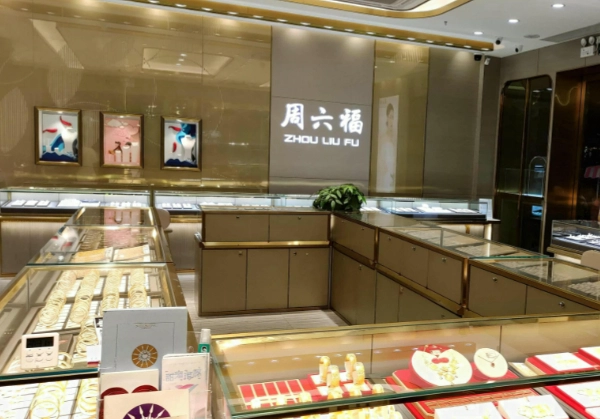
A $100 Fine Exposes the Cracks in Chow Tai Fook's $400 Million Empire: Quality Control Failures in a Light-Asset Franchise Model
A mere $100 fine has exposed quality control failures at Chow Tai Fook, reflecting systemic risks and capital hollowness in its light-asset franchise model.
In mid-2026, as international gold prices hover at elevated levels amid intense geopolitical maneuvering and macroeconomic risk-aversion, the terminal retail price tag for one gram of pure gold has long since approached or even breached the 800-yuan threshold. Within this rigid precious-metals consumer landscape, steeped in wealth anxiety, an administrative penalty notice for a mere 739.75 yuan reads as both absurd and laced with bitter irony. Recently, the Luohu Regulatory Bureau of the Shenzhen Municipal Administration for Market Regulation issued this trifling fine to Chow Six Fuk Jewelry Co., Ltd., with the violation cited directly as "product quality non-compliance," alongside confiscation of illicit gains.
A fine that cannot even buy one gram of gold — for a national jewelry chain with annual revenues routinely in the billions — does not even register as a speck of dust on its financial statements. Yet strip away the negligible seven-hundred-odd yuan veneer, and the underlying causes strike precisely at the systemic backlash that domestic legacy jewelry companies have long been destined to face after their breakneck expansion built on the "brand shell plus asset-light franchising" model. This penalty notice is not merely administrative discipline for a single violation; it is a muted funeral bell tolling for an entire business model that props up its hollow prosperity by reselling brand licenses and collecting franchise fees.
The Hollowing-Out Game Beneath the Capital Shell: Penetrating the Real Foundation of a 400 Million Share Base
To grasp the enormous operational fissures hidden behind this 700-yuan fine, we must cast aside those PR narratives about "century-old heritage" and "artisan craftsmanship" that jewelry brands love to peddle, and instead direct our gaze to the underlying corporate and capital architecture.
A clear data trail lays bare how this enterprise truly operates. Through Tianyancha's equity penetration mapping, one can see with total clarity that Chow Six Fuk Jewelry Co., Ltd., established in April 2004, lists its legal representative as Li Weipeng, with a registered capital of approximately 440 million yuan. Beneath this seemingly massive and asset-heavy capital foundation, the shareholder lineup exudes an unmistakable aura of financial and capital maneuvering: Shenzhen Ruoshui United Investment Co., Ltd., Shenzhen Shangshan United Investment Co., Ltd., and Shenzhen Qiankun United Investment Co., Ltd. hold joint stakes.
These investment entities, sitting quietly in Tianyancha's corporate archives, carry names steeped in classical philosophy — "supreme goodness like water," "turning the tide" — yet their commercial essence is that of cold-blooded holding platforms and capital amplifiers. A manufacturing enterprise genuinely committed to honing hardcore product quality, controlling upstream gold mining, or fine-tuning terminal production lines would typically have its equity structure deeply embedded in the core nodes of its supply chain. Chow Six Fuk's heavily financialized top-level design, by contrast, makes the management's ultimate intent unmistakably clear: this is not a grueling business of manufacturing and design, but a financial playbook built on rapidly expanding the offline store network, inflating revenue streams, and ultimately cashing out in the capital markets.
The 440 million yuan in registered capital is, at its core, a credit endorsement designed to showcase strength to franchisees. But in real business flows, this heavy-capital shell wraps a profoundly fragile, hollowed-out core. When capital's will completely supersedes product-centric values, and the pursuit of store-opening speed and per-store franchise fee extraction takes precedence, extreme indifference toward terminal product quality control becomes an inevitability. That 739-yuan fine is the predictable collapse triggered by operational distortions at the most basic sales outlets under this hollowing-out strategy.
Manufacturing Disconnect and the Label-Brokering Business: The Frenzy and Loss of Control in Shenzhen's Shuibei Model
Chow Six Fuk's birth and rise are deeply rooted in Shenzhen's Shuibei district, the world's largest gold and jewelry distribution hub. Over the past two decades, China's jewelry industry has harbored a highly clandestine and lucrative gray zone. A host of regional enterprises born in Shuibei quickly built initial brand recognition by cleverly attaching themselves to established Hong Kong giants like "Chow Tai Fook" and "Luk Fook" through name association, exploiting information asymmetry among consumers in lower-tier markets.
But what truly drove their asset scale to exponential growth was the extreme exploitation of the "franchising model" and "outsourced manufacturing." In Chow Six Fuk's commercial landscape, the corporate entity itself rarely touches the heavy, thin-margin gold manufacturing processes directly. Its core profit source is collecting franchise fees, brand usage fees, and network access management fees from thousands of franchise stores scattered across third- and fourth-tier cities, and even county towns.
This is a classic "label-brokering" business. Franchisees pay hefty entry fees to earn the privilege of hanging the "Chow Six Fuk" sign. In actual stocking, however, apart from core styles that must be sourced through designated headquarters channels, the supply chain origins of large volumes of non-standard accessories, K-gold, silver pieces, and jade-inlaid products are often highly fragmented. To cut costs and squeeze out higher margins in the brutally competitive retail end, some franchisees privately source from low-tier factories or even small workshops in the Shuibei market, then illegally attach brand labels to sell the goods.
When thousands of stores become isolated islands of self-interest, headquarters' quality control over the terminals degenerates into an empty slogan. Though the brand sets extremely harsh breach-of-contract clauses, in practice, as long as franchisees pay their annual management fees on time and in full, headquarters tends to turn a blind eye to this "sand-mixing" behavior. The fine issued by the Luohu Regulatory Bureau, with confiscation of paltry illicit gains, suggests the product in question was likely a low-cost, low-margin silver ornament or shoddy inlay item. But this is far from an individual clerk's oversight — it is a precise exposure on the regulatory radar of a supply chain spiraling out of control. When a brand surrenders absolute command over its production pipeline and lays its goodwill bare to the darker impulses of thousands of profit-driven franchisees, the underlying logic of such a business model guarantees a product quality minefield riddled with hidden traps.
The Stern Scrutiny of the Stock-Clearing Cycle: Life-or-Death Choices After the Capital Tide Recedes
Placing this minor penalty incident within the macro-consumption context of mid-2026, the chill it radiates is far more biting than the number on the fine slip.
In recent years, Chow Six Fuk has made multiple attempts to break into the capital markets, seeking to knock on the doors of the A-share market. Each time, the listing committee's rigorous questioning pierced straight through the soft underbelly of its business model: extreme reliance on franchisee cash injections, distorted primary revenue structure, and frequent trademark infringement lawsuits. The regulators' logic is unwaveringly clear: an enterprise lacking a hardcore supply-chain moat and surviving purely on brand licensing rent has virtually zero resilience when confronted with economic cycle volatility.
The terminal consumer market has long since undergone a ruthless evolution in mindset. As gold prices continue their sharp ascent, the logic behind younger generations' jewelry purchases has pivoted entirely from the traditional "paying for brand premium and complex design" to an ultra-pragmatic "weight-based pricing plus minimal processing fees" investment-and-preservation framework. The influx of walk-in customers to the Shuibei market and the transparent gold pricing broadcast across livestream e-commerce channels are grinding the inflated brand premiums of legacy jewelry names into the dirt.
Within this brutal stock-clearing process, franchisees' survival space is being squeezed to the limit. As foot traffic at physical stores plunges off a cliff, exorbitant rents and headquarters' cut-throat commissions become unbearable burdens. To stay afloat, franchisees cutting corners on material quality and shirking after-sales responsibilities will inevitably surge. And for Chow Six Fuk, a parent body so dependent on tribute from its franchise network, the thousands of stores it boasts as its crown jewel could at any moment morph from profit reservoirs into a chain of bombs destroying brand credibility.
The laws of business evolution have never shown mercy. Within a survival reality defined by genuine product strength, razor-thin supply-chain efficiency, and absolute compliance bottom lines, the rough-and-tumble era of imitation-based beginnings, leverage-marketing, and asset-light expansion has already been declared dead ahead of schedule.
Those sprawling investment entities and dazzling registered capital figures sitting in Tianyancha's archives — if they cannot truly descend into the muddy manufacturing workshops in the battles ahead, and cannot build an ironclad quality-control net using digital tools to trace every product's full lifecycle, then the collapse of this 400-million-yuan capital edifice may require only a few more such 700-yuan fines as the spark. This seemingly trivial quality violation case sounds the most severe alarm for all traditional consumer brands still intoxicated by financial trickery and franchise harvesting: when you abandon reverence and sovereign control over the product at the foundation, the iron fist of the market and the rule of law will ultimately shred your meticulously woven capital fantasy — along with that flimsy piece of paper called a brand license — into fragments.