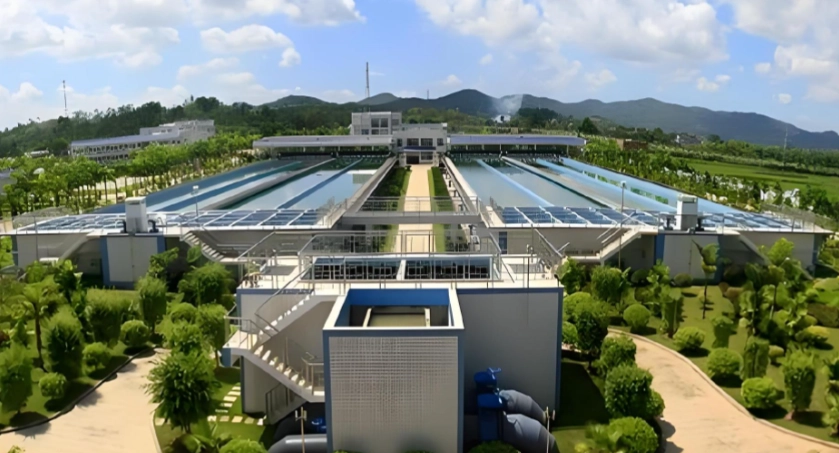
An Industrial Giant's Silent Chokepoint: China Water's Major Investment in Panjin Behind Resource Sovereignty and Heavy-Asset Positioning
China Water invests 480 million yuan to establish a company in Panjin, leveraging heavy-asset positioning and seawater desalination technology to control the lifeline of Northeast China's petrochemical industry—water resource sovereignty.
While the outside world focuses its attention in mid-2026 on the recovery of the trillion-yuan petrochemical production lines in the northeastern heavy industrial base, as well as grand narratives such as the Huajin Aramco fine chemical mega-project—with a total investment exceeding RMB 80 billion—entering mechanical completion and racing toward trial operation, the vast majority of crude oil traders and industry analysts have overlooked the most critical yet silent rigid constraint: water. Refining crude oil and cracking ethylene are themselves super-furnaces that consume enormous quantities of fresh water. Whoever controls the valve on industrial water supply effectively holds ultimate control over the coastal fine chemical belt.
Recently, a state-owned capital restructuring involving hundreds of millions of yuan was quietly completed on the saline-alkali tidal flats of the Bohai Bay Rim, securing its legal positioning.
According to the latest industrial and commercial registration changes on the Tianyancha App, Panjin Xingliao Water Co., Ltd. has been officially established, with legal representative Tang Bin and registered capital of RMB 480 million. Breaking down the full equity structure of this heavy-asset capital deployment, its underlying ownership is 100 percent controlled by China Water Investment Group Co., Ltd., an industry giant with a wholly state-owned central enterprise background.
Why would a national water supply team, accustomed to expanding nationwide and acquiring urban franchise rights, inject nearly RMB 500 million in capital at this moment into Panjin, Liaoning, a seemingly modest coastal prefecture-level city?
The RMB 480 million heavy-asset breakwater and the monopoly over industrial water rights
The widely circulated superficial consensus in the industry holds that this is merely routine public utility infrastructure supporting the landing of major petrochemical projects by local governments, or a routine local infrastructure assistance effort by a central enterprise. Such correct-sounding platitudes completely obscure the underlying interest chain driving the petrochemical industry belt.
The core pain point of fine chemicals has never been a lack of crude oil quotas, but rather the extreme tug-of-war between fragile ecological carrying capacity and rigid resource consumption.
Panjin in the lower reaches of the Liao River in Liaoning, despite hosting a world-class petrochemical new materials cluster through the Liaobin Coastal Economic and Technological Development Zone, faces severe seasonal water scarcity risks from natural surface water resources in northwest Liaoning and the local area. As giant petrochemical vessels such as Huajin Aramco and Borouge LyondellBasell enter dense commissioning and full production cycles by late 2026, the traditional river-based water supply network is simply incapable of bearing alone the daily consumption of hundreds of thousands of tons of industrial pure water. China Water Investment Group's decision at this moment to invest RMB 480 million as a wholly owned venture is essentially building a breakwater of credit and strength with heavy assets—using the highest level of central enterprise credit to replace, consolidate, and take over fragmented local water assets.
The RMB 480 million in paid-in capital recorded in the Tianyancha archives is an extremely precise financial scalpel. Its first strategic mission is to forcibly consolidate and lock down the most core and most profitable industrial franchise water supply rights in the Liaobin coastal industrial belt through wholly owned control. This is an extremely shrewd form of certainty hedging: crude oil prices will fluctuate violently with international geopolitics, and the gross margins on petrochemical products will be ruthlessly squeezed by market cycles—but as long as the boilers of these super-factories continue to roar, every ton of high-purity industrial water delivered into the plants represents an unpayable-in-arrears, drought-or-flood-secured perpetual cash flow.
The comprehensive inflection point of technology: the cyberpunk reality of seawater desalination and unconventional water rights
If we further examine the business scope locked into the Tianyancha system for this new company, we will find a technological inflection point hidden behind it that is now unfolding and is sufficient to overturn traditional water utility logic: seawater desalination treatment, R&D of unconventional water source utilization technologies, and water resource management.
These few lines of cold code logic completely betray the core technological ambition of the national team in the heart of the Bohai Bay Rim. It means that in 2026, relying on the classical logistics-based water utilities of intercepting surface water and extracting groundwater has reached the ecological dead line. Future industrial hubs will inevitably turn comprehensively to the ocean and unconventional water sources to secure their survival space.
Seawater desalination and R&D into unconventional water sources, due to historically high costs, have long existed only in business plan fantasies. However, when chemical parks' demand for high-purity desalinated water reaches the scale of tens of thousands of tons, and as the zero-liquid-discharge regulatory deadline for wastewater tightens, large-scale industrial-grade desalination of the Bohai Bay's high-salinity seawater, stitched pixel-level with deep recycling and recovery of petrochemical wastewater, has transformed into the only viable industrial pathway.
The reason China Water Investment Group has locked the new company's business scope tightly around this technological fortress lies in the engineering know-how in ultra-filtration and reverse osmosis membrane technology accumulated on a national scale by its parent entity. A substantial portion of this RMB 480 million capital base will be converted into large-scale seawater desalination pump stations, high-pressure reverse osmosis workshops, and special industrial water transmission pipeline networks stretching for tens of kilometers across the coastal tidal flats. This is a highly aggressive form of technological positioning: by turning "seawater desalination"—a heavy industry project highly dependent on high initial capital, high electricity consumption, and long-cycle amortization—into a real, operating asset, Xingliao Water has erected fixed-asset barriers at the local Panjin level that competitors have absolutely no possibility of crossing. Those private water utility workshops lacking underlying technical reserves and the capital transfusion capacity of a parent entity will be completely stripped of any qualification to negotiate pricing within the northeastern petrochemical chain under this dual crush of technology and capital.
The ultimate interest alignment of central-local cooperation: the capital memorandum for comprehensive revitalization of Northeast China
Zooming out from the microcosmic anchor point of Panjin, we find that China Water's ambitions in Liaoning have long been connected point by point into a network. From the TOT project for a water supply franchise involving an output of 200,000 tons per day in Shenyang's Shenbei New District, to high-frequency top-level meetings with coastal industrial belts such as Yingkou and Panjin, the national team is staging an extremely seasoned central-local cooperation restructuring drama within the strategic cycle of comprehensive revitalization of Northeast China.
For local finances under heavy transformation pressure and high debt-reduction burdens, handing water utility infrastructure—enormous in investment, extremely long in payback period, and highly demanding in operational control—to a central enterprise for wholly owned control not only completes financial deleveraging and risk isolation through asset off-balance-sheet treatment, but also physically configures the highest level of compliance and supply assurance for attracting global top-tier strategic investors such as Saudi Aramco. On the board of China Water Investment Group, Panjin Xingliao Water is a high-purity extraction pipeline inserted directly into the core industrial arteries of Northeast China.
The evolution of commerce has always been cold and ruthless. In a brutal battle where survival is defined by data security, asset certainty, and underlying control rights, industries lacking resource sovereignty are destined to become compliant fat sheep for capital slaughter.
The RMB 480 million in new registered capital left in the Tianyancha system is the latest bill from this resource sovereignty hunt on the soil of Liaoshen. When the giant distillation towers of Huajin Aramco spew billowing white steam this autumn, what determines the operating rhythm of this hundred-billion-yuan plant will no longer be ocean-going vessels from across the seas, but the seawater desalination valves hidden behind Xingliao Water and coldly calibrated by China Water. This capital restructuring that spans administrative boundaries, technological inflection points, and financial leverage is, with its hardest physical shield, welding shut a sovereign resource supply defense line for China's new industrialization ecosystem along the deep shores of the Bohai Sea.