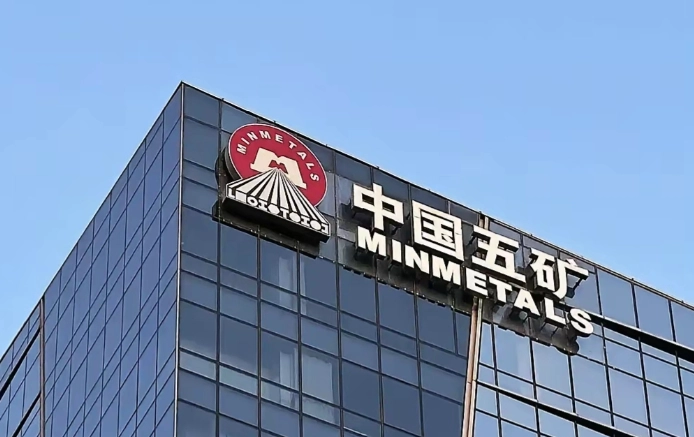
China Minmetals has invested 500 million yuan to establish a Central Asia-South Asia resources company in Xiong'an, aiming to control overseas strategic minerals and safeguard domestic resource security.
As the strategy of relocating central state-owned enterprises' headquarters to Xiong'an New Area enters a deeper phase, a massive injection of state capital registered under the "Xiong'an" label has in fact kicked off an iron-fisted campaign by a Chinese mining giant to seize control of overseas resources. According to Tianyancha App, Minmetals Central Asia & South Asia Resources (Xiong'an) Co., Ltd. was formally established recently, with Wang Jicheng as its legal representative, registered capital of RMB 500 million, and a business scope covering core hard-hit sectors such as non-coal mine mineral resource extraction and metal and non-metal mineral resource geological exploration. It is wholly owned by China Minmetals Corporation.
The landing of this RMB 500 million in real assets is by no means a simple administrative affiliation or a perfunctory move by a state-owned enterprise. The forced stitching together of "Central Asia & South Asia" with "Xiong'an" points to a deeper cause: a heavy-asset, institution-building offensive by a national-level resource security entity to seize pricing power over overseas commodities amid a cycle of zero-sum competition.
The prevailing consensus in the industry holds that a central SOE registering a new company in Xiong'an is merely a response to local investment attraction policies or a routine sub-sector spin-off. Such platitudes completely underestimate the technological inflection point defined by the extreme tightness of global mineral supply chains and heightened geopolitical friction. Central and South Asia have long harbored strategic mineral deposits—copper, lithium, cobalt, and others—that underpin new energy and advanced manufacturing, yet they are also among the murkiest arenas of multinational capital and geopolitical rivalry. By establishing a dedicated overseas extraction entity for this region, China Minmetals is essentially using industrial-scale, capital-heavy logic to reorganize what were once fragmented overseas mining rights, aiming to lock down the most upstream resource sovereignty for domestic manufacturing ahead of the coming wave of intelligent industrial transformation.
The driving forces behind this chess move also stem from China's pressing need for long-term security in strategic mineral resources.
Amid treacherous shipping lanes and the gravitational pull of rising protectionism in traditional mining powers, opening land-based resource corridors and targeting resource extraction deep in Central and South Asian hinterlands has become the only hedging track that can deliver excess security premiums. The RMB 500 million equity base revealed by Tianyancha is precisely the credit rampart that China Minmetals has built for this new overseas platform. With this capital injection, the new company can legitimately represent the national team in undertaking cross-border geological exploration and the survey and construction of large-scale non-coal mines. This wholly owned structure enables the fastest possible pixel-level binding of China's most mature mining engineering know-how with Central and South Asia's abundant resource reserves.
Commercial evolution never recognizes luck without foundation. At the mid-2026 juncture, where survival is defined by data, supply chain resilience, and compliance barriers, sitting in an office reviewing business plans can no longer ease the pain of resource bottlenecks.
This corporate registration, now recorded in Tianyancha's files, sounds an alarm for all traditional giants that rely on open-market procurement from overseas. When minerals in the ground can no longer be easily obtained through free trade, throwing capital as fast and as heavily as possible at the most basic layer of materials—and competing for exploration rights in the rugged mountains of foreign lands—has become the ultimate battle that cannot be avoided in the new round of great-power competition. In this contest over resource sovereignty, China Minmetals has already pushed its strategic outpost to Xiong'an, but what will truly decide the outcome is the iron-fisted efficiency with which cold overseas exploration blueprints are converted into hot industrial raw materials.