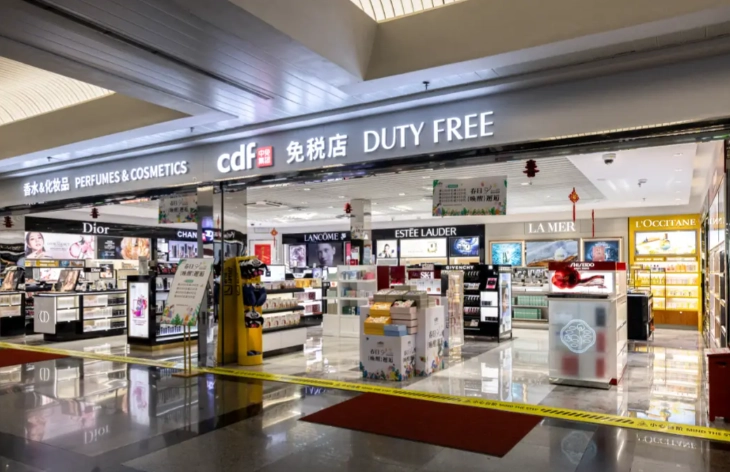
CDFG Partners with Inner Mongolia Airport Group: Flow Monetization and Duty-Free Landscape Reshaping Behind the Encirclement of Downstream Ports
CDFG joins forces with Inner Mongolia Airport Group, deploying 3.9 million yuan in a light-asset layout in Hohhot to capitalize on low-cost traffic at a regional hub and reshape the duty-free landscape.
As the tax-free dividend at premier mega international airports enters a period of deepening growth challenges, squeezed by cross-border capacity diversion and "consumer deleveraging" among core spending demographics, the duty-free giant is pivoting with remarkable agility and granularity, driving its defensive and surprise heavy-asset reach into second-tier regional feeder hubs that offer geopolitical advantages and long-tail growth.
Recently, a business registration notice disclosed by Tianyancha App has fully exposed a core long-term strategic move by China Duty Free Group (CDFG) in terms of densifying its presence in northern ports and expanding into lower-tier markets: the quiet establishment of CDF (Hohhot) Commerce Co., Ltd. In stark contrast to the imposing scale of tens of billions of yuan the "duty-free leader" has poured into Hainan and Shanghai, this latest strategically positioned entity has a registered capital precisely and extremely lightly set at RMB 3.9 million.
Most industry observers, accustomed to evaluating the duty-free landscape through Sanya海棠湾 GMV figures and international route recovery rates, tend to interpret this move as a routine regional retail consolidation of little consequence, or a formality registration by the conglomerate to meet specific local port bidding requirements. This superficial reading completely misjudges the systemic monetization anxiety faced by CDFG's core management team amid pressure on traditional heavy luxury retail sales and the extreme compression of profits in core duty-free channels by exorbitant minimum guaranteed rents, as well as the deeper rationale behind their attempt to forcibly acquire near-field traffic in the inland northwest through the purest form of regional "resource alliance" packaging.
This capital maneuver, shifting from traditional mega-hubs to regional feeder capillaries, has its real interest chain hidden within the cold slices of business registration data in the Tianyancha system.
Tianyancha business information clearly shows that CDF (Hohhot) Commerce Co., Ltd. is jointly held by China Duty Free (Group) Co., Ltd. and Inner Mongolia Autonomous Region Civil Aviation Airport Group Co., Ltd., with寇帅 as the legal representative. Opening its registered business scope in the Tianyancha system reveals a monopolistic landscape heavily dependent on specific administrative access and franchise rights: duty-free goods sales, tobacco product retail, and food sales are all listed as core categories.
Why would a mega-conglomerate controlling half of the global duty-free market choose this moment to deeply bind itself with a local civil aviation airport group through a mere RMB 3.9 million stake?
The key driver lies in the unforgiving survival rules of the duty-free industry, shifting from a "blind faith in mega-hub astronomical rents" to "precision harvesting of high-margin franchise goods."
Under traditional business logic, CDFG's dominance at top-tier airports in first-tier cities has come at the cost of paying staggering commission rates and minimum guarantee rents. This heavy-asset gamble was a money printer during periods of surging traffic, but in the quagmire of a long-cycle consumer downturn, it rapidly transforms into a cash flow black hole that cannibalizes the parent company's health. CDFG's only future profit defense line lies in building long-term pure profit channels based on extremely low rental costs and strong-demand franchise goods (such as tobacco and specialty foods).
Hohhot, as a core hub connecting feeder airports across Inner Mongolia and radiating toward the Mongolia-Russia border ports, has seen its density of international transfer and regional business traffic undergo structural restructuring in recent years. More critically, the direct equity participation of Inner Mongolia Civil Aviation Airport Group in the Tianyancha shareholder table means that CDFG has forcibly welded the local airport's capacity sovereignty to its own retail sovereignty at the most fundamental level of the interest chain.
With local state-owned airport group equity participation, CDFG can not only secure the most prime storefront locations at Hohhot Baita International Airport (and even the future Shengle International Airport) at incredibly favorable commercial terms—potentially even zero minimum guarantee—but also virtually eliminate all administrative friction costs and time depreciation in highly regulated areas such as tobacco product retail and specific food import sales, which rely heavily on approvals from local tobacco bureaus and food and drug regulators.
And this RMB 3.9 million micro-injection is precisely the most astute "light-asset trial-and-error isolation wall" within this high-purity profit cleansing model.
Keeping the registered capital of the domestic entity within a single-digit million boundary is a clear demonstration of the frugal mindset of CDFG and Inner Mongolia Airport Group in their long-cycle strategic layout. The second half of the retail war in Shanghai and Shenzhen has long moved beyond the rough paradigm of blindly spending on luxury fit-outs and heavy-asset cash-advance expansion. Through this clean commercial shell, CDFG can strategically feed high-margin duty-free tobacco and alcohol, excess inventory of major cosmetics brands, and other supply chain resources to inland feeder hubs, cleansing transit traffic into pure cash flow profits at extremely low customer acquisition costs.
If this port successfully establishes a high-frequency, high-growth closed loop amid the broader geopolitical and commercial landscape, the dividends can flow back to the parent company with high capital efficiency. Conversely, should regional capacity take a downturn amid messy market clearing, the maximum legal and financial depreciation is firmly locked within the extremely low defense line of RMB 3.9 million, never threatening the sustained premium of CDFG's parent balance sheet.
The duty-free story, now in its second half, has long moved beyond the false prosperity of blindly stacking store counts and buying capital confidence through grand narratives. When the scale dividends of rough expansion are fully exhausted, what truly tests a dominant player's survival capability is no longer how many international routes it occupies, but whether its most fundamental cells can maintain absolute compliance-driven profitability and low-cost resilience amid the clearing of existing inventory.