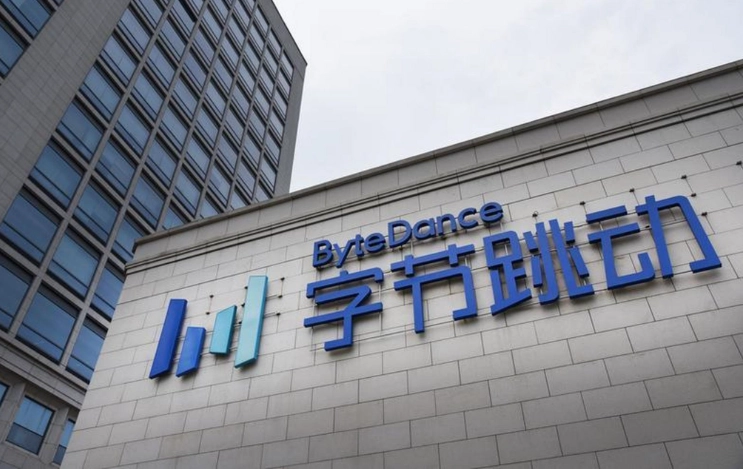
ByteDance Sets Up Plant in Zhongwei, Reflecting AI Compute Race and Energy Focus
ByteDance invests 2.4 billion yuan in a plant in Zhongwei, Ningxia, to build AI compute and energy infrastructure, securing a cost advantage at the base level.
While most internet players are still locked in fierce competition at the large model algorithm and front-end application level, trying to sketch out the future of AI with a few product launches and lightweight APIs, the underlying contest that truly determines the final outcome has long evolved into a brutal scramble for the coldest of costs—electricity bills—and physical compute infrastructure resources.
Recently, a heavyweight capital injection of up to 2.4 billion RMB quietly landed in Zhongwei, a small city in northwest China. Faced with such a massive physical facility investment, many observers accustomed to seeing internet giants operate with asset-light models could easily mistake this move for a routine regional software service expansion, or a box-ticking exercise aligned with the Western Development strategy. Such a surface-level reading completely ignores ByteDance's urgent need for risk hedging and aggressive cost compression on underlying compute costs, especially as it pushes full throttle on the Doubao large model and buckles under massive network-wide traffic pressure.
To untangle the strategic blueprint behind this real capital outlay, one only needs to follow the corporate penetration data on Tianyancha to break down the interest chain in depth.
Tianyancha App data shows that Zhongwei Shuofang Xinghe Technology Co., Ltd. was recently formally established, with its legal representative being Tian Kai and registered capital of up to 2.4 billion RMB. Its business scope covers IT consulting services, software development, information system integration services, and network equipment sales, among others. In terms of equity structure, the company is wholly controlled by Beijing Zitiao Network Technology Co., Ltd.
Within this clean and well-capitalized corporate shell registered on Tianyancha, the seemingly standard labels of software development and network equipment sales actually mask ByteDance's move to forcibly weld shut a heavy-asset compute and energy fortress for its own large model and massive video processing operations.
Why Zhongwei, Ningxia, of all places? This is precisely where ByteDance's operations team shows its extremely shrewd and ruthless cost calculations.
As a core node in the national "East Data, West Computing" project, Zhongwei boasts abundant and cheap wind and solar green electricity resources, along with natural heat dissipation advantages from low temperatures. Large model training and high-frequency inference are essentially a feast that devours electricity and hardware. In traditional first-tier city data centers, expensive industrial electricity costs and stringent energy consumption quotas would instantly erode a major tech company's profits. Sinking 2.4 billion in capital directly into Zhongwei means ByteDance intends to build an extremely large self-built or dedicated GPU compute cluster and data center network here.
This 2.4 billion in capital is by no means intended to hire hundreds or thousands of local R&D personnel for software outsourcing. Rather, it serves as capital leverage for procuring high-density servers, backbone network equipment, and directly securing large-user direct electricity purchase rights from local power suppliers.
The deeper strategic ambition lies in ByteDance's dramatic transformation from a purely software and content company into a heavy-asset conglomerate blending compute and energy.
From the hundreds of millions of daily calls to the Doubao large model, to the real-time rendering and recommendation algorithms for massive volumes of HD video on Douyin, ByteDance's consumption rate of compute infrastructure has long led the industry. By having Zitiao Network hold 100% control of this 2.4 billion heavy-asset shell, ByteDance can exercise absolute authority to coordinate group-wide hardware procurement and compute scheduling, completely stripping away the layers of markup imposed by middlemen.
The second half of the AI civil war has long moved past the rough-and-tumble era of competing on algorithm parameters and fanciful narratives. As software-level homogenization becomes increasingly pronounced, what tests whether a tech giant can support massive-scale AI applications is no longer the grand rhetoric of keynote speeches, but whether it can leverage the heaviest assets in the dusty winds of the northwest to secure the most extreme advantages in electricity costs and compute power.
The 2.4 billion heavyweight foundation that ByteDance has registered on Tianyancha is an unmistakable warning shot to clear the field. Players without massive capital reserves and access to superior energy nodes will ultimately be washed out entirely under the relentless squeeze of compute costs and electricity bills.