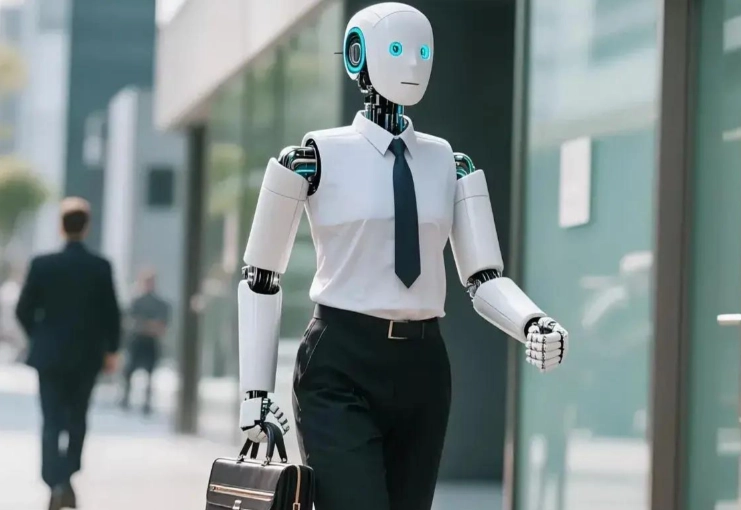
ByteDance's Physical Penetration and Legacy Daily Chemical's Capacity Anxiety: The Computational Power Shift from Virtual to Real Behind a Joint Robot Investment
ByteDance and Nice Group jointly invested in a robotics company, revealing the physical penetration of big tech after traffic peaks and the cost-cutting anxiety of traditional manufacturing.
When the algorithm operator of a short-video empire and a veteran of traditional manufacturing who built his fortune selling laundry powder sit, incongruously, at the same shareholder table of a robotics startup, this has clearly departed from the conventional narrative of financial investment. Quantum Leap, a subsidiary of ByteDance, joined forces with Nice Group to invest in Shanghai Weilai Bu Yuan Robotics Co., Ltd. This seemingly incongruous cross-industry co-investment precisely exposes the ambition of big tech to penetrate the physical economy after reaching peak traffic, as well as the production capacity anxiety of traditional FMCG giants squeezed by shrinking profit margins.
The hype around large models and embodied intelligence has begun to induce fatigue in the venture capital circle—purely pitching technology stories can no longer easily coax real money from investors. Following the trail of the business registration changes frozen in Tianyancha to dig into this tech entity founded less than two years ago, its business scope spans AI-based foundational software development and industrial robot manufacturing, which together form a bridge connecting virtual computing power with physical production lines.
In this capital expansion that saw registered capital rise from 6.28 million to 7.69 million yuan, the identities of the participants carry more industrial metaphor than the financing amount itself.
ByteDance's Physical Penetration
For ByteDance, the breakneck growth of Douyin e-commerce is hitting the fulfillment ceiling of the physical world. Front-end livestream selling can achieve explosive conversion through its ferocious recommendation algorithms, but the back-end warehousing, sorting, and logistics flows are built on cold metal tracks and extremely dense human labor. With online traffic dividends fully exhausted, the core competition among e-commerce giants has long shifted from front-end customer acquisition costs to back-end per-package fulfillment losses.
By extending its capital reach into industrial intelligent robotics, ByteDance's fundamental purpose is to leverage its surplus AI visual recognition and algorithmic scheduling capabilities to equip traditional automation equipment with a shell capable of autonomous decision-making. This is not merely about defending against JD.com and Alibaba's moats in asset-heavy logistics, but also about forcibly squeezing out valuable profit margins in the fiercely competitive e-commerce stock market through unmanned robotic ecosystems.
Nice Group's Production Capacity Anxiety
Nice Group's abrupt entry exposes the most realistic survival pain points in the heartland of Chinese traditional manufacturing. The daily chemical FMCG industry is a red-sea quagmire where gross margins are calculated down to fractions of a cent. Under the combined assault of volatile raw material prices and continuously rising labor costs, the old-fashioned management model of relying on sheer manpower on traditional production lines has long become unsustainable.
This traditional giant's decision to fund a robotics startup is not about chasing tech trends, but about finding a lifeline to fundamentally overhaul its own assembly lines and cope with the looming labor shortage. They need extremely low-cost, highly efficient intelligent robots to replace dense manual labor in workshops, thereby preserving their last bit of cash flow in the brutal price wars of distribution channels.
The Survival Code of Virtual-Physical Convergence
These two seemingly unrelated capital forces converging at the company "Weilai Bu Yuan" sketches out the coldest survival rules of the second half of China's intelligent manufacturing race. Internet giants wielding core algorithms urgently need physical shells to host their overflow technical capabilities and use them to aggressively penetrate the depths of physical supply chains; meanwhile, traditional manufacturers stuck in growth stagnation desperately need the lowest-cost intelligent transformation solutions to hedge against cost crises.
This quietly occurring equity change has fully torn off the veil of self-admiration worn by some tech companies in their isolated laboratories. As capital frenzy recedes completely, what determines the life or death of a robotics startup is no longer the esoteric code frameworks in financing pitch decks, but whether it can simultaneously satisfy the supply chain ambitions of big tech and the cost-reduction hunger of traditional workshops. This increase of a few hundred thousand yuan is merely a tentative entry ticket. It signals that amid intense industrial restructuring, any tech player that cannot rapidly convert algorithms into genuine efficiency gains on factory assembly lines will be ruthlessly washed away in this grinding convergence of the virtual and physical.