Bluepoint Touch commands 80% share, but its high margins face pressure as a cost-reduction storm sweeps the robot-building industry.
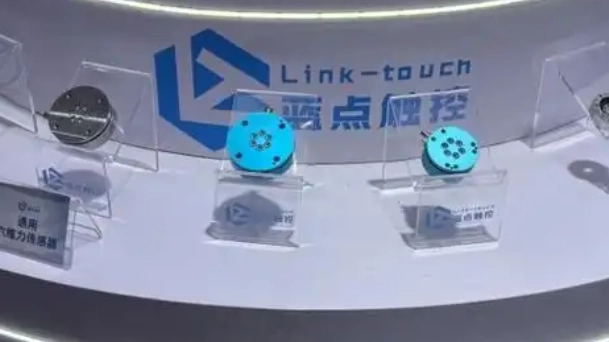
When a report jointly released by CCID and China Electronics News pushed the Chinese humanoid robot six-axis force sensor market into the spotlight, disclosing that domestic sales last year broke through the 10,000-unit mark for the first time, that domestic manufacturers captured 92.8% of the market share, and that Bluepoint Touch alone swallowed a dominant slice of more than 80%, the outside world's attention to the robot supply chain finally shifted substantively from mechanical transmission hardware such as coreless motors and planetary roller screws to the neural center that determines whether a robot can perceive the physical world the way humans do.
If one focuses only on the national narrative of a sweeping victory in domestic substitution, one will overlook what lies behind this hundred-million-yuan-scale micro-track that displayed highly oligopolistic characteristics at a very early stage: the ecosystem lock-in with OEMs, the bottleneck of micro-adjustment decoupling processes, and the brutal price pressure under the cost-reduction storm of mass production of complete machines.
In the physical composition of a humanoid robot, six-axis force sensors are often vividly compared to the nerves at the robot's fingertips and ankles. Unlike single-axis pressure sensors that can only measure force in the vertical direction, six-axis force sensors must simultaneously and precisely resolve three directional forces and three directional moments in a three-dimensional Cartesian coordinate system. For a long time, this precision instrument was monopolized by established sensor giants from Europe, the United States, and Japan in small-batch, ultra-high-unit-price industrial niches such as aerospace wind tunnel testing, high-end automotive crash testing, and orthopedic surgical robots, with a single unit often priced at tens of thousands or even over a hundred thousand yuan.
When humanoid robots suddenly pushed open the door to the physical world, requiring a single complete machine to be equipped with 4 to 6 force sensors at the wrists, ankles, and other locations, while the BOM cost of the complete machine had to be compressed to within several hundred thousand yuan, the arrogant posture of traditional overseas giants—with delivery lead times as long as half a year and a refusal to cooperate with algorithm iteration—directly opened up a huge strategic vacuum for local innovative enterprises.
Following the industrial and commercial foundation to penetrate the organizational form and production capacity formation of this hidden champion, its trajectory of expanding from R&D laboratories to industrial manufacturing is clearly visible in Tianyancha data. Tianyancha industrial and commercial data show that Bluepoint Touch (Beijing) Technology Co., Ltd. was established in April 2019, with registered capital of approximately 5.5832 million yuan, and its legal representative is Liu Wuyue. The enterprise labels have directly been marked as a specialized, refined, distinctive, and innovative small and medium-sized enterprise as well as Series D and above.
In the out-of-town investment map penetrated by Tianyancha, the company established its wholly owned subsidiary Bluepoint Touch (Jiangmen) Technology Co., Ltd. as early as November 2022.
Beijing is responsible for underlying force perception algorithm iteration and joint R&D with leading customers, while Jiangmen relies on the mature hardware and machinery processing and industrial worker dividends of the Pearl River Delta to undertake batch final assembly and automated calibration. This north-south collaborative industrial layout enabled Bluepoint Touch to complete the heavy-asset climb from blueprint prototyping to large-scale mass production lines before the industry风口 took off.
The more critical commercial moat lies in its extremely aggressive early customer ecosystem positioning and capital feedback.
The core threshold of six-axis force sensors appears on the surface to be the structural design of elastomer strain gauges, but the deeper logic is extremely complex cross-decoupling algorithms and a lengthy joint calibration process. When force is applied, there is naturally physical deformation coupling interference among the various axial directions. How to accurately resolve the signals requires sensor manufacturers to go deep into the underlying motion control code of OEMs for months of close-fit adaptation.
In the early stage, Bluepoint Touch decisively bypassed the red ocean of traditional industrial robotic arms and fully plunged into the first batch of domestic embodied intelligence OEMs such as AgiBot, Galaxy General, and Xiaomi. Through deep binding with these pioneering customers at the early prototype stage, Bluepoint Touch not only locked in exclusive access for future batch orders in advance, but also used real force data from dozens of OEMs to feed back into the maturity of its own decoupling algorithms.
Along with the successive hundred-million-yuan-level heavy bets this year from industrial capital such as Puquan Capital under CATL and AgiBot, this capital closed loop—acting as both supplier and forming an interest community with downstream leading complete-machine makers—directly built a cliff of up to 80% market share at the physical level, marginalizing established players such as Kunwei and Yuli in the humanoid robot incremental segment to less than 10% share.
However, standing at the peak of 80% share absolutely does not mean Bluepoint Touch can sit back and enjoy excessive profits.
A sales volume of 10,000 units and a hundred-million-yuan-scale market still represent an extremely small industry pie for a unicorn in its growth stage whose valuation has been pushed to Series D by various capitals. Once the commercialization of humanoid robots falls short of expectations, annual demand at the 10,000-unit level will quickly hit a growth ceiling. The more fatal pressure comes from the almost perverse extreme pressure that complete-machine manufacturers place on BOM costs.
In order to achieve mass production and deployment, Tesla Optimus and mainstream domestic complete-machine manufacturers are forcing the entire industry chain into cliff-like cost reduction. The average unit price of six-axis force sensors is plunging toward several thousand yuan or even within one thousand yuan, halving every year.
If in the future OEMs shift to using lower-cost single-axis force sensors combined with motor current loop algorithms for equivalent force control, or if complete-machine giants build their own sensor production lines internally for independent controllability, the high-gross-margin single product on which Bluepoint Touch depends for survival will face enormous risk of being bypassed or deeply squeezed.
This battle for component positioning on the eve of the humanoid robot explosion conveys a sober fact to all hard-tech supply chain players: in an emerging hardware wave, using engineering response speed to capture an early high share only secures a front-row seat. But when the capital carnival recedes and mass production of complete machines enters a brutal period of affordable cost accounting, how to defend the bottom line of technical premium and cash flow self-sufficiency in the quagmire of extreme cost reduction is the ultimate test that determines whether a segment leader degenerates into a contract manufacturer casually manipulated by downstream players or truly leaps into a global giant in force perception.