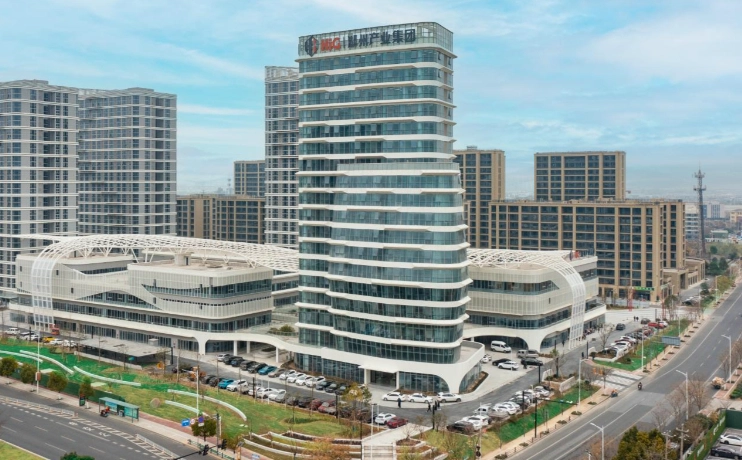
A Billion-Dollar Bet from Digits to Data: Local Urban Investment Firms Navigate a New Capital Landscape Beyond Land
Huzhou Urban Investment injects 800 million yuan into data technology, exploring a new path of data assetization beyond land finance.
A seemingly dull state-owned enterprise capital increase has actually raised the curtain on a ruthless restructuring of local government balance sheets. The Tianyancha App shows that recently, Huzhou Digital Group Co., Ltd. underwent industrial and commercial changes, with the company name changed to Huzhou Data Technology Group Co., Ltd., and registered capital surging from RMB 200 million to RMB 1 billion, an increase of 400 percent. Meanwhile, Wang Zhen stepped down as legal representative and was succeeded by Pan Zimin.
This RMB 800 million injection of real capital, fully funded by major shareholder Huzhou City Investment Development Group, is by no means a simple administrative renaming. The shift from "Digital" to "Data Technology" reflects a deeper underlying cause: local understanding of the digital economy has officially transitioned from a cost-expenditure phase for government IT systems to a capital-harvesting phase for data asset monetization.
In the past, the digital group was essentially a funding pass-through vehicle for IT construction, representing pure cost consumption. Now, with the renaming to Data Technology Group and the RMB 1 billion injection, the technological inflection point lies in the wave of data factoring and localized large model training. Data has been established as a certified factor of production. The core mission of this new group is no longer to spend money on software, but to centrally clean and monopolize the city's public data, transforming itself into a machine that generates cash flow by licensing data usage rights and renting out computing capacity.
On the other side of the profit chain, this move exposes the intense survival anxiety of parent company Huzhou City Investment after losing the dividends of land.
As traditional land collateral shrinks significantly across the board, how can a city investment company maintain its credit rating to borrow cheap long-term funds from banks? The answer lies in the RMB 1 billion equity base revealed by Tianyancha. Data asset inclusion on balance sheets is becoming the most legitimate capital maneuver of 2026. To turn virtual data into hard assets that can be valued and mortgaged on a balance sheet, the operating entity's capital base must be sufficiently robust. This expanded RMB 800 million is the credit wall Huzhou City Investment has built for this new financing platform. With this RMB 1 billion in capital, Huzhou Data Technology Group can take on mega intelligent computing center projects, pledge local data for financing after valuation, and thus carve out a financial channel independent of land.
The prevailing bandwagon consensus in the industry holds that as long as a data group is established, a locality can instantly uncover a digital gold mine. Such platitudes underestimate the extremely high barriers to monetizing data elements. The cleaning, certification, and scenario-based deployment of data involve technical hurdles far more complex than building structures. Without market-oriented operational talent, even RMB 1 billion in capital can erode through depreciation.
Pan Zimin's appointment comes against this backdrop, carrying expectations of ruthless execution. This industrial and commercial change recorded in Tianyancha files serves as a wake-up call for old-school city investment firms still clinging to land finance. When soil can no longer provide a lever for cash generation, mining for value in the microscopic world of bits has become the ultimate battle that cannot be avoided in urban competition. In this game of data sovereignty, Huzhou has already placed its chips—RMB 1 billion—and what will truly determine the outcome is the ruthless efficiency with which cold data tables are converted into hot cash assets in the period ahead.