BeiGene trades a price cut for 8% of patients in exchange for political breathing room, while $26 billion in domestic production capacity comes under pressure, reflecting the geopolitical game of Chinese innovative drugs going global.
When BeiGene announced that it had reached a voluntary price reduction agreement with the U.S. government to restructure the pricing of its core PD-1 monoclonal antibody tislelizumab (Baizean) in the United States, and emphasized that it would cover only about 8% of specific local patients, the first reaction of the pharmaceutical capital market was a long sigh of relief. Constrained by strict confidentiality clauses, the size of the price cut was not made public, but the highly restrained beneficiary ratio of 8% quickly led Wall Street and the secondary market to the optimistic conclusion that the impact on total revenue would be limited.
However, if one looks beyond this superficially mild financial figure and deconstructs the deep waters of the China-U.S. pharmaceutical geopolitical game, it becomes clear that this so-called voluntary price reduction is by no means a routine concession for medical insurance access, but rather a highly sophisticated set of political de-mining and defensive hedging tactics actively deployed by a Chinese domestic innovative drug giant in the face of the drug pricing storm under the U.S. election cycle, the restructuring of most-favored-nation treatment, and the undercurrents of the BIOSECURE Act.
For a long time, the U.S. pharmaceutical market has been the ultimate sanctuary where all global drugmakers sustain ultra-high gross margins. Unlike the sweeping price-for-volume approach of domestic medical insurance negotiations in China, the complex ecosystem of commercial insurance and PBM intermediaries in the United States has built the world's most expensive but also most lucrative drug pricing pool. However, this old order, which relies on high pricing to extract excess global profits, is collapsing.
The most-favored-nation drug pricing executive order promoted by the White House requires drug prices to align with the lower prices of overseas developed countries; and the Inflation Reduction Act (IRA) even directly grants Medicare the power to forcibly cut prices for blockbuster mature drugs. In this round of political strangulation, multinational pharmaceutical giants are all on edge, and as the first Chinese domestic pharmaceutical company to bring a self-developed monoclonal antibody to the U.S. medical insurance negotiating table, BeiGene is under exponentially magnified scrutiny.
Domestic heavy-asset foundation: a physical wall built by 26 billion yuan in registered capital
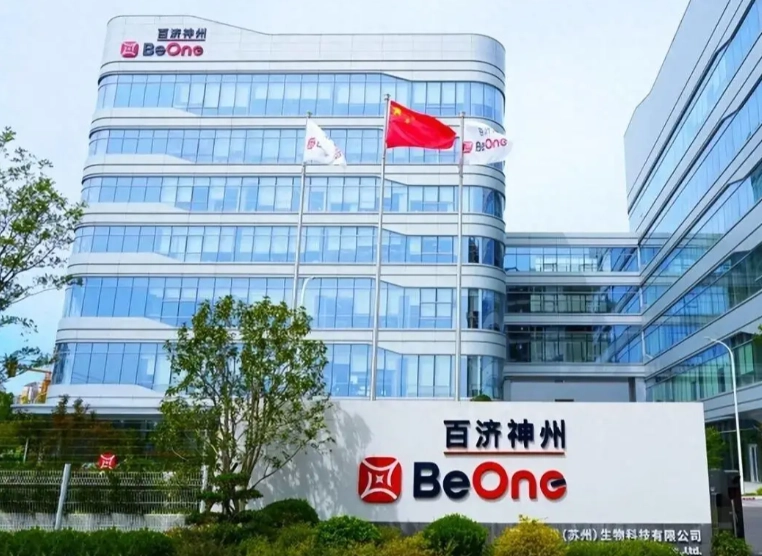
Following the underlying industrial and commercial structure to penetrate BeiGene's industrial layout, the scale of its domestic R&D and production heavyweights is extremely profound in its industrial and commercial records. Tianyancha industrial and commercial data shows that BeiGene has built a huge and independent cluster of entities within China: BeiGene (Beijing) Biotechnology Co., Ltd. has registered capital of approximately 2.723 billion yuan and leads early drug discovery;
BeiGene (Suzhou) Biotechnology Co., Ltd. has registered capital of approximately 4.973 billion yuan and undertakes the industrialization of small-molecule innovative drugs; while BeiGene Biologics Co., Ltd., which carries the massive production capacity for large-molecule biologics, has registered capital as high as an astonishing 18.972 billion yuan.
A domestic registered capital foundation of more than 26 billion yuan connects advanced R&D centers and world-class bioreactor clusters in Beijing, Suzhou, Guangzhou, and other places. This massive set of physical assets constitutes BeiGene's most solid physical wall, but it also means that its enormous production capacity and R&D depreciation must rely on the continuous blood-making of major global payment markets to complete amortization.
The partial 8% price cut: extreme shrewdness in commercial and political maneuvering
It is precisely based on this underlying demand that the partial 8% price cut demonstrates BeiGene's extreme shrewdness in commercial and political maneuvering.
Although tislelizumab is certainly the cornerstone of solid tumors in BeiGene's overall revenue matrix, in the U.S. market it only officially entered indications such as second-line esophageal squamous cell carcinoma this year, and facing layered encirclement by first-mover overlords such as Keytruda and Opdivo, its market share is still in an early pioneering stage. More importantly, the super blockbuster that truly carries half of BeiGene's overseas revenue is the blood cancer drug zanubrutinib.
Choosing to be the first to extend an olive branch to the White House in the Medicaid disadvantaged scenario for Baizean not only exchanges a reimbursement green card for new drugs entering state public medical insurance catalogs at a very small revenue cost, but also completes a low-cost gesture of showing a cooperative posture to local regulators.
The deeper intention of this feint is to win a broader strategic buffer zone for the real cash cow, zanubrutinib. Zanubrutinib currently relies on statutory exemptions under multiple orphan drug designations to temporarily avoid the first batch of mandatory price negotiations under the IRA. By voluntarily cooperating with price cuts in a segmented solid tumor field, BeiGene on the one hand avoids the political risk of being placed on a punitive target list, and on the other hand builds a subtle firewall for potential future tariff exemptions or regulatory access.
Cracks in the de-mining defense line: global price linkage and supply chain decoupling risks
However, this de-mining defense line is not impregnable.
The core logic of the most-favored-nation pricing promoted by the U.S. government lies in international price linkage. If BeiGene lowers the price anchor for tislelizumab within a specific U.S. public system, will this demonstration effect of price reduction trigger chain reactions from other overseas payers such as Europe and Japan demanding similar cuts? Once medical insurance review agencies in various countries around the world follow the trail and demand equal discount terms, its overseas commercialization pricing system will face the risk of being pierced through in a chain reaction.
An even more severe hidden danger lies in the fact that if the domestic R&D and production heavy assets of more than 26 billion yuan face further decoupling from the geopolitical technology supply chain and cross-border review, how to maintain the seamless flow of global supply in the double crevice of compliance and geopolitical mutual trust will be a hard battle the company cannot avoid.
This transoceanic drug pricing compromise on the eve of the late-autumn election releases a cold warning to the entire Chinese innovative drug overseas expansion sector: the era of going overseas to pan for gold simply by relying on laboratory molecular advantages has ended. In the deep waters where overseas payment systems are becoming increasingly conservative and geopolitical defense lines are being reinforced layer by layer, going overseas is not only a competition in clinical data, but also an extreme maneuvering act of continuously trading partial interests for overall survival space under the gun muzzles of policy.