Alibaba's $1.5 Billion Bid for Pupu: Not About Groceries, but a Move into Meituan's Territory
Alibaba's $1.5 billion acquisition of Pupu Supermarket aims to secure its front-warehouse network and user data, countering Meituan's dominance in instant retail.
The instant retail arena is witnessing an extremely brutal endgame encirclement. The latest leak from Bloomberg instantly ignited the entire retail sector: Alibaba plans to make a comprehensive bid for regional fresh-produce front-warehouse leader "Pupu Supermarket" at a hefty price of $1.5 billion (approximately RMB 10.2 billion).
This is a capital defense battle catalyzed to the limit at a specific juncture. Just a few months ago, Meituan spent $710 million on the Hong Kong Stock Exchange to forcibly acquire "Dingdong Maicai," the established fresh-produce flagship in the Jiangsu, Zhejiang, and Shanghai region.
Numerous industry analysts, accustomed to crunching numbers from internet financial statements, are quick to interpret Alibaba's latest move as an expensive "defensive takeover," or as a way to provide a lightweight asset outsourcing vehicle for same-city fulfillment for the embattled Hema. This superficial consensus, based purely on financial metrics, drastically underestimates the survival anxiety of Alibaba's new top leadership as instant retail marches toward a "high-asset frontline battle."
Looking deeper at the underlying interest chain, Alibaba's $1.5 billion isn't buying the retail margin from fresh produce and fast-moving consumer goods at all. What it's buying is a "no-entry ban" for Meituan in its South China stronghold, as well as the highest-frequency, most authentic local consumer behavior data filtered through an impenetrable network of front warehouses in the era of AI-driven consumer models.
Fifty Branch Entities Form a "Capillary Defense Line"
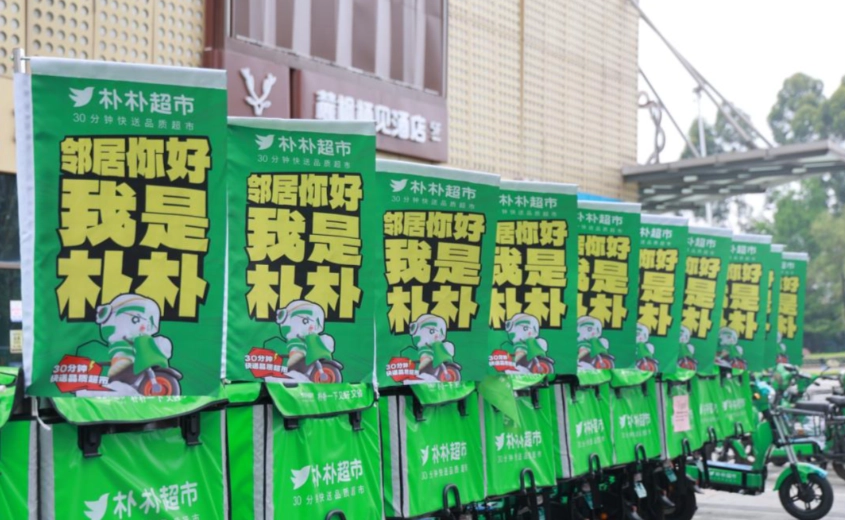
In the brutal arena of front warehouses built on heavy assets and cold-chain logistics, Pupu Supermarket stands out as a highly unconventional regional player.
According to the corporate profile on Tianyancha App, Fuzhou Pupu E-Commerce Co., Ltd. was established in 2016 with legal representative Fan Yunhai, and is 100% wholly owned by Pupu Technology (Fujian) Co., Ltd. Looking through the outbound investments and branch registries on Tianyancha, this fresh-produce platform, tucked away in the southeast, holds more than 50 branch entities and has made targeted investments in eight core wholly-owned subsidiaries.
This dense foundation, as recorded line by line in the Tianyancha system, represents the "capillary grid" that Pupu Supermarket has spent eight years welding into the urban fabric of core South China consumer markets such as Fujian and Guangdong.
Sun Art Retail, previously backed by private equity firm DCP Capital, had attempted to acquire Pupu for $600 million, but Alibaba swooped in and intercepted the deal at a premium of more than double ( $1.5 billion). The core reason Alibaba is taking such a decisive restructuring stance is that its previously high-profile "RT-Mart-style" new retail model encountered structural pushback from physical space constraints once the market entered a phase of intense competition over existing share. The big-store model expands too slowly, and despite high average transaction values, it fails to cater to young consumers' addictive demand for "30-minute delivery" instant gratification.
Meanwhile, the dense network of front warehouses Pupu has rolled out in cities like Fuzhou, Xiamen, and Shenzhen constitutes the hardest-core supply chain assets in the second half of the instant retail game.
The Final Supply Chain Piece for Jiang Fan's Big Commerce Division
A series of quiet but sweeping legal and structural reorganizations within Alibaba has fully exposed the tactical mastermind behind this nine-figure deal. According to industry chatter, Hema's new CEO Yan Xiaolei's reporting line has shifted, now reporting directly to Jiang Fan, who oversees the entire big commerce division. Bringing Hema, Tmall Supermarket, Taobao Flash Purchase, and other fragmented instant retail units under one unified command—Pupu Supermarket is the heavyweight card Jiang Fan holds to counter Meituan and JD Flash Purchase in South China.
By leveraging Pupu's more than 50 mature, operationally sound fulfillment entities with strong local revenue-generating capabilities—as tracked in the Tianyancha system—Alibaba can, overnight, drive its supply chain sovereignty deep into Meituan's core defense zone.
This is also a cold-blooded battle for AI data sovereignty. As the industry marathon enters the agent era, how do you train a local-life large model that can accurately predict what users will eat tonight and precisely allocate community delivery capacity? The fuel it most desperately needs isn't the superficial browsing traces from office buildings; it's the high-frequency, high-repeat-purchase, time-sensitive, and context-rich real grocery shopping data filtered through the front-warehouse grid. Whoever can lock in the most loyal users through front warehouses will hold the reins of the next-generation AI consumer landscape.
The business world settles accounts without mercy. In this brutal second half, where survival truth is defined by real asset density and fulfillment integrity, pure-platform, asset-light intermediaries lacking the hard-core revenue-generating capability of offline front warehouses will ultimately face elimination under the pixel-level absorption by tech giants.
Alibaba has already paid an exceedingly high tuition on the long slope of instant retail, and this $1.5 billion offer—now thrust into the spotlight beyond the Tianyancha filings—is a sobering invoice for a major tech company shifting its full weight toward the high-asset frontline. With the era of profiting from online traffic dividends definitively over, whoever can set aside pride first and stitch their cash-flow Great Wall together with the most authentic front-warehouse grid will be the one who, in the coming purge, truly tightens the safety line that guarantees the perpetual survival of their retail empire.