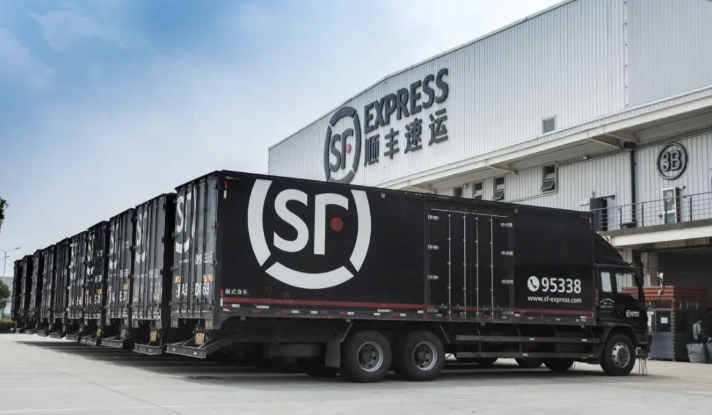
SF Express injects 20 million yuan into its Tibet subsidiary, deepening high-altitude specialty and cold-chain logistics, positioning in key western strategic territory.
16-Year Veteran Bets Against the Tide: SF Express Injects 20 Million Yuan to Rebuild Its Highland Foundation, Positioning Itself in the Strategic Deep Water of Snowy-Region Logistics
While the express delivery market on the eastern coast has long been mired in penny-by-penny price wars over existing volume, with industry dividends nearly exhausted, the capital firepower of the logistics industry's established giants is now shifting decisively—through the most concrete corporate actions—toward the deeply isolated borderlands.
Recently, corporate registration information disclosed by Tianyancha App showed that Tibet SF Express Co., Ltd. completed a significant business registration change during a highly pragmatic strategic adjustment, increasing its registered capital to 20 million yuan in one move. As a logistics veteran that has operated in Tibet for sixteen years, this seemingly low-key capital increase from the millions to the tens of millions has instantly exposed the strategic framework through which SF Express (002352) is building an absolute monopoly barrier in western special-purpose logistics, cold-chain supply chains, and border-adjacent last-mile delivery, following the nationwide logistics network restructuring that has entered its deep-water phase.
Many industry observers, accustomed to viewing the logistics world through the lens of "time-definite delivery, drones, and free shipping for e-commerce" in first- and second-tier cities, tend to dismiss this capital increase as nothing more than routine regional financial support. Such a superficial reading completely underestimates the deep-rooted strategic calculus of the direct-operated express giant as it positions itself amid the national "East Data, West Computing" initiative, the release of western clean energy capacity, and the comprehensive upgrade of border-region infrastructure—particularly regarding core transportation hubs and highland cold-chain assets.
To understand the underlying drivers behind this 20 million yuan capital injection, one must use Tianyancha to trace the commercial skeleton of this highland entity. Tibet SF Express Co., Ltd., which first planted its flag on the snowy plateau in July 2010, is wholly owned by SF Express Co., Ltd., with Liu Wei serving as its legal representative. According to the business scope disclosed by Tianyancha, alongside the traditionally rigid express delivery services, core supply chain functions such as general warehousing services and domestic freight forwarding operate in tandem.
Why would a direct-operated titan—long dominant atop the domestic express delivery pyramid on the strength of high unit prices and extreme time-definite service—choose at this moment to inject capital against the trend into a highland branch characterized by extremely low population density and exceptionally high geographic transport costs? The core profit driver lies in the extremely scarce, high-premium "special-purpose and cold-chain logistics" dividends unlocked by the deepening of the Western Development Strategy. Tibet boasts uniquely valuable geographical-indication specialties such as cordyceps, highland yak meat, and Tibetan fragrant pork. These agricultural products demand extremely high standards for transport timeliness, temperature control precision, and coordination with mainline air cargo capacity—making them classic "high-margin, high-barrier" fresh-produce contracts. When ordinary Tongda-system franchise express networks confront Tibet's treacherous, high-altitude, weather-volatile capillary outlets, their loose supply chains and end-of-line fulfillment capabilities often systematically collapse.
At its core, this capital increase revealed by SF Express through Tianyancha is intended to channel tens of millions of yuan in cash ammunition directly into the construction of digital cold-chain front-end warehouses in Tibet, the upgrading of specialized high-altitude transport equipment, and the localized outright purchase of air cargo hold capacity.The settlement model of this slow business has been completely rewritten by the scale effects of direct-operated capital.
In the current cycle of diminishing e-commerce parcel dividends—even facing price undercutting—clinging to razor-thin margins in mature markets amounts to little more than burning through resources. SF Express's decision to inject capital into its Tibet subsidiary is a cold, hard commercial calculus to "claim territory" in the west. Leveraging Tibet's abundant policy incentives and low-cost clean energy advantages, SF Express is forcibly weaving its asset-heavy direct-operated defense network into every county and even border outpost in the Tibetan region. This not only squeezes competitors attempting to lay claim to high-priced specialty parcels from the plateau but also secures long-term leverage for building cross-border, cross-regional special-purpose bulk freight forwarding in the southwest, locking in the most formidable bargaining power for settlement.
When the public relations rhetoric of the logistics industry fades, what truly determines the survival caliber of a direct-operated major is no longer the flashy daily parcel volume in its financial reports, but rather its ability to exercise extreme cost control and refined operational precision over every ton of cargo, every vehicle, and every front-end warehouse under extreme geographic conditions.This 20 million yuan capital shift by a 16-year Tibet veteran is a piercing signal of industry transition: the second half of the express delivery civil war has long abandoned the romanticism of price wars along the coast. Whoever can first use capital to weld an immutable physical delivery wall in the ultra-high, ultra-cold unmanned zones of the supply chain will be the one who truly secures a lasting premium on the entire balance sheet amid the coming industry-wide shakeout.